Author Archives: Donatella Lorch

Unknown's avatar

About Donatella Lorch

I am a former New York Times foreign correspondent and a former correspondent for NBC News and Newsweek. Lots of formers there. I am also a mom of four, a wanderer and I've lived overseas for more than a decade. Most recently, after four years in Kenya, three years in Nepal, and three years in Ankara, Turkey, we've returned to our home in the Washington DC area.

To Mina — With Love

Ready for hiking during hunting season ©Lavinia Lorch

Mina ready for hiking during hunting season  2013 ©Lavinia Lorch

I just clicked on the New York Times “most emailed” article on Tuscany and Machiavelli and sent it to my mother. Machiavelli was the last class she taught before retiring as a professor at Columbia University and I thought what better way to connect across the miles on her birthday. I’ve lived overseas for six years now and distances are still tough to bridge. Between Kathmandu and New York, the 10hr and 45min time difference means email and Facetime have been my two main ways of communicating with her. She has long ago given up my childhood companion, her manual olive green Olivetti typewriter, for the less noisy touch of Microsoft Word and Gmail. Today Maristella, known these days to her children and friends alike as Mina, turns 95.

In the jumble of the everyday, the every year, the talk of weather and health, of ISIS and Hong Kong protests, and my mother’s adamant arguments that I should go back to studying Sanskrit since I live in Nepal, I never seem to have found the time or the patience to articulate what only I know and only I have experienced as her youngest child. I am sad that yet again, living half way around the world, I am not celebrating with her.

Mina with her grandson Lucas this summer holding up the poster for the launch of her most recent novel ©Donatella Lorch

Mina with her grandson Lucas this summer holding up the poster for the launch of her most recent novel:”Beyond Gibraltar” ©Donatella Lorch

My mother never bought me a doll. It was not her way. She prefers to weave tales, some real, some fantasies and some caught in between the two. She put me to bed with them and on long car rides between churches, museums and ruins in Europe, I’d curl up my head on her lap and follow the exploits of Alexander the Great or the battle of Thermopylae or my mother’s adventures as a partisan in World War II Rome. I can still feel the silky touch on my cheek of her brightly colored scarf that she lay over my head to block out the afternoon sun. Occasionally it was replaced by a sharp cornered road map. As an adult I became aware that my mother has no sense of direction and therefore the map was without doubt not used to guide my father.

Mina writing in the second volume of the family book. © Donatella Lorch

Summer 2014 -Mina writing in the second volume of the family book. © Donatella Lorch

As I grew older, and was introduced by her to the wonders of books, I learned to leverage reading knowing that Mina would let me skip washing dishes if I went off to the couch to read “War and Peace.” If reading became my escape and her tales of wars ignited my desire for adventure, we also clashed a lot on the way. I had to learn French, Latin, then Greek and when I eventually convinced her I could drop Greek, she replaced it with German. That meant that every weekend, hours were spent butting heads on homework assignments.

But exploring has always been our special link. Though more than 40 years of her life have been spent at Columbia University, she, like me, feels the need to see and smell and feel different worlds. My mother has kept all of my hundreds of loneliness-filled aerogrammes I wrote her during a post college year studying Chinese in Taiwan and then wandering South Asia. She has gotten on many planes to visit me and not to reach idyllic vacation spots. In Peshawar, Pakistan, where I was a stringer for The New York Times, she insisted on visiting refugee camps and the families of the Mujaheddin fighters I travelled alongside in Afghanistan. She ignored my strict instructions not to interfere in my reporting and asked Abdul Haq, a senior Mujahed commander (who was later killed by the Taliban in 2001) to swear to her his men would keep me safe. The following year when at the UN General Assembly in New York, Abdul Haq dropped by her apartment with a dozen red roses.

Mina's 93rd birthday in Nairobi, Kenya. © Donatella Lorch

Mina’s 93rd birthday in Nairobi, Kenya. © Donatella Lorch

In Africa for the The New York Times, having “Mama” along on interviews opened innumerable doors though she did occasionally weasel in time for her own questions. Before I could begin my interview with Kenneth Kaunda, the legendary first president of independent Zambia, Mina and Kaunda opined for over half hour on every topic from St. Augustine to Apartheid and World War II. When I covered post- genocide Rwanda before the wide-spread use of the internet, Mina sent the Hotel Milles Collines daily faxes to me commenting in detail on my day’s article. They were all written in her scrawling, looping, mostly illegible handwriting and my response always included: “Please type!” When I told her I planned to leave The New York Times for NBC News, Mina, whose New Yorkness is defined by the Old Grey Lady, switched to Italian, her language for the most serious of conversations: “Ma sei pazza?” she asked me. “Are you crazy?” She did eventually come around.

Mina, always ready for a good time, with her grandson Alex, 2014 ©Lavinia Lorch

Mina, always ready for a good time, with her grandson Alex, 2014 ©Lavinia Lorch

These days she Facetimes to find out why my nine-year-old son, Lucas, is not learning Nepali history in the British school in Kathmandu and she is relentless about admonishing me to find sacred Hindu texts to study in the local university libraries. The fact that I am more interested in the legacy of a Maoist civil war and the problems of creating infrastructure in Nepal is irrelevant to the conversation.

Mina with her daughters Lavinia (left) and Donatella (right) summer 2014 in New York City. ©Johannes Zutt

Mina with her daughters Lavinia (left) and Donatella (right) summer 2014 in New York City. ©Johannes Zutt

My primary image of my mother has always been of her writing, teaching or reading. (You can find her novels on Amazon under Maristella Lorch). Her apartment bookshelves overflow with diaries, lectures and heavily underlined and annotated books. I tease her that its hard to go anywhere without meeting one of her students who probably will describe her reciting the Divine Comedy in a class 30 years gone. Lucas and I believe that our Rhodesian Ridgeback must be related as, like her, he insists on accompanied long daily walks. And every time Mina brings up the subject of walking – which is every day -I slip back to her childhood tales of when her own mother made Mina and her three siblings hike up the local mountain in Northern Italy, lugging their Latin homework and the pot to cook the lunchtime polenta.

Mina feeding her daughter Lavinia's Llamas and alpacas. 2013. © Lavinia Lorch

Mina feeding her daughter Lavinia’s Llamas and alpacas. 2013. © Lavinia Lorch

Scratch the surface and you’ll find the party girl who even hand carried a frozen turkey to Rwanda to cheer up my friends far from home. Mina never likes to be left out. At a get-together in Nairobi, she convinced a dashing blond British cameraman that what he really wanted to do was take her to Mogadishu (I blocked that plan). If there is an image I treasure of Mina in action is watching her barefoot in an ankle length wispy summer dress, dancing and twirling with my father on our lawn in the Catskills. She’s a woman who is always ready for another adventure. Age, after all, is just a number.

What an airport can tell you about a country’s growing pains

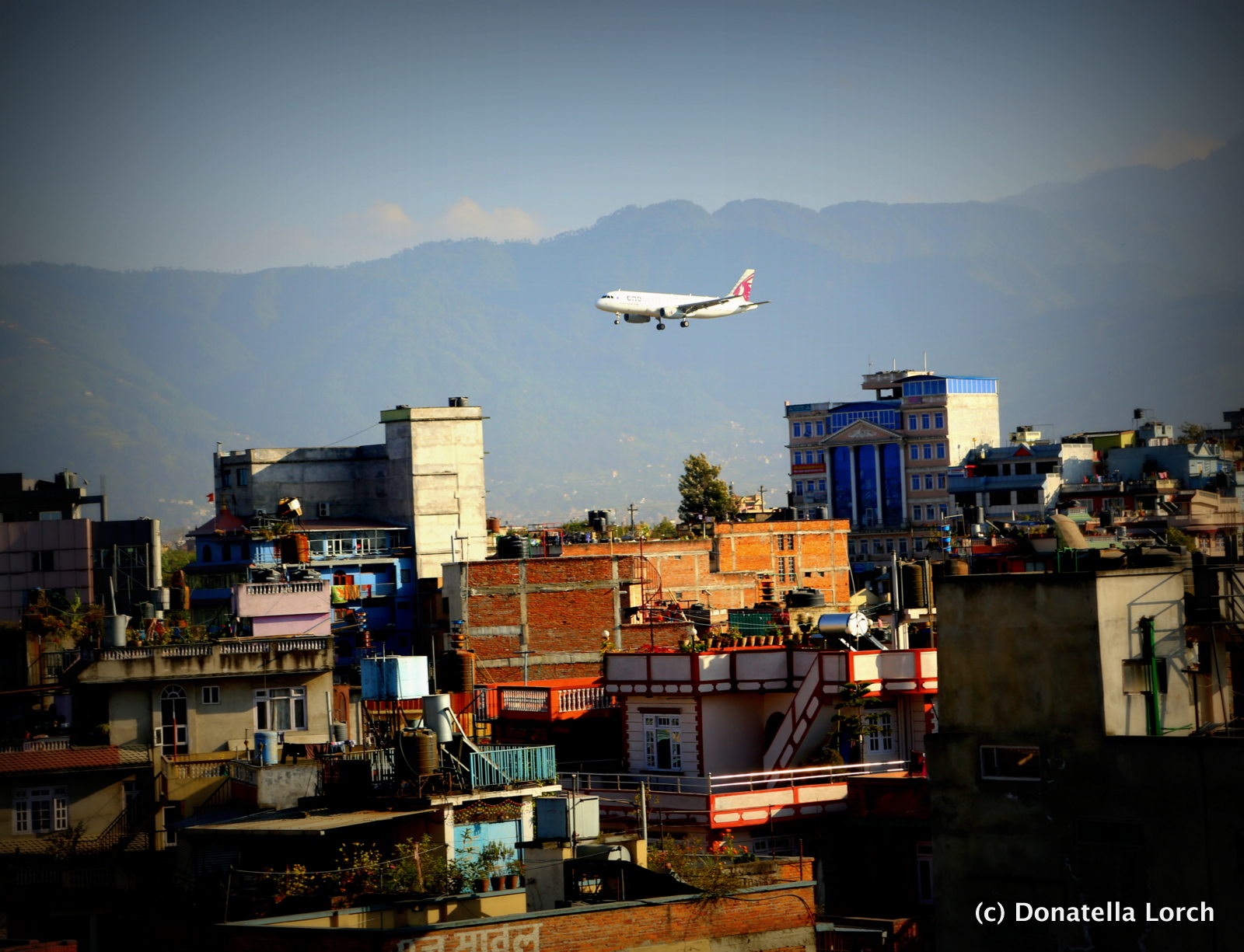
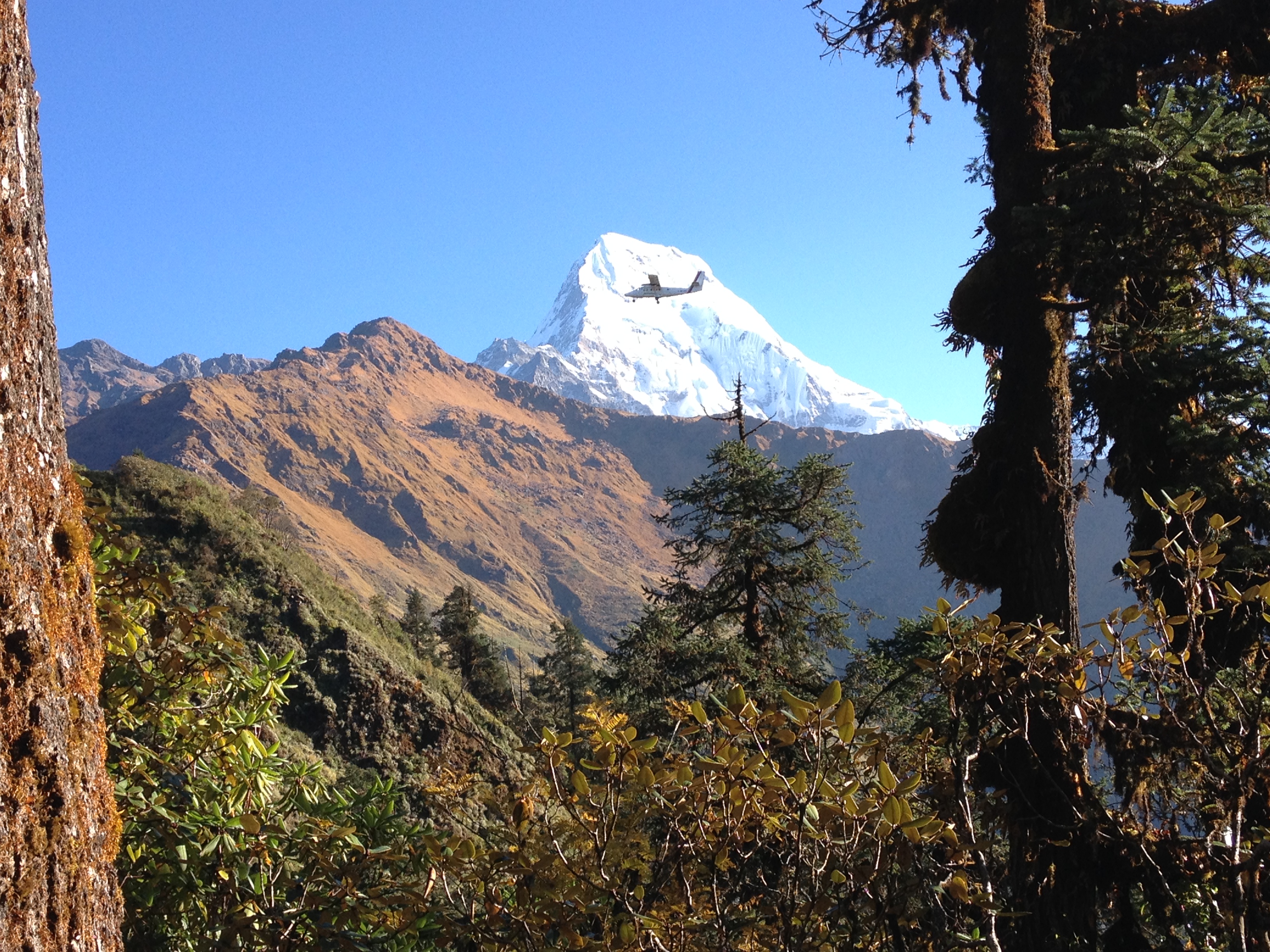
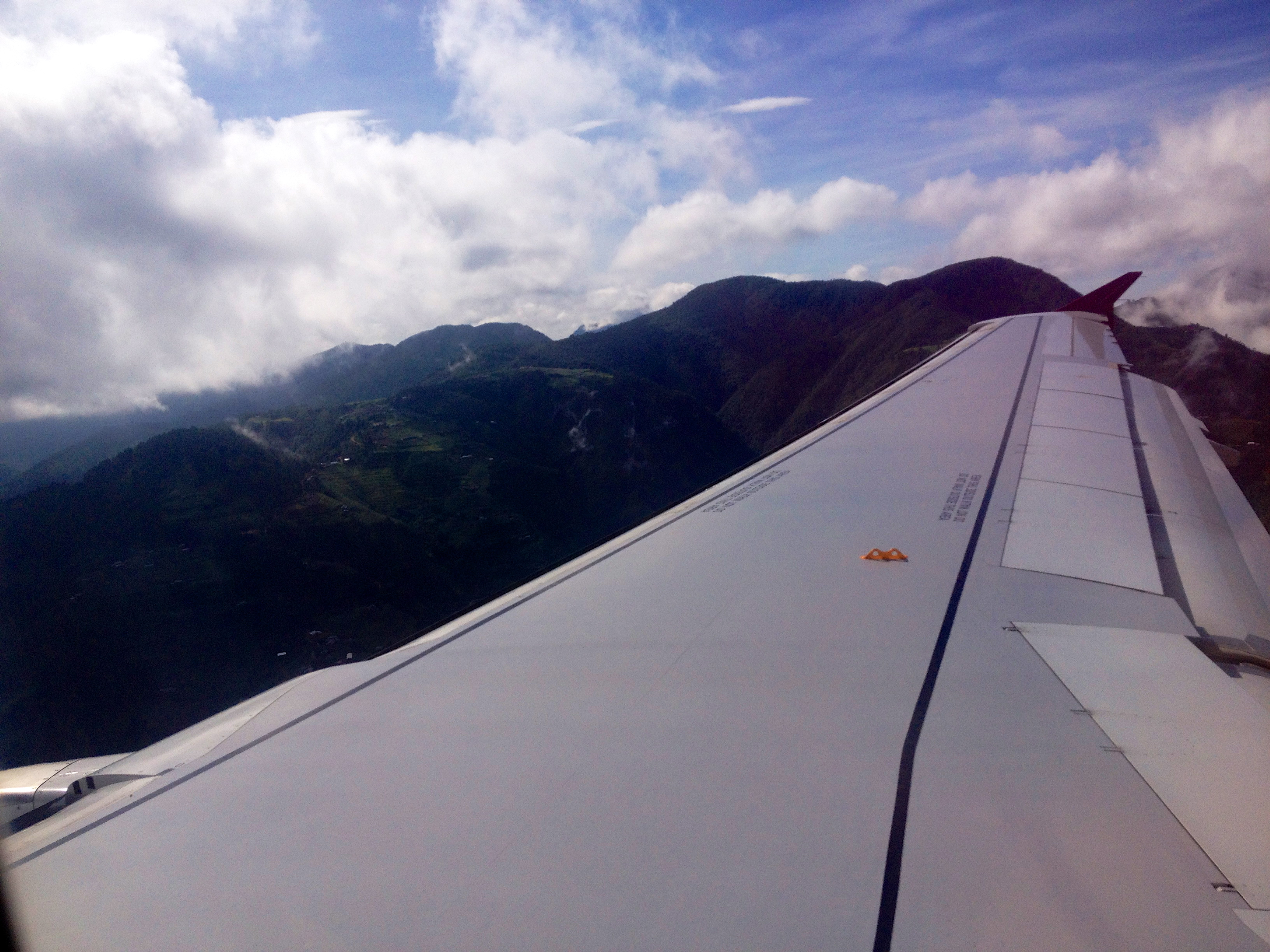
There is an intimacy to landing in Kathmandu.  From the plane window, you can see the wings skim the mountains as the hairpin dirt roads leading to perched villages close in above you. From my neighborhood, earth and sky rumble together with each approaching plane.

Down we go! © Donatella Lorch

Down we go! © Donatella Lorch

When I was 27, fresh from two years of reporting inside Afghanistan, the New York Times assigned me to cover the borough of Queens. To soothe my homesickness for the wind-swept arid mountain ranges I had left behind, every morning I slowed down as I drove past La Guardia airport, rolled down my window, and deeply inhaled the jet fuel. Then planes were about escape. In Kathmandu, 25 years later, it means connection.  I live near the main landing path, and the sound of a plane is both comforting and awe-inspiring. It means that neither the valley’s fog, smog, storms nor its unpredictable wind shear have closed Kathmandu’s airspace. Kathmandu is a pilot-only, visual-only landing, and every time I fly in or out, or listen to a plane overhead, I am reminded that technology is not solely in control but that just one person is leading the way in.

Economists refer to it as ‘connectivity’. A poor country cannot reach middle-income status unless its people can be connected by economic, social and political opportunities within their country and with other economies.  This cannot be done without roads and airports. The challenge is huge in Nepal, South Asia’s poorest nation, a vertical land where roads have to be carved out of steep, unstable cliffs that are prone to landslides and where mountains rise so fast and sheer that radar is not always relevant and planes have very limited options on how to get to an airstrip. Imagine terrain so perpendicular that pilots turn off their ground proximity warning system because the constant computer generated voice warning: “Terrain, terrain, terrain,” is not only obvious but also distracting.

Planes landing at TIA skim Kathmandu rooftops. © Donatella Lorch

Planes landing at TIA skim Kathmandu rooftops. © Donatella Lorch

Nepal has 48 airports, mostly dirt strips precariously balanced on mountain tops or in narrow valleys, but there is only one international runway, Tribhuvan International Airport, an example of the vast complexities surrounding the issue of connectivity that go beyond just being able to land planes. In Nepal, tourism is the second biggest earner of foreign exchange, and with mostly dirt roads and vast numbers of road casualties, planes are critical to enabling tourists to come and continue to fuel growth.

Yet what happens when tourists come faster than the existing infrastructure can accommodate? Set inside the city of Kathmandu, TIA is bursting at the seams. It has only nine bays, but almost 50 daily international arrivals and more than twice that number for national flights. Visas are available on arrival, but the line is long and the unbridled crowded chaos of baggage claim is only enhanced by an enveloping dark penumbra. Mandarin seems to be the most spoken tongue. According to the local papers, vast amounts of cash are also exchanging hands at customs, where several officials, including the acting director, are under investigation.

So close yet so far. © Donatella Lorch

So close yet so far. © Donatella Lorch

Nature is not always cooperative. Flights can stack up for hours circling outside the Kathmandu valley, over Chitwan National Park, a domino effect often started by winter’s morning fog and aggravated by vehicle and generator-induced smog or summer monsoon storms and wind shears. There is one landing strip in dire need of re-tarmacking. Last summer, earth worms infested the runway, attracting nearby birds and closing down the airport for a day.  When I fly in or out, I find myself glued to the FlightRadar24 app, scanning weather and delays. The international airline with most delays appears to be Turkish Air, which has the uncooperative 6:55 a.m. landing slot:  thick fog at that time often brings long landing delays and recently a flight was even rerouted to Bangladesh for the day because of it.  The radar system, only for international approaches, is 25 years old and was installed after two major airplane crashes caused by white-out conditions, but it is struggling to keep up with the rapidly growing traffic. With only a 30-mile radius and blind spots, it is scheduled for a much needed facelift and expansion.

Yet international flights are almost always full, especially the five daily jets coming from five different Chinese cities and the scores of flights from the Middle East and South East Asia—the latter often carrying Nepali migrant workers to and from their host countries. Business must be good as landing rights at TIA are more expensive than Bangkok and on par with Singapore, while refueling charges are extremely high (all fuel comes by truck from India). In addition, pilots need special simulator training for Kathmandu landings. Two airlines, Qatar and Korean Air, are now even using the newest technology, satellite-based GPS systems, that provide the pilots with more information and greater leeway during their landing approach.

As in every other sector in Nepal, there are many improvement plans afoot. The government wants to build two new international airports, and is actively pursuing the Chinese government for soft loans. But airports are also competing with projects such as hydropower plants, expressways to India and China, waste water treatment plants, drinking water for the Kathmandu Valley, and sewage systems for all their cities. The wish list is long, the government cash-strapped, and so far investment is only cautiously moving in.

TIA will be it for the next few years.  That means accommodating the dozens of extra weekly flights scheduled to start soon from China. I don’t see the two security check lines that snake through the length of the departure area getting any shorter.

In Nepal, a perfect storm leaves a trail of devastation

Last week, trekking the Annapurna circuit with my nine-year-old son, Lucas, we hit a deserted, particularly tough patch of trail that had been partially swept away by a landslide. Single file, one foot in front of the other, five of us gingerly and slowly made our way across a six-inch-wide uneven slanted ledge, a sheer cliff up to our left and a sheer precipice to our right. The previous day’s rain had soaked the shale underfoot and it moved slightly with our weight. Our guide shouldered Lucas’ daypack and held his hand tightly instructing him not to look down the hill but just to focus on his feet. I struggled not to let my son see my intense fear of heights. Later, we both agreed it was just part of the incredible and inspiring week we had spent hiking.

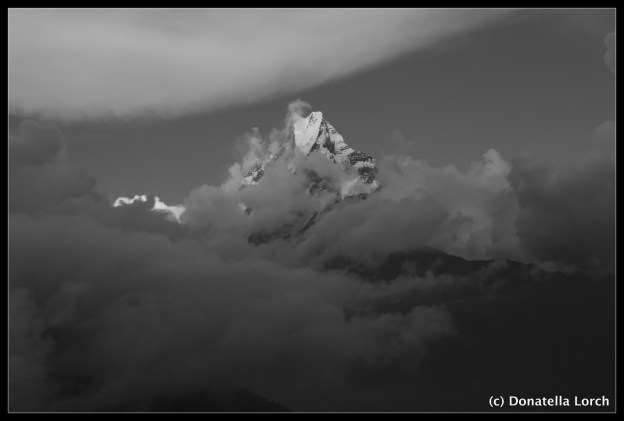
Why do people come to Nepal to trek?  The ever changing mountains take your breath away every moment of the day.©Lucas Zutt

Why do people come to Nepal to trek? The ever changing mountains take your breath away every moment of the day.©Lucas Zutt

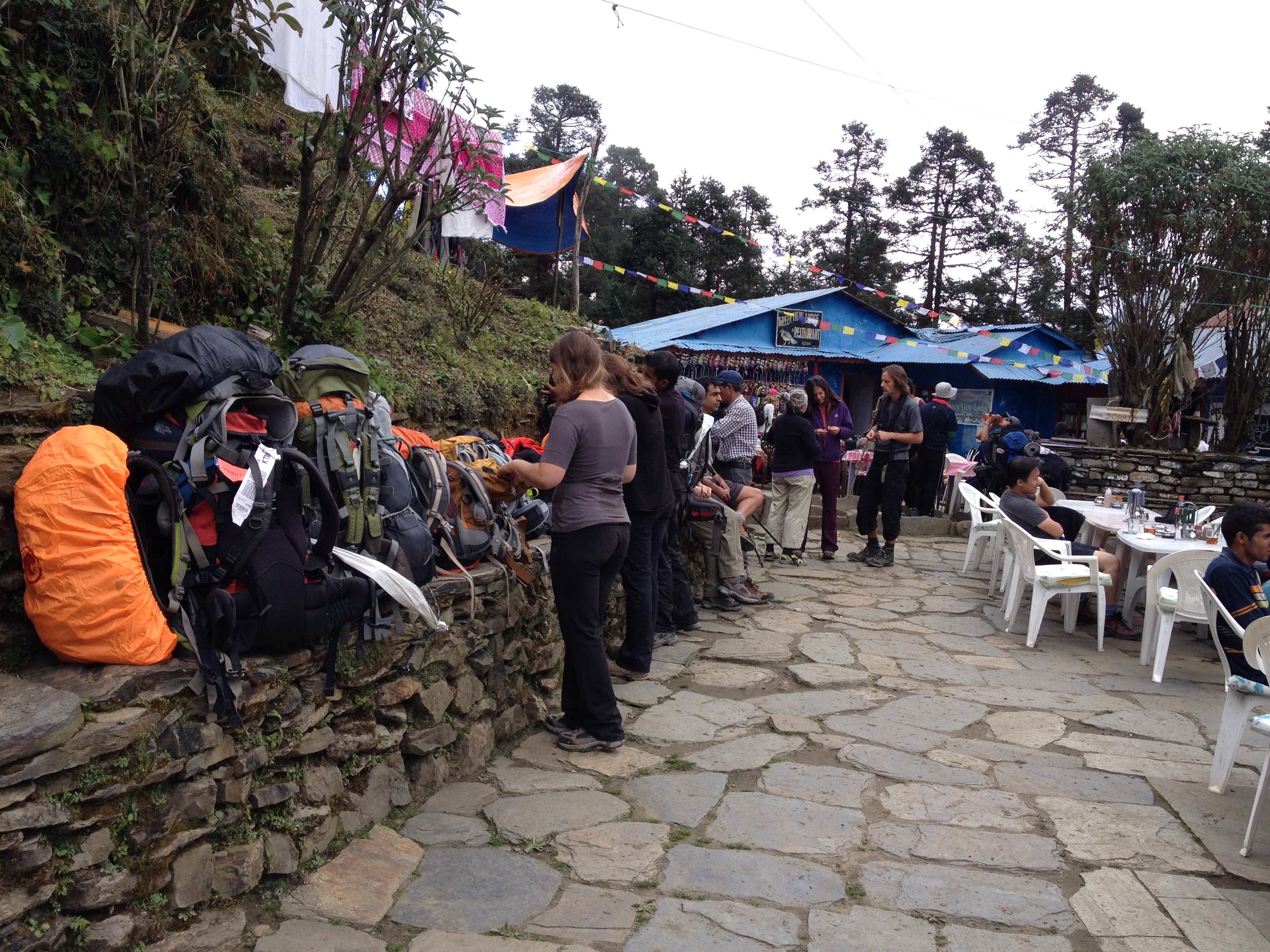
In October, peak tourist season in Nepal, the main trails of the Annapurna Circuit are full of foreign trekkers. ©Donatella Lorch

In October, peak tourist season in Nepal, the main trails of the Annapurna Circuit are full of foreign trekkers. ©Donatella Lorch

This is not an unusual occurrence in Nepal, a land where mountains are steep and unstable, and weather patterns can transform a landscape in a split second. Everyday, newspapers print stories of roads wiped away by landslides, of villages marooned by snow falls or Monsoon-swollen raging rivers swallowing homes and fields. “In Nepal,” my friend Kunda Dixit warned me on this trek, “everything is further and more difficult than it seems.”

This week, at the height of the region’s trekking season, a perfect storm hit Nepal killing at least 24 foreign trekkers as well as seriously wounding Nepal’s tourism industry. Two days after cyclone Hudhud made landfall in Eastern India, it tore into Nepal. Lucas and I had just returned to Kathmandu when the storms started. In the Valley, torrential rain fell unabated for two days accompanied by ear-splitting thunder. Flights were cancelled or rerouted, almost all airports were closed.

Even before Hudhud hit, the mountain afternoons were fogged in and had heavy rain. ©Donatella Lorch

Even before Hudhud hit, the mountain afternoons were fogged in and had heavy rain. ©Donatella Lorch

The weather in the mountains was even more vicious and unpredictable especially in the Annapurna Conservation Area Project (ACAP), a favorite for trekkers who call it the Annapurna Circuit, an area that encompasses 7629sq kms. Blizzards and avalanches in Manang, near Thorong La Pass(5416m)and at Dhaulagiri Base Camp killed the trekkers most of them foreigners. But in this vast isolated area frequented by a huge number of tourists, it is unclear who is still missing.

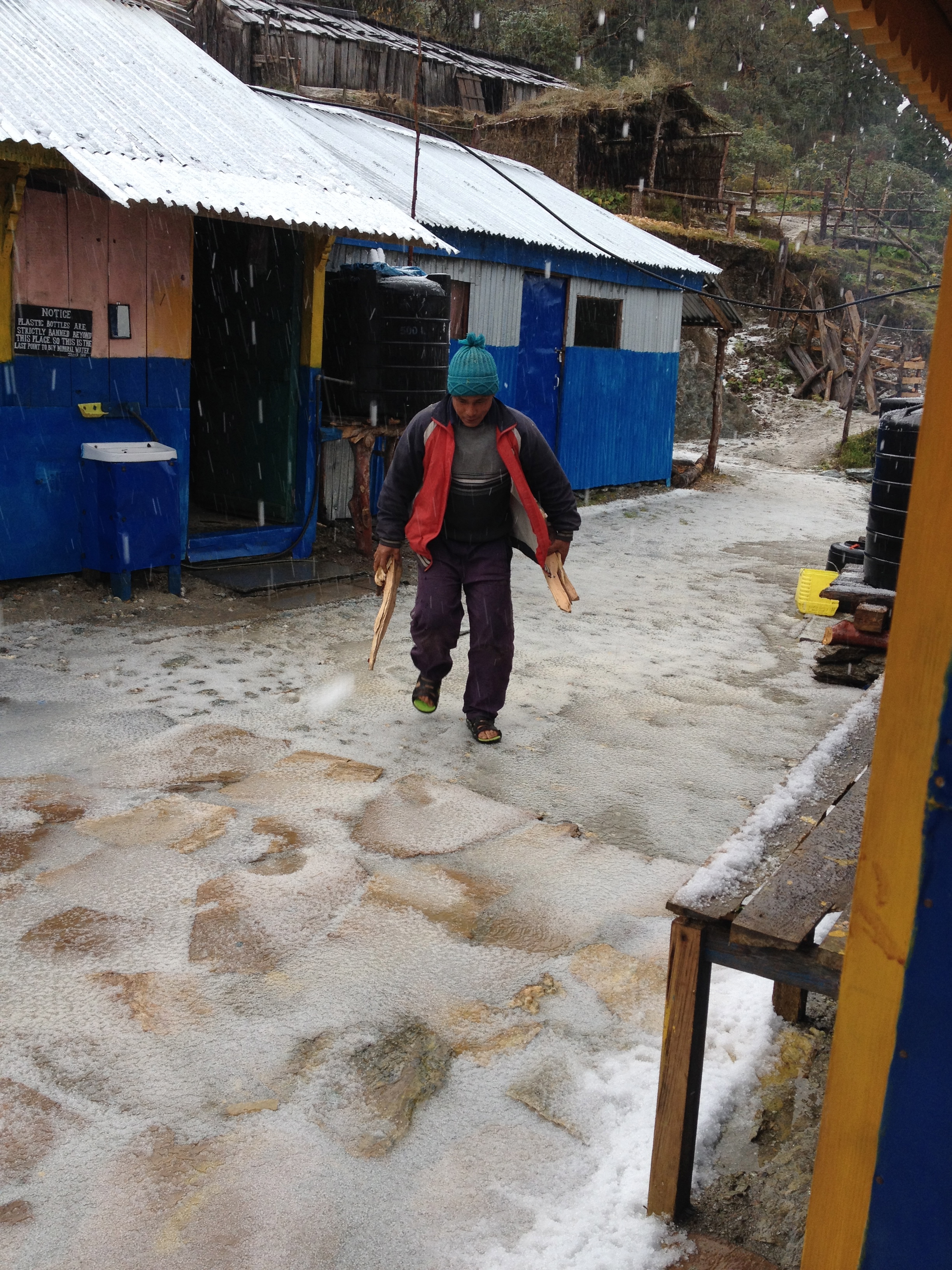
Before Hudhud hit, we had hail storms where we stayed over 3,000m ©Donatella Lorch

 We had hail storms where we stayed over 3,000m ©Donatella Lorch

One man slipped off a muddy path and fell into a river. He has not been found. We know about him because he was with many other trekkers. What about the more isolated areas of Manaslu and Langtang and the Tsum Valley? Even before Hudhud hit, the weather during our seven-day trek brought rain every afternoon turning into hail and snow at higher altitudes. Many of the smaller, narrower and desolate trails, like the ones we took, had landslides and were already water logged. We were four and had a guide as well as two porters (they moved way faster than we did) so we had safety in numbers as well as knowledge of the area. The only road to the northern part of the Annapurna Circuit takes you to Jomson. A good chunk of it is dirt and last month it was closed for a week because of rock fall. You can fly to Jomson, but only subject to the unbendable Nepali mountain rule: weather permitting. Even in good weather, flights cannot land in Jomson after 10am because of high winds. Fall and break a bone and you have two options: a helicopter or a multiple hour trip lugged in a stretcher to a road or an airstrip.

The flight Pokhara-Jomson offers stunning views and is very close to the mountain tops. ©Donatella Lorch

The flight Pokhara-Jomson offers stunning views and is very close to the mountain tops. ©Donatella Lorch

We met a group of three soloing young Americans from Colorado. They had no phones, an incorrect map (trekking map quality is poor in Nepal) and understandably a desire to get off the very beaten track and lose the hordes of other tourists. They had not registered at the US Embassy and their families did not know where they were going. Then there were the young Nepali tourists, climbing up the mountains in sneakers, without winter gear and most importantly not carrying any water. The Indian religious pilgrims that flock to the shrine in Muktinath near Thorong La Pass are also not prepared for winter. The women wear silk saris and thin shoes and ride up to the shrine on mules. And sometimes even if you are an expert mountaineer, the mountains can still claim you. Many years ago, Kunda’s brother, Kanak Dixit, had crossed the Thorong La Pass and was walking solo down past Manang when he slipped on the muddy trail and fell hundreds of feet down a cliff. He lay there badly injured for 48 hours before his brother found him. Kanak was helicoptered out and spent months in hospital. He still treks every year in all seasons.

It is a pristine Kathmandu afternoon today, a side-effect of a perfect storm. In front of me, the dark green of the valley’s hills melts into the emerald rice paddies, many flattened by the storm. My week in the high mountains taught me respect and made me fall in love. In the high mountains, I know the clouds and the evening cold will have already moved in. I hope the injured have been found.

Monsoon Madness

During the summer months, I sleep with my curtains and windows open.  After the day’s humid heat, the nighttime breeze is soothingly welcome. But it is the monsoon storms that mesmerize and bring the night to life. Sometimes they last for hours, a pillaging army slowly marching across the high mountain tops into the Kathmandu Valley. I see it first. Icy and blue, the sheet lightning soundlessly outlines the hills, dark layered spines and humps that spread west and north from my bed’s vantage point.

During the Monsoon, the clouds speak their own language. ©Donatella Lorch

During the Monsoon, the clouds speak their own language. ©Donatella Lorch

The thunder takes its time. Long rolling grumbles ricochet from hill to hill reminding me of childhood tales of grumpy, unruly giants. The rain, like a Diva arriving appropriately late, can pound with brutal force or just steadfastly descend unbroken for hours.

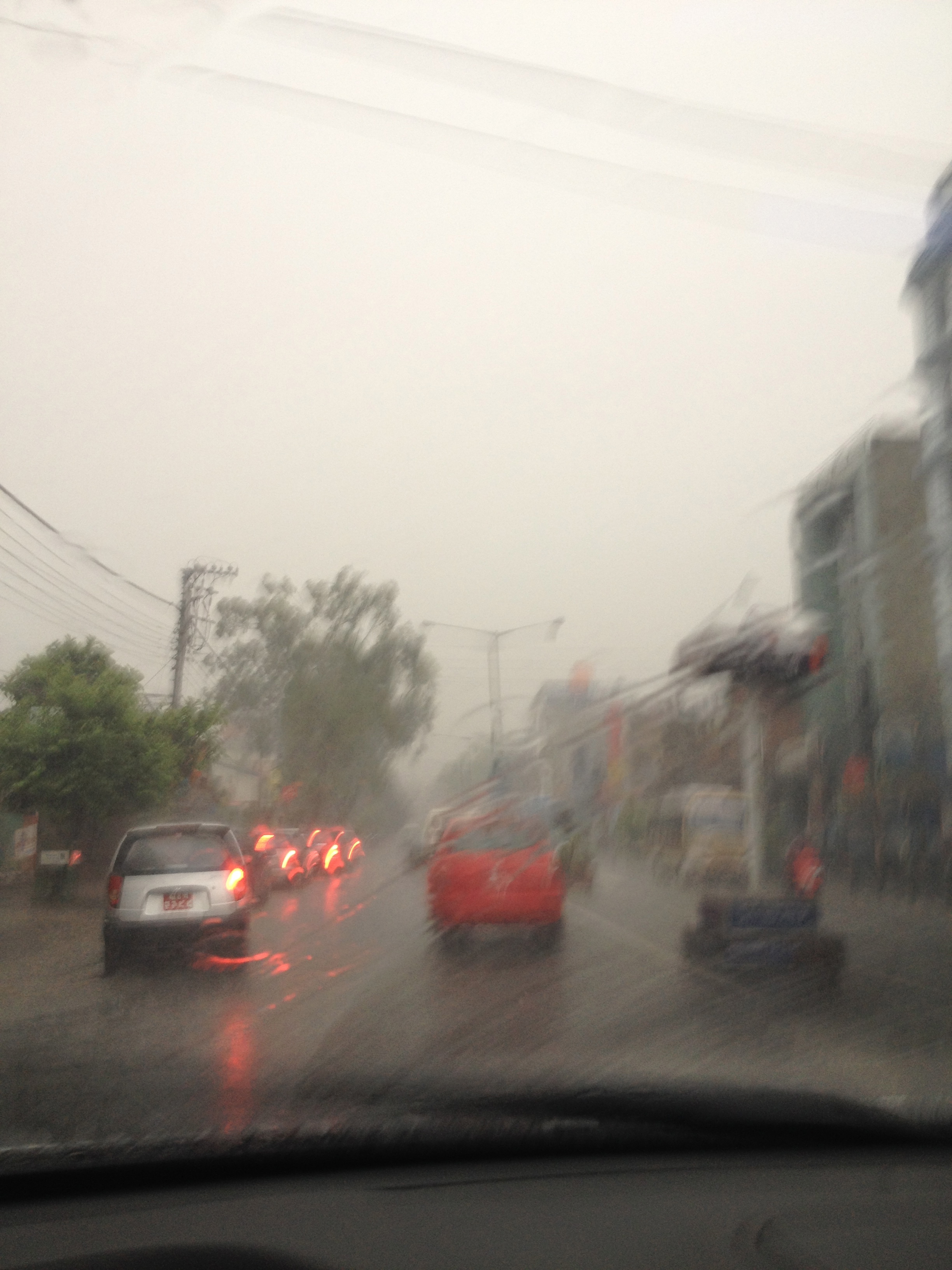
Navigating one of the season's first heavy rains. ©Donatella Lorch

Navigating one of the season’s first heavy rains. ©Donatella Lorch

When the rains come, Kathmandu becomes a city of mud roads — thick, slithering mud – and large lakes of water where road construction crews somehow omitted to include drainage ditches. It’s the season when I stick to flip-flops or rubber boots. When I walk my dog in the open fields, I carry salt to eradicate the leeches that latch on to both of us. The streets are umbrella jams not only for the downpours but also for the searing sun that alternates with them. My vote for monsoon fashion statement is the Siamese twin rain poncho with two slits for the heads of both the motorcycle driver and passenger, worn by tens of thousands of motorcyclists.

Nothing escapes the rain. ©Donatella Lorch

Nothing escapes the rain. ©Donatella Lorch

If you live at the whim of the monsoon’s power, the rains become, in big and small ways, an obsession. They are talked about for months before they come, hitting this part of the Himalayas in June and sticking around into September or even October. The BBC News weather reporter talks in exotic terms such as “monsoon troughs” and frequently warns of landslides.

The icon never changes. ©Donatella Lorch

The icon never changes. ©Donatella Lorch

My iPhone forecast has a sole icon for all three months in Kathmandu even if there are long stretches of sunshine: a grey cloud with a thunderbolt through it.

The monsoon has a different meaning depending on what you do and where you live. For the farmers that constitute a majority of Nepal’s population, it’s flooding rice fields and growing wheat, barley, potatoes and putting food on the table. For the four million people in the water-starved Kathmandu Valley, it means the bore-holes and the wells are being replenished. In smog-choked Kathmandu, the rains settle the dust and wash the trees and break the Valley into a palette of so many vibrant greens that even Martha Stewart would be challenged to give them names.

The monsoon is Nepal's most vibrant and beautiful season. ©Donatella Lorch

The monsoon is Nepal’s most vibrant and beautiful season. ©Donatella Lorch

Nepal’s rains are a bonanza for the entire region. Deep snows and heavy rains feed the rivers that flow into India and Bangladesh, where hundreds of million people live. The water powers Nepal’s hydroelectric power plants, and during a few wet months our power cuts shrink from 18 to a mere 5 hours a day.

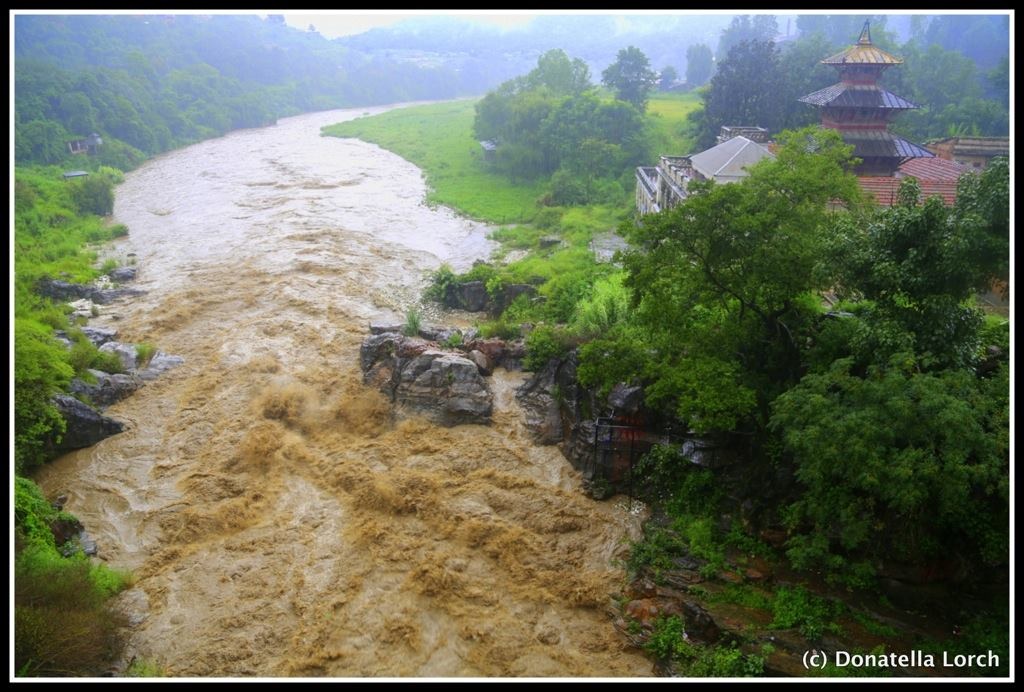
Last week in Kathmandu, 71 mm of rain was recorded in 24 hours. Without warning, the Dhobi Kola that traverses the city, fed also by rains upstream, turned into a raging torrent, tearing over riverbanks and flooding houses. This monsoon was one of the most severe in years. Nepal’s powerful rivers flooded huge tracts of land in the Terai, on the border with India, killing hundreds and rendering thousands of Nepalis homeless. Nepal, a land of steep mountains where roads are precariously carved out of their perpendicular flanks and villages huddle near rivers, is plagued by massive landslides that wipe away roads and swallow entire villages.

The roiling Bagmati River tears through Kathmandu. ©Donatella Lorch

The roiling Bagmati River tears through Kathmandu. ©Donatella Lorch

In the middle of the night on August 2nd this year, near the Chinese border in the northeast, an entire mountainside cleaved off and brought down tons of boulders and mud, burying a village and killing more than 160 people and their livestock. Loss of life aside, its economic impact is still being felt two months later. The mudslide blocked a large river, creating an impromptu lake that flooded a hydroelectric plant and threatened to flood villages downstream as far south as India. It also buried the only paved road to China, a vital trade link that has now been severed.  To keep a bit of trade alive, porters now ferry trade goods on their backs across the unstable landslide.

Dawn over the Kathmandu Valley. ©Donatella Lorch

Dawn over the Kathmandu Valley. ©Donatella Lorch

Savior. Destroyer. The monsoon does not like to be ignored. It is Nepal’s most vibrant and intensely beautiful season. The clouds alone speak their own language, sometimes burying the city or constantly moving, grey and white, wisps that cling to the mountain sides or hover over the Bagmati River in the pre-dawn, slowly rising to drape the mountain tops. During the day, they turn angry, thicker, layered, yet often opening up to share with sharp sunlight and blue sky.  It can pour in one part of the city and be brilliant sunshine in another, less than half a mile away. Wind shear and lightning make it a treacherous time of year to fly, and planes are frequently delayed and occasionally rerouted.

This sunset can speak for itself. ©Donatella Lorch

This sunset can speak for itself. ©Donatella Lorch

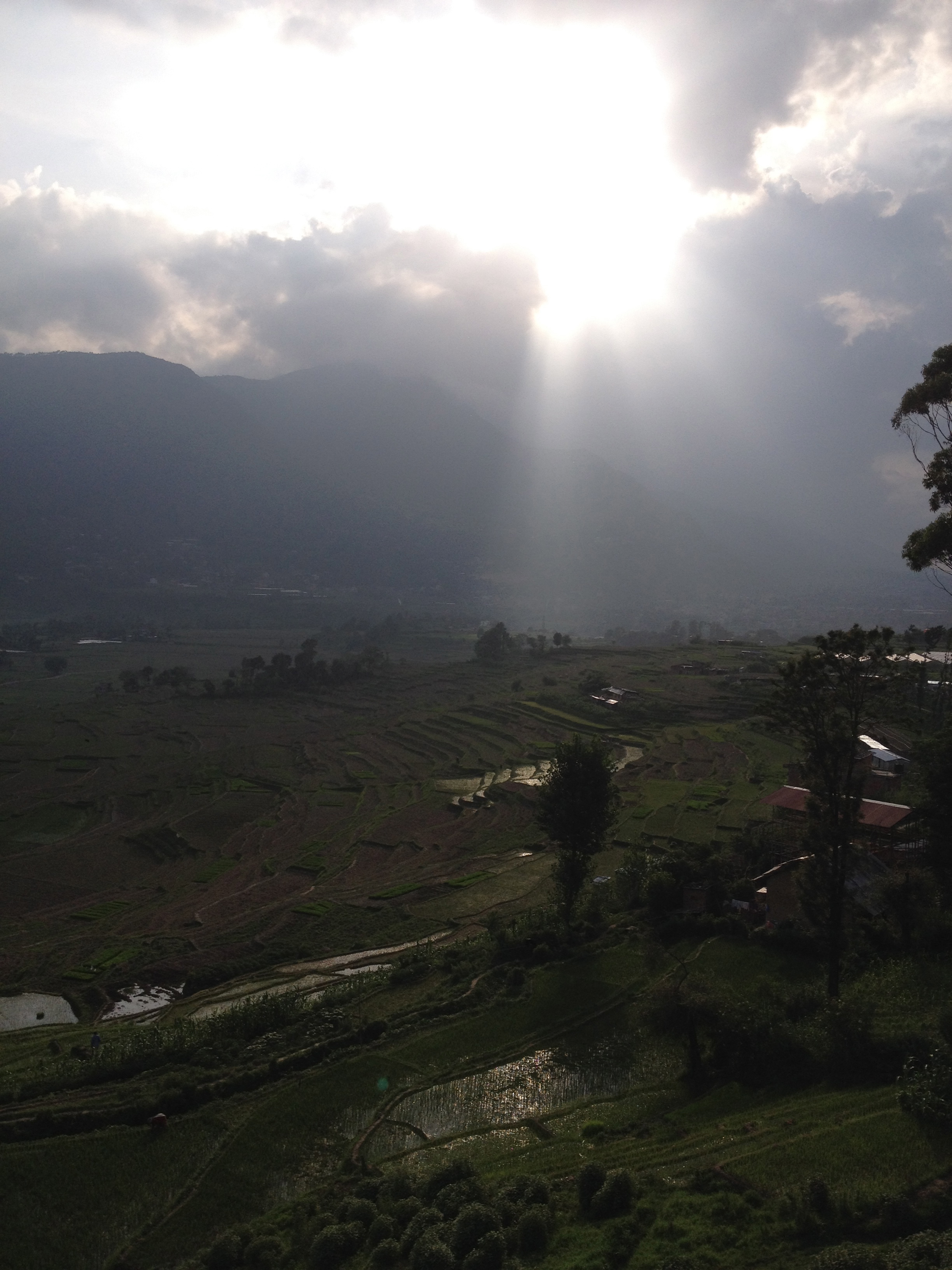
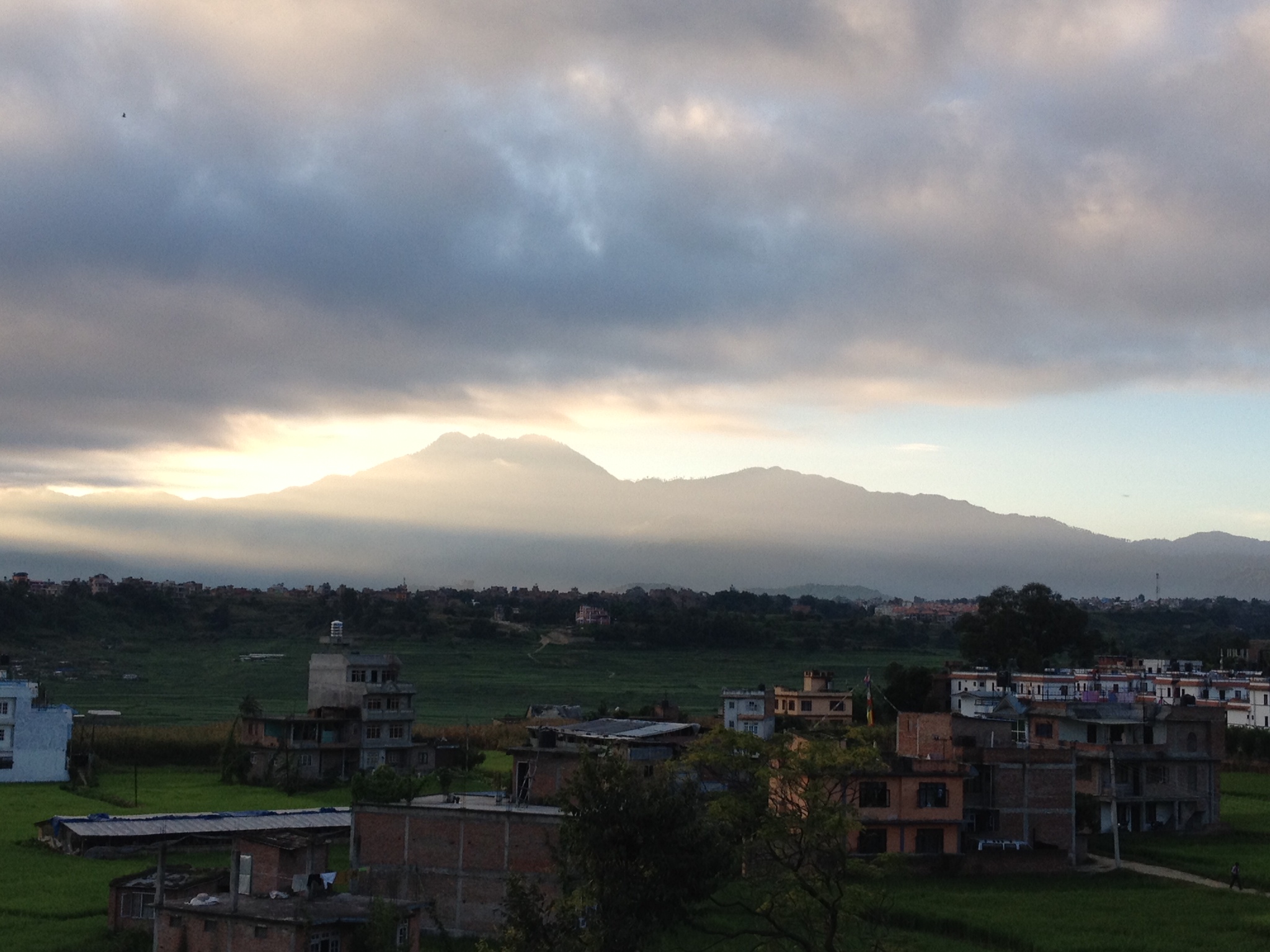
I love my hills. They are forever moving and shifting with the light.  Just before sunset, I stand watch over an amphitheater of terraced emerald rice paddies. Flocks of long-necked brilliant white egrets float in long lines caught between the darkening mountains and the paddies, too far for me to hear them. Sunsets are never the same. Clouds move, slow motion avalanches around the mountain peaks, mixing greys, blues, whites, reds. I hear the comforting sound of a plane overhead. The sky is cooperating with Kathmandu tonight.

The wisdom of a Nepali street dog

Stray dogs happily sleeping the day away ©Donatella Lorch

Stray dogs happily sleeping the day away ©Donatella Lorch

I had noticed her only in passing. On any given day there can be as many as 10 stray dogs moving up and down a 40-meter stretch of my street but I usually just pay attention to the two trouble makers that try to intimidate my Rhodesian Ridgeback when I take him out for a walk. The others either sit and watch or completely ignore our temporary presence.

Kathmandu's 20,000 stray dog are an integer; part of the city ©Donatella Lorch

Kathmandu’s 20,000 stray dog are an integral  part of the city ©Donatella Lorch

Recently, a local crowd caught my attention, hovering over a dog lying and whimpering in an open sewage ditch, unable to move. A car had hit her, I was told, and she was incapable of walking or standing up.

Living in Kathmandu, an interaction with a stray dog is inevitable. There are, after all, more than 20,000 of them in the Valley’s tri-city area. When I first moved here a year ago, I lumped them all together into one large category: destitute, miserably hungry, unloved, unhappy and most critically, unvaccinated and un-neutered. Rabies is present throughout Nepal and Lucas, my nine-year-old son, knows never to reach out and pet a stray dog. Nepalis in general coexist with the strays, feeding them scraps, letting them hang out on their stoops, but the dogs are not family pets and the Nepalis do not care for them. On the dark side, I’ve seen dogs kicked and abused. I’ve seen little kids garrot a puppy and drag him around for fun. Some dogs, starving or maimed, grovel for leftovers from the stronger strays.

Raksi was lying in a ditch whimpering and unable to move. ©Donatella Lorch

Raksi was lying in a ditch whimpering and unable to move. ©Donatella Lorch

My Nepali neighbors hovered over the dog and attempted to feed and give her water, but she was in pain and intensely afraid. In Kathmandu, injured stray dogs are left to their fate, even if it means days of suffering. But I couldn’t walk away. At the same time, I was hesitant to interfere. In the back of my head I was replaying a line that my producer at NBC News would tell me regularly: “Dony, you can’t play God.”

A mobile vet injected her with anesthetic. ©Donatella Lorch

A mobile vet injected her with anesthetic. ©Donatella Lorch

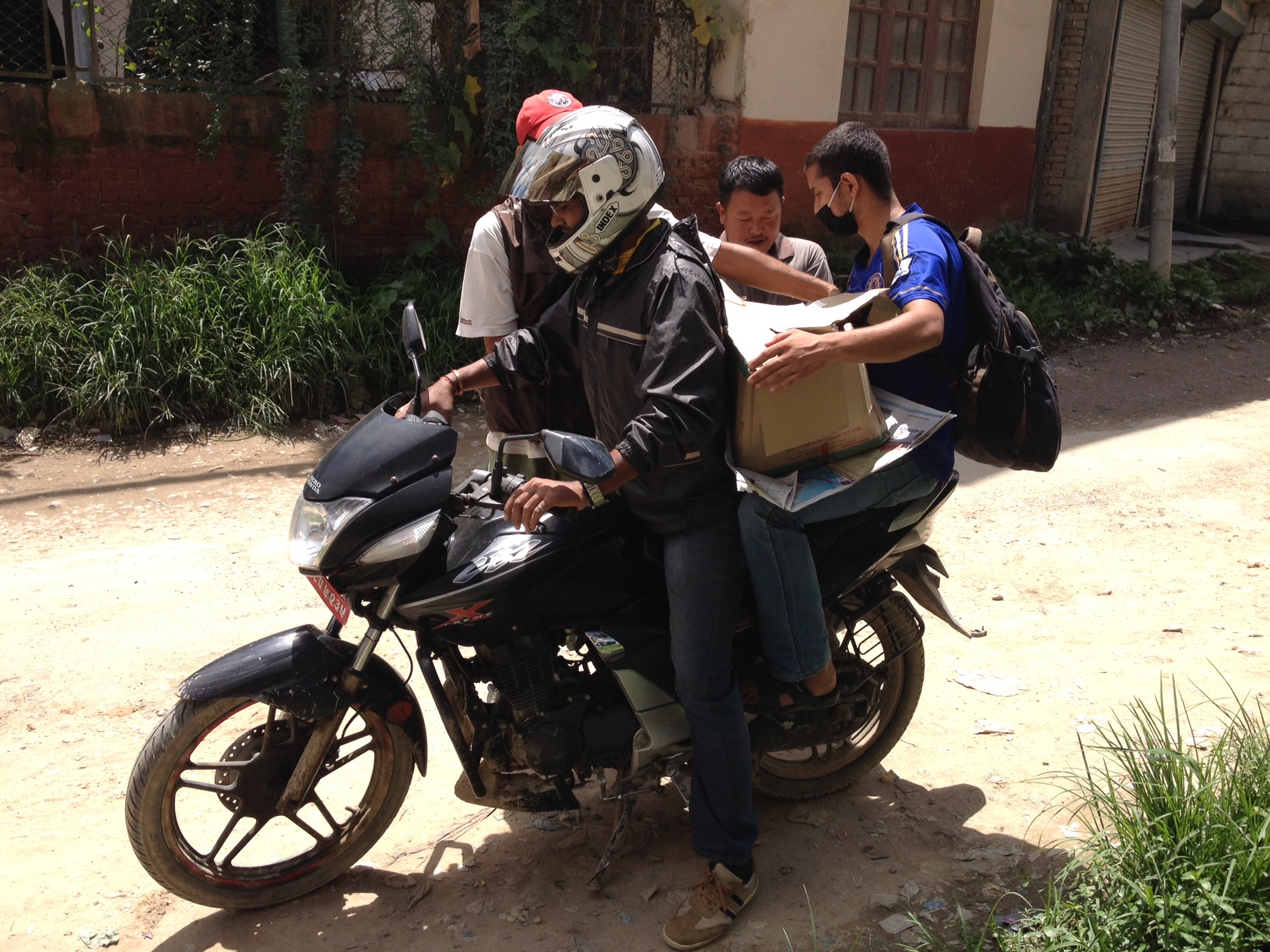
Perhaps, I reasoned, I could make her death more peaceful if in fact she was badly injured. I couldn’t move her so I called the local mobile vet. Though Kathmandu is Nepal’s largest city, it is home to all types of farm animals, and vets also treat cows, buffalo, goats, sheep and elephants. After some time, two young men arrived on a motorcycle, pulled out a syringe and anesthetized the dog. They packed her in a cardboard crate, placed her between them on the bike and drove off to their roadside two-room clinic to X-ray the injury. I followed in my car.

The mobile vets packed her in a crate © Donatella Lorch

The mobile vets packed her in a crate © Donatella Lorch

raksi on bike The dog had only tissue damage, but she needed a week of daily steroid, antibiotic and pain killer shots. This meant keeping her virtually immobile in the vet’s small cage, recovering for a week. If she was then immediately released back on the street, her chances of survival were slim. By then, it had become clear to me that I had inherited a stray and its hospital bill. She had also at some point been blinded by a stick or rod in her left eye, so before I changed my mind, I added in drops for the infected eye as well as rabies, distemper and paro-virus shots. Lucas named her Rexi. The Nepalis, having some difficulty in pronouncing Rexi, renamed her Raksi – after the local moonshine.

For the past year, in my morning runs and commutes to school, I have studied the multi-layered social interactions and relationships between Kathmandu canines and the world of humans. The Nepalis who have dogs as pets (often white, furiously yapping, furry Spitzes) keep them indoors or on their rooftops. Some people tie their guard dogs on such short chains outside their houses they can barely lie down.

Raksi'd first efforts at standing up. © Donatella Lorch

Raksi’d first efforts at standing up. © Donatella Lorch

The vast majority of strays, like Raksi, are community dogs that live their lives outside in a self-delineated territory of a couple of city blocks. They drink from the open drainage ditches that often double as sewers, and beg–always patient, unobtrusive and even elegant–from store fronts and especially from the ubiquitous one-room butcher shacks. They are mostly thin and dirty though some are strikingly handsome. Raksi had a thick black and brown coat and impressively healthy white teeth. Some are social and wag hello, others are terrified when I walk by and on rare occasions there will be one that snarls or barks. In this city of massive and aggressive traffic, a week never goes by without seeing at least a couple of dogs lying on a road, killed by a vehicle. Sometimes the animal lies there for days before being removed.

Kathmandu dogs are nocturnal, and their baying, howling, snarling, yelping and ululating barks punctuate my night. Silence only descends briefly between 4am and dawn. In the winter, the cold takes the weak. In the dry, hot months, thirst kills. Puppies have a particularly high death rate. Wounds from nighttime fights fester. I never cease to be amazed by the dogs daytime ability to sleep — absolutely anywhere — though they love to spread out in the middle of roads, oblivious of honking trucks or speeding motorcycles. During my weekly runs, I’ve taken to greeting the strays on my route. Occasionally one or two will join me for a stretch of road.

Within two days of moving in, Raksi was  walking around our garden. ©Donatella Lorch

Within two days of moving in, Raksi was walking around our garden. ©Donatella Lorch

After her stay at the vet, we took Raksi to our house to recover. Once in our home, she stayed in a makeshift corrugated iron shack with cardboard and a towel as a bed. My dog, Biko, immediately disapproved of Raksi’s presence and not only ignored her but me as well. After a day, she began to limp around cautiously, and then soon was wandering around the garden, sleeping in our garage and trying to find ways to enter our house. Gentle and courteous, she wagged up a fury whenever she saw anybody, circling her head high so as to catch us with her good eye. I began to worry that she would never leave. I knew with each passing day, I was falling for her too.

At the end of the first week, as Lucas and I walked one morning onto the main road, Raksi followed. She went to sit facing us on a mound of half-burned blue and pink plastic garbage bags. Lucas tried to woo her back through our gate with her favorite dog bones and a bowl of milk, but she sat there sphinx-like and dignified and finally just turned, crossed the road and disappeared down a narrow alley.

Lucas went to school in tears that day. He thought that he had lost a friend. But Raksi didn’t really move away; she moved back to where she always had been—on the streets in our immediate neighborhood. Since then we have seen her every day, sometimes in front of our gate or on the concrete landing in front of the local tailor shop next door, even as far away as across the main road by the green grocers. I see her sleeping, surrounded by her many companions. She’ll get up and limp over to sniff a newcomer, warning him off with a bark. Her favorite spot is the sand pyramid on the construction site opposite our place. She has always greeted us with utter delight and wagging tail, dog-tracking towards us with a huge grin, one black ear perked, the other flopping.

Lucas visit Raksi on her street side home where she lives with half a dozen other stray dogs. ©Donatella Lorch

Lucas visit Raksi on her street side home where she lives with half a dozen other stray dogs. ©Donatella Lorch

I like to think that this is her way of telling me that she is okay. The dog rescue organizations in Kathmandu had warned me that there was virtually no chance of finding her a home and that if a foreigner adopted her (the most likely possibility) he or she would probably leave Raksi behind when leaving Nepal. If she was healthy, the street was the best place for her.

I still grapple with all I have learned from Raksi. When I saw street life as misery, why did I automatically believe she thought the same? Why did I assume my joy was her joy? I thought she was like my Ridgeback, an obsessively loyal animal whose idea of home was lying by my side. Biko won’t even smell the street garbage that is Raksi’s food. But it’s obvious to me that Raksi, like so many other dogs here, is only at home in her pack. She and several other dogs move, eat, sleep together. She has the freedom to roam. She perks up with the chaos of trucks and honking horns and it also lulls her to sleep, lying inches away from the paved road. She likes to lie with her nose on the edge of the open sewer. And though she greets me effusively, when I see her, one thing is clear: This is her world.

Where ancient rituals rule in modern times — ‘Tis always the season!

     Growing up in New York, I rarely associated religious festivals with a national or even a city holiday, though occasionally alternate side of the street parking was suspended – to my father’s delight.

     Half way around the world, Nepal has taken the idea of religious festivities to another level. Beginning in late August and continuing until the end of October, religious festivals follow each other like tumbling dominoes, occasionally bridged by government holidays. The festivals can last a day or a more than a week. Parking, though, is not an issue in Kathmandu, a capital where parallel parking has yet to be discovered and the rule on the hair-raising narrow roads seems to be: “Never give way.”

Fires are often part of religious rituals as these impromptu ones along a procession route. © Donatella Lorch

Fires are often part of religious rituals as these impromptu ones along a procession route. © Donatella Lorch

It is a season when the complexities of Nepali society seem to surf above the capital’s physical chaos, pollution, political disorder and venality. The ties to yore, to myth, to custom and to religion may be a matter of worship or just a question of habit or a mere acquiescence to an insistent mother-in-law. In any case, Nepal’s festivals are not a matter that can be ignored.

     Depending on how you look at it, life in Kathmandu either slows down as stores and offices close or it hums with an entirely different undercurrent. There are different colors, smells, noises. Traffic jams change locations. In Nepal, the kaleidoscope of Newar, Tamang, Chhetri, Brahmin and other holy days challenge the most ardent ritualists, who consult multiple types of calendars not only to stay connected with the outside world but also to follow the local customs. Most of the calendars are based on a lunar cycle, so every year, schools, offices and government nimbly have to readjust their schedules. To keep everyone on their toes, some holidays rely on astrologers. 

The land where Puja is intertwined in every aspect of daily life.©Donatella Lorch

In Nepal, Puja is intertwined in every aspect of daily life.©Donatella Lorch

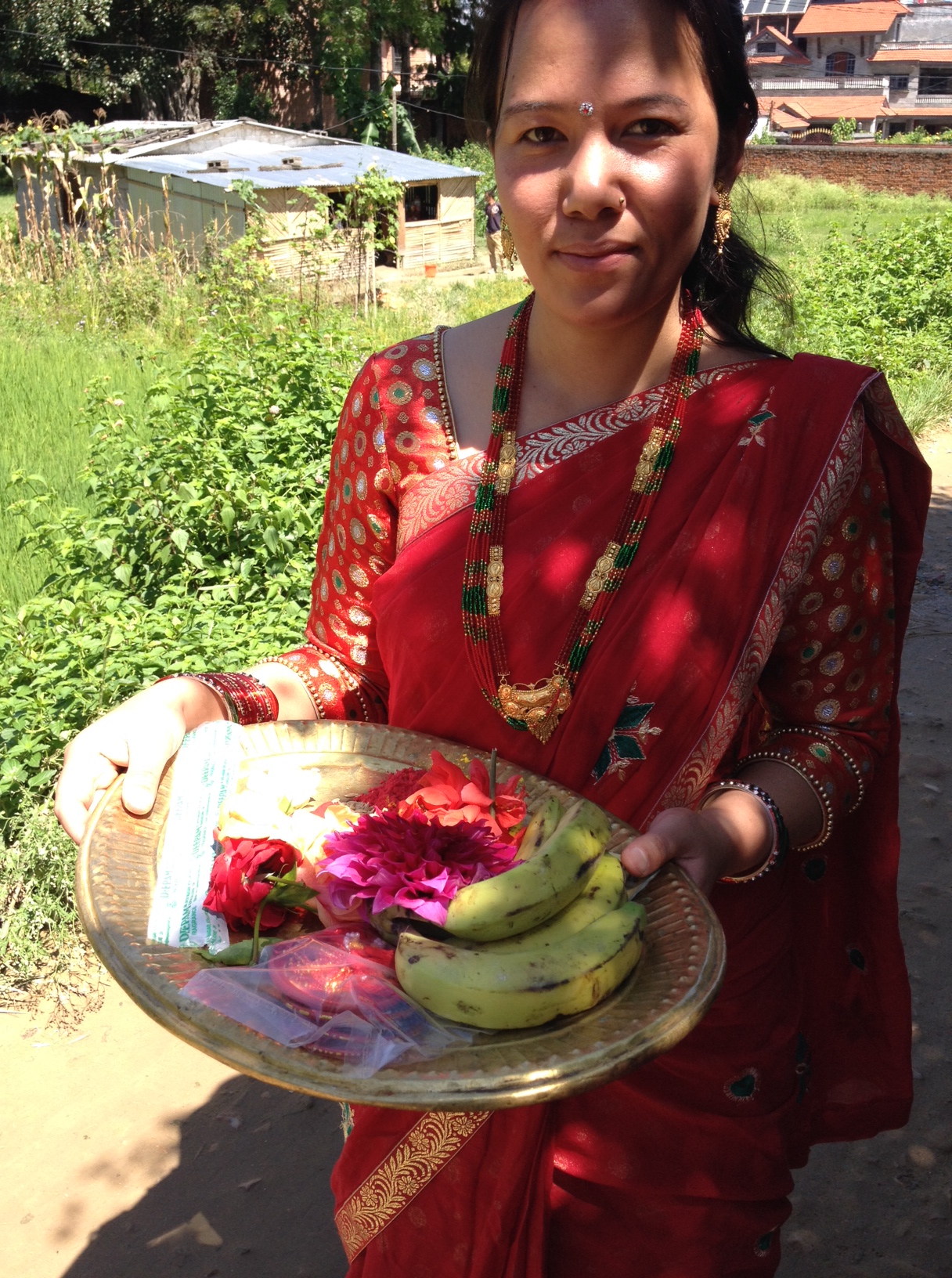
     This year, the season began on August 10th, with Janai Purnima, when Brahmins and Chhetri communities go visit their guru to have their sacred thread changed. For good measure, there are those who add on a dip in a local river. Just a day later, on the 11th is Gaijatra or Cow Festival, a huge event in the Kathmandu Valley, when you decorate your cow or one of the many stray bovines in your neighborhood and join the dancing, singing parades. Some choose to wear cow head-gear. It is meant to pave the way towards heaven for any relative that has died that year. As the end of the month nears, there is Father’s day and close by the day when Hindu priests give (or more precisely sell) the faithful some ‘Kush grass’ so that Vishnu will live in their home for the coming year.

On Teej, women queue on long lines to worship at temples all over the Kathmandu Valley and beyond. ©Donatella Lorch

On Teej, women queue on long lines to worship at temples all over the Kathmandu Valley and beyond. ©Donatella Lorch

Some festivals are all-inclusive, others pick their ethnic group, pointing in numbers to the changing ethnic powers in the Kathmandu Valley. Take Teej, which is followed by Chhetris and Brahmins but not by the Newars, the area’s original inhabitants. If color is a sign, then the Newars are far from being the majority they once were.

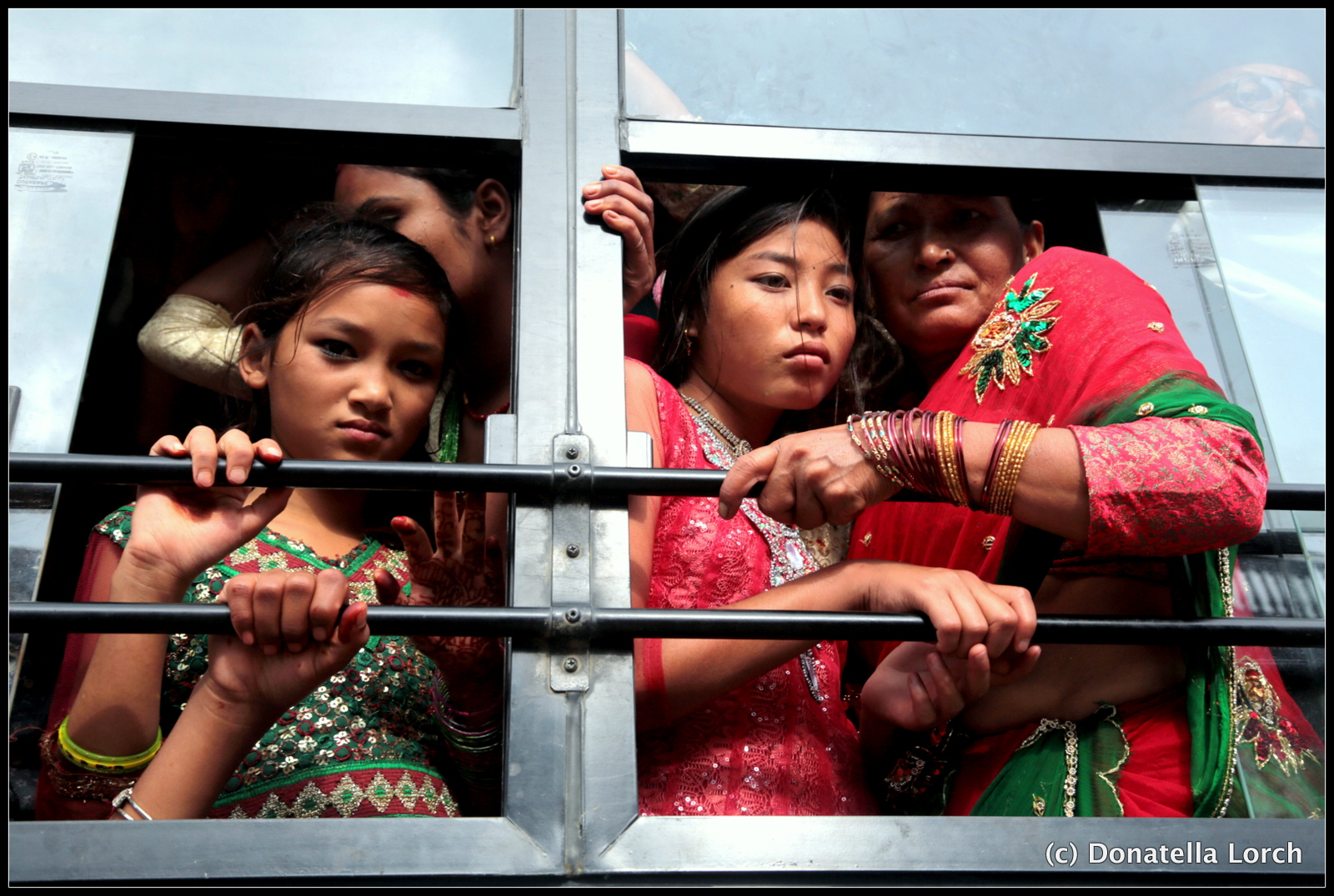
  For the five days of Teej, observant women wear red saris, turning the entire valley into a red sea. The government closes down the roads in one of the busiest sections of Kathmandu so that thousands of red clad women can worship at Pashupatinath, one of the holiest Shiva shrines in the world. Red saris are scrunched against the windows of overloaded public buses or billow elegantly in an Isadora Duncan sort of way on the back of motorcycles. Teej is billed as a woman’s festival – but it is really about the men, for it is a time when a woman either prays for the well-being of her husband or, if she not already married, for a husband-to-be.

     If a woman is very traditional, she will fast and she will also bathe her husband’s legs and drink the run-off water. This has some of my women friends in the States decrying marital abuse. But watching these red saris dancing in front of temples, standing and chattering on endless lines with their girlfriends and daughters, puja (offerings) and smart phones in hand, all bedecked in traditional gold jewelry, it is clear that, for them, Teej is not only about bonding but also about a great escape from endless daily chores and demanding husbands. It’s a time of year when gold prices in Kathmandu skyrocket. I’m inclined to believe that if you acquire new jewelry and a new sari, and spend five days with your friends, worshipping a husband is a fair exchange.

Women in traditional "wedding day" saris are scrunched on buses returning from worshipping at Pashupatinath, a World Heritage Site. ©Donatella Lorch

Women in traditional “wedding day” saris are scrunched on buses returning from worshipping at Pashupatinath, one of the world’s holiest Shiva shrines. ©Donatella Lorch

     The festivities don’t end with Teej. A short break afterwards, there is an eight-day Indra festival in Kathmandu. More masked dancers and drums in procession with the Kumari Devi, or ‘Living Goddess,’ blocking more traffic. And then Nepal’s most universal and longest festival – Dashain – begins and continues for about 15 days. This year it falls at the very end of September. On the surface Dashain is a celebration of the victory of gods and goddesses over demons or of good over evil, but between the prayers, it is mostly a celebration of family and community. Flights into Nepal have already been booked for weeks now. Nepali migrant workers in the Middle East borrow money to return home, others fly in from the U.S. and Europe. Kathmandu empties out as families return to their ancestral villages spending long hours on buses and often walking the last bit to grandma’s old mud- wattle or stone house. Aside from hotels and a few restaurants in the tourist neighborhoods, Kathmandu shuts down. The sky is a jumble of kites maneuvred by young kids on rooftops. The chaotic traffic jams and the smog melt away.

     This is a time of sacrifice – animal sacrifice that is. My friend Keshav, has been fattening his mutton for three years just for this year’s holiday. On October 1st this year, the day will begin with the army’s ritual throat-slitting of scores of buffaloes and then everyone has the go ahead to kill and feast on their own buffalo or goats and the drain-less roads will be covered in blood. Even if you live in an apartment, there is pressure to buy and butcher your own animal.

Nightime poetry during Tihar in Patan's old city. ©Donatella Lorch

Nightime poetry during Tihar in Patan’s old city. ©Donatella Lorch

 My favorite festival is none of these, but comes a bit later. After the dancing, chanting, techno-filled boom-blasted nights of Teej, just passed, I look forward to Tihar, the festival of lights, at the end of October. If poetry can transcend words, it is found at night in Patan’s old city. Every household creates on their road-side stoop mandalas of rice and painted flour lit by butter lamps. The narrow roads cornered by ancient temples are full of families strolling or going to prayer in the flittering, smoky lamplight. If there are no power cuts (and the government goes out of its way to avoid them during Tihar), cascades of Christmas lights decorate the taller buildings. Of course, modern times intrude. On Tihar, it is traditionally auspicious to buy metal; these days that means buying electronics, and so phones, televisions and stereos sell briskly.
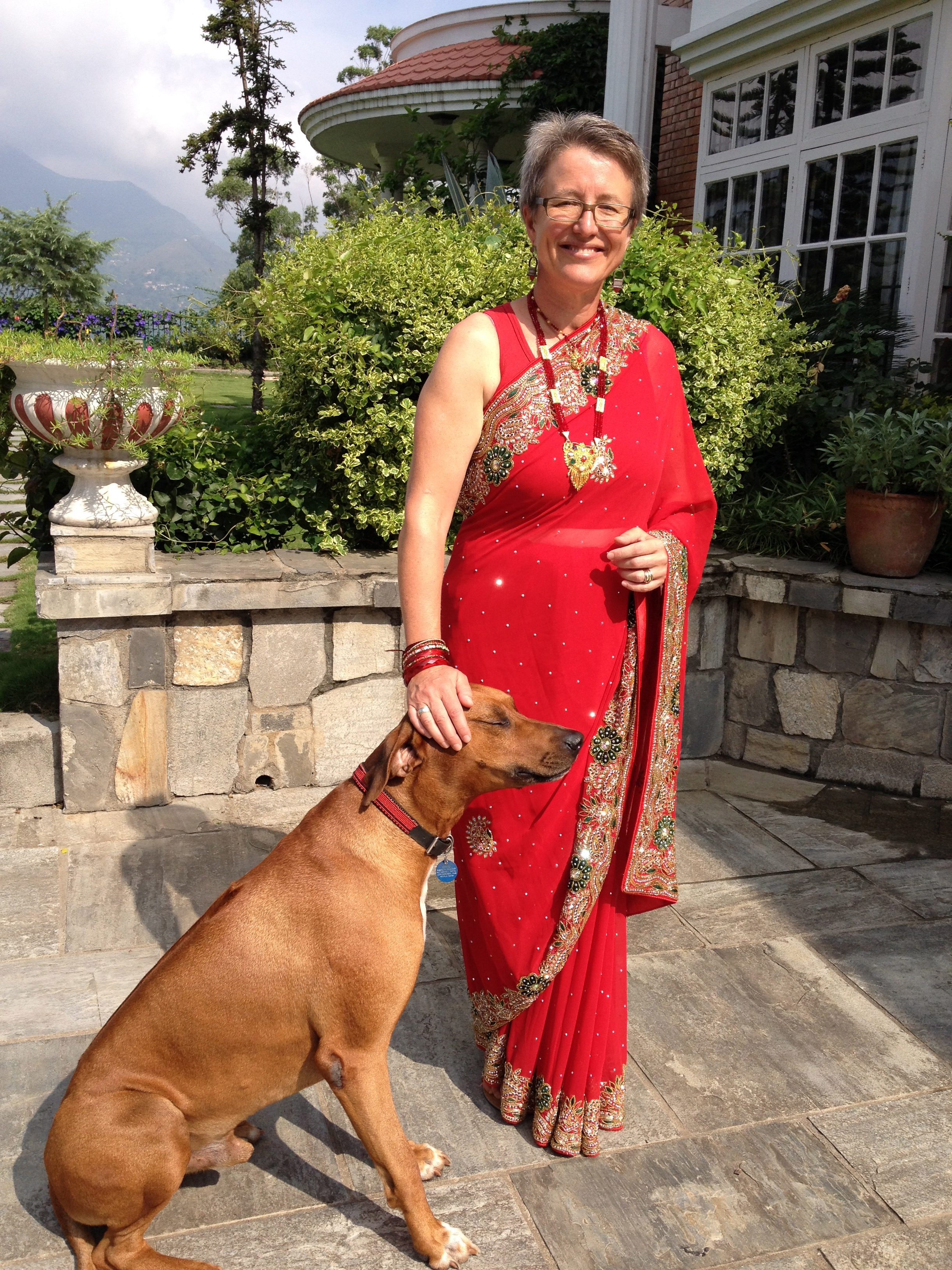
I too turned red - briefly. My dog, Biko, was just a prop. ©Bimla Shiwakoti

I too turned red – briefly. My dog, Biko, was just a prop. ©Bimla Shiwakoti

Luckily, when it is all over, I won’t suffer from withdrawal. There are of course many more festivals during the year but in the meantime I still have my neighborhood Hindu priest to remind me I live in Kathmandu. Without fail, 365 days a year, he starts clanking his bell to wake Shiva at 5:15AM. I lie in bed, counting the 25 to 31 reverberating sharp and hard rings occasionally enhanced with some megaphone chants. When I moved here a year ago, the head-thudding noise forced me up and out of bed but these days, it has a soothing quality, alternating with the baying packs of neighborhood stray dogs and the coo-ing pigeons on my windowsill. I roll over, a smile on my face, knowing that the ancient is still there to guard the new day.

‘REVOLUTION IS NOT BED OF ROSES’ — Postcard from Nepal

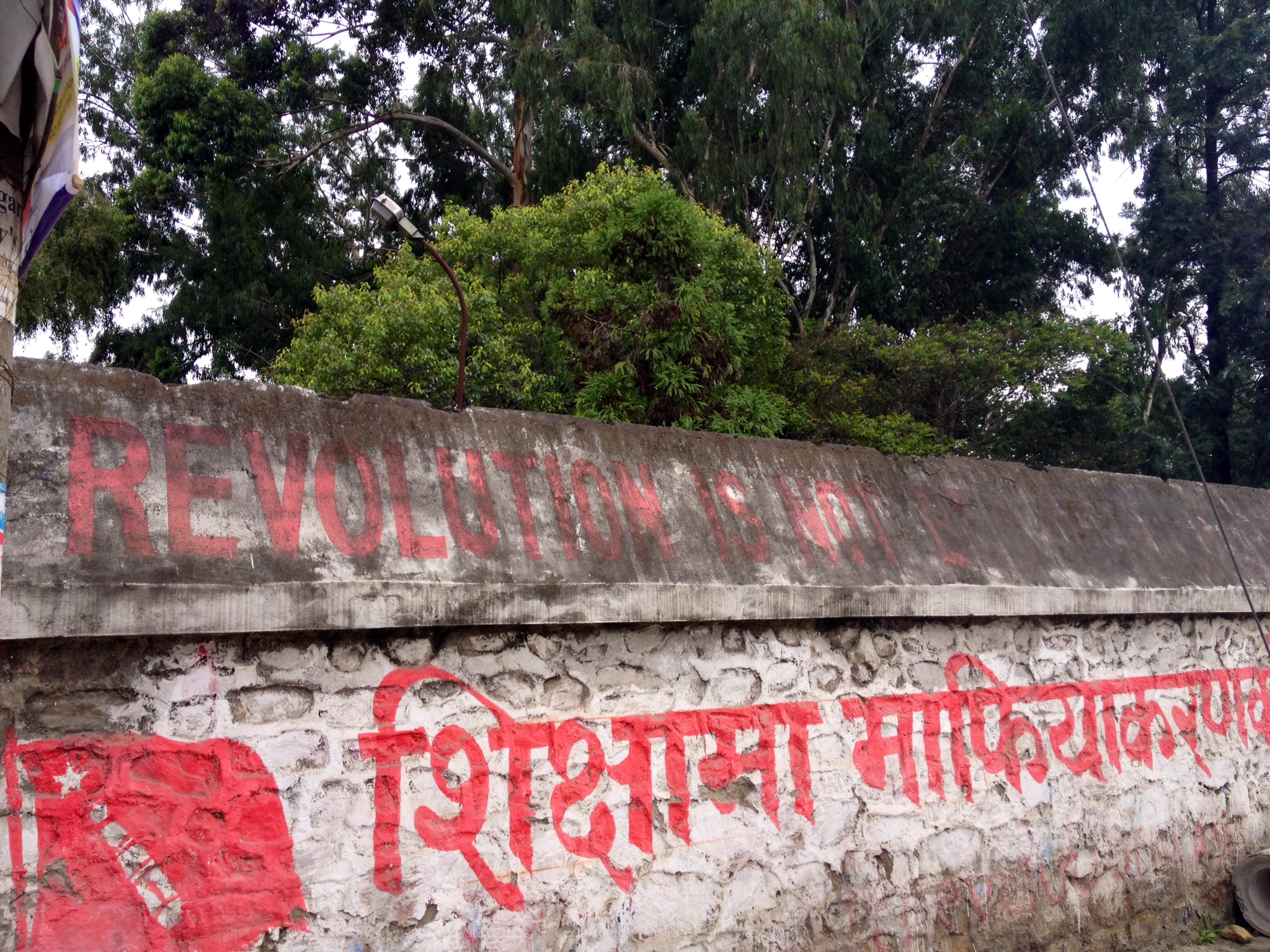
This graffiti was once bold and bright, an eye-catcher on Patan's main avenue ©Donatella Lorch

This graffiti was once bold and bright, an eye-catcher on Patan’s main avenue ©Donatella Lorch

“I am calling from Nepal,” I began the conversation with my usual opener. I was on the phone with Visa, my credit card having been blocked three times in one week. “That’s a tiny country between China and India,” I explained to the befuddled voice on the other end and then without pause added the tried and true clincher: “It’s the country of Mt. Everest.”
       Sometimes, I feel tempted to skip the obvious and instead to share my favorite, rather obscure fact about Nepal. In 1996, when communism was already an anachronism, Nepali Maoists, with little base among the masses, began a brutal 10-year civil war. They weren’t sufficiently pure Maoists to be recognized by China but were declared terrorists by India and the U.S–though an Indian group, the Naxalites, are said to have provided them much of their military training. Their very first weapons, whose bullets heralded the opening of the war, were American-made and had been air-dropped to Tibetan rebels in 1961 to mount a revolt in China.  To make the story even quirkier, the Maoist leaders are now in the fledgling new Nepali government.  Their former military commander, who directed the war from India and who was believed by some to be a fictional character, today is still referred to by his ‘nom de guerre,’ Prachanda or “Fierce”, and remains a subject of Nepali gossip  — not about where he may be hiding but about how he acquired his wealth and fancy cars.

         There is a fast-fading moldy quotation painted in two-foot high bold lettering on the concrete wall that border the main avenue of Patan, Kathmandu’s sister city. “REVOLUTION IS NOT BED OF ROSES, it declares in what was once blood-red paint, before the rest of the sentence fades into black-leaching monsoon mold. The author’s originally spelled name resurfaces briefly: “Friedl Castro.”

There are still stenciled Chairman Mao portraits in Kathmandu as well as Nepal's villages. ©Donatella Lorch

There are still stenciled Chairman Mao portraits in Kathmandu as well as Nepal’s villages. ©Donatella Lorch

Nepali communism (a unique brand that includes three separate and fractious parties) is far from dead but it has morphed and become part of the flow of the varied influences that define 2014 Nepal. And, yes, for the tourist mountain climbers and trekkers out there, it has even made it to Mt. Everest. With the official title of “Lumbini-Sagarmatha Peace March,” a 2012 expedition to Everest was co-led by Prachanda’s son and funded by the then-communist-led Nepali government. There are still black-stenciled faces of Chairman Mao around Kathmandu, and at election time last November the hammer and sickle was ubiquitous. A social media and Twitter coach might advise that they revisit their 1960s party brands: ‘Unified Communist Party of Nepal (Maoist)’; ‘The Communist Party of Nepal Unified Marxist- Leninist’. Catchy they are not. Businesses looking to invest in Nepal may also be a bit taken aback by politician’s business cards bearing these names from another era.

     From absolute monarchy through a vicious civil war, a military coup and now a fledgling democracy, Nepalis, it often appears, struggle, survive and succeed despite, and not because, of their governments.  With bleak employment opportunities in Nepal, more than two million Nepali youth work overseas mostly in the Middle East and Malaysia as an unskilled labor force.  A similar number cross the border to look for work in India.  Their remittances represent about 25 percent of Nepal’s GDP. Critics point out that fewer unemployed restive youth at home means fewer problems for the government. None of Nepal’s many political parties have come up with a “Yes We Can” style political slogan, but the common man has found a phrase to express his resignation to the water, fuel and electricity shortages, the slow progress in constitution writing, and even the weather.   The quintessential “khe garne?” literally translates as “What to do?” This is not really a question as much as a manifestation of decades-worth of a culturally-fed apathy and fatalism. 

Life in Nepal is heavily influenced by Hinduism and Buddhism. ©Donatella Lorch

Life in Nepal is heavily influenced by Hinduism and Buddhism. ©Donatella Lorch

    Nowadays, the revolutionaries are not in opposition.  In fact, many Nepalis believe that they share in government corruption; and they remain mixed and melded and molded with deeply ritualistic Hinduism and its hundreds of festivals. Bandhs (“strikes”), once a feared Maoist weapon, are now part of the mainstream, adopted even by right-wing Hindus–but, though they are occasionally violent, as in the rest of South Asia, observing uniquely Nepali manners, they are maintained only during business hours and not on any major religious holiday. Mahatma Gandhi’s most visible legacy in Nepal is the hunger strike, often undertaken by individuals to demand justice for crimes committed during the civil war. Some are very serious, like the hunger strike of the parents of Krishna Prasad Adhikari, murdered in 2004, demanding that the police arrest his killers believed to be Maoist cadres, but others are a little more comical, in a Nepali way, like a recent statement of various civil servants that they would undertake “relay hunger strikes” until their demands were met. I told my husband that I too would be on a hunger strike between lunch and dinner.

Road widening in Kathmandu was begun under Nepal's last prime minister, a Maoist, and continues today. ©Donatella Lorch

Road widening in Kathmandu was begun under Nepal’s last prime minister, a Maoist, and continues today. ©Donatella Lorch

After living for four years in Nairobi, a city beset by violent crime and the danger of terrorist attacks, it has been a delight to live in Kathmandu for many reasons, including the lack of ubiquitous crime. I can go out at night, with no fear. Driving my car, I don’t have to check my rear view mirror to see whether I am being followed. I don’t even have to worry about drunk-drivers.  Though Nepalis can drink–heavily–the Kathmandu police enforce zero tolerance for drinking and driving, and many an alcohol-scented driver has found himself stranded at a police checkpoint at night.

    Yet national interest and community self interest often clash. Many Nepalis feel that only protests spark government responsibility. In the aftermath of an August 2nd landslide that destroyed villages, killing 156 people and burying more than 10kms of Nepal’s only major trade route to China, the local community’s “struggle committee” blocked army bulldozers from trying to address the ensuing problems, demanding first that the government deliver the aid that it had promised. Subsequently frustrated by government inaction, local businessmen are now building their own bypass road. The government appealed for funds in the local papers, printing a bank account number for Good Samaritan direct deposits. The Chinese ambassador delivered his government’s donation in cash.

The government provides insufficient garbage dumping space. Open dumping is ubiquitous. Nepalis dump their garbage on roadsides and along river banks. ©Donatella Lorch

The government provides insufficient garbage dumping space. Open dumping is ubiquitous. Nepalis dump their garbage on roadsides and along river banks. ©Donatella Lorch

 In Kathmandu recently, where garbage disposal is beyond a crisis, residents of the neighborhood adjacent to the city’s only garbage dump (a way station to a bigger dump outside the city) complained to the local government about weeks of overflowing and unmanaged dumping. When the city ignored them, the locals padlocked the gate to the dump. Needless to say, the garbage got dumped anyway–somewhere even less appropriate.  

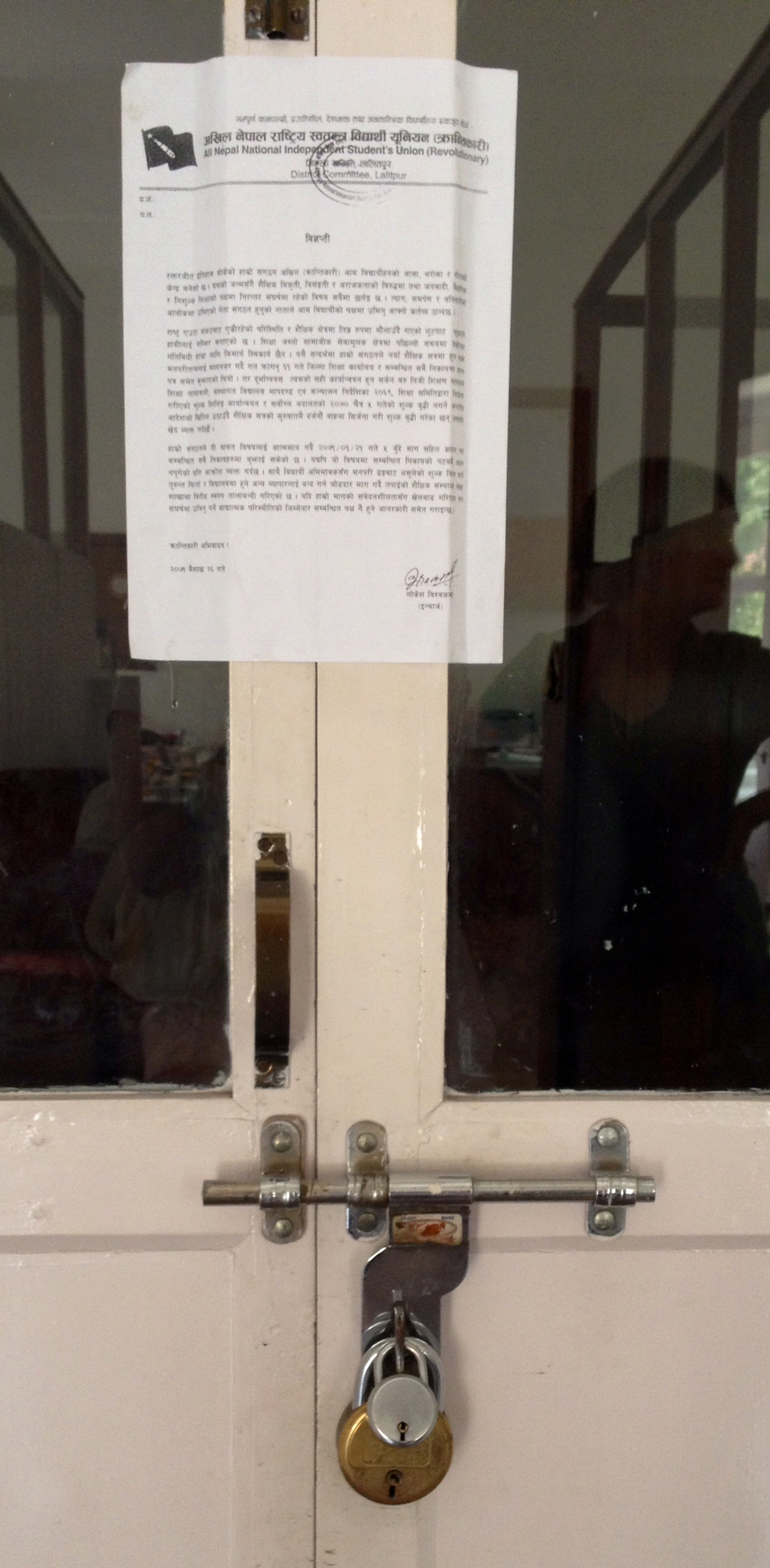
Padlocking, as a threat is often used by communist youth groups. Here a school accounting door was double locked and sealed. © Donatella Lorch

Padlocking, as a threat is often used by communist youth groups. Here a school accounting door was double locked and sealed. © Donatella Lorch

Padlocking as a threat is often used in Nepal, especially by communist youth groups. This year when private schools announced a tuition hike, the youth groups padlocked and sealed the offices of the schools’ accountants, and added threats of violence for good measure. It was fairly effective–because they have a reputation of delivering violence, fire bombing buses and taxis and (just this week) trashing local newspaper offices.

    Friedl Castro definitely had a point about revolution:  it is not a bed of roses. Democracy is also a long, painful, and convoluted process. From 2011 to 2013, Baburam Bhattarai, the Maoist party’s ideologue, who has a degree in urban planning, was Nepal’s prime minister. It is his vision of widening Kathmandu’s narrow roads that is slowly untangling the capital’s horrific traffic jams. If only the contractors had remembered to add drainage ditches.