Author Archives: Donatella Lorch

Unknown's avatar

About Donatella Lorch

I am a former New York Times foreign correspondent and a former correspondent for NBC News and Newsweek. Lots of formers there. I am also a mom of four, a wanderer and I've lived overseas for more than a decade. Most recently, after four years in Kenya, three years in Nepal, and three years in Ankara, Turkey, we've returned to our home in the Washington DC area.

Dhaka to Kathmandu — A different commute

I dread Fridays. The anxiety can start the day before, and then the mornings find me pacing and monitoring the Internet, the local weather channel, a friend’s broadband radio and WhatsApp. On Fridays, my husband is scheduled to come back to Kathmandu from Bangladesh. It’s not that I don’t want to see him. Spending an occasional weekend together is a welcome treat. The problem is getting him here. Every week, what is in fact just an hour and ten-minute flight, a Washington D.C. to New York hop, can evolve into a several day ordeal, if it happens at all.

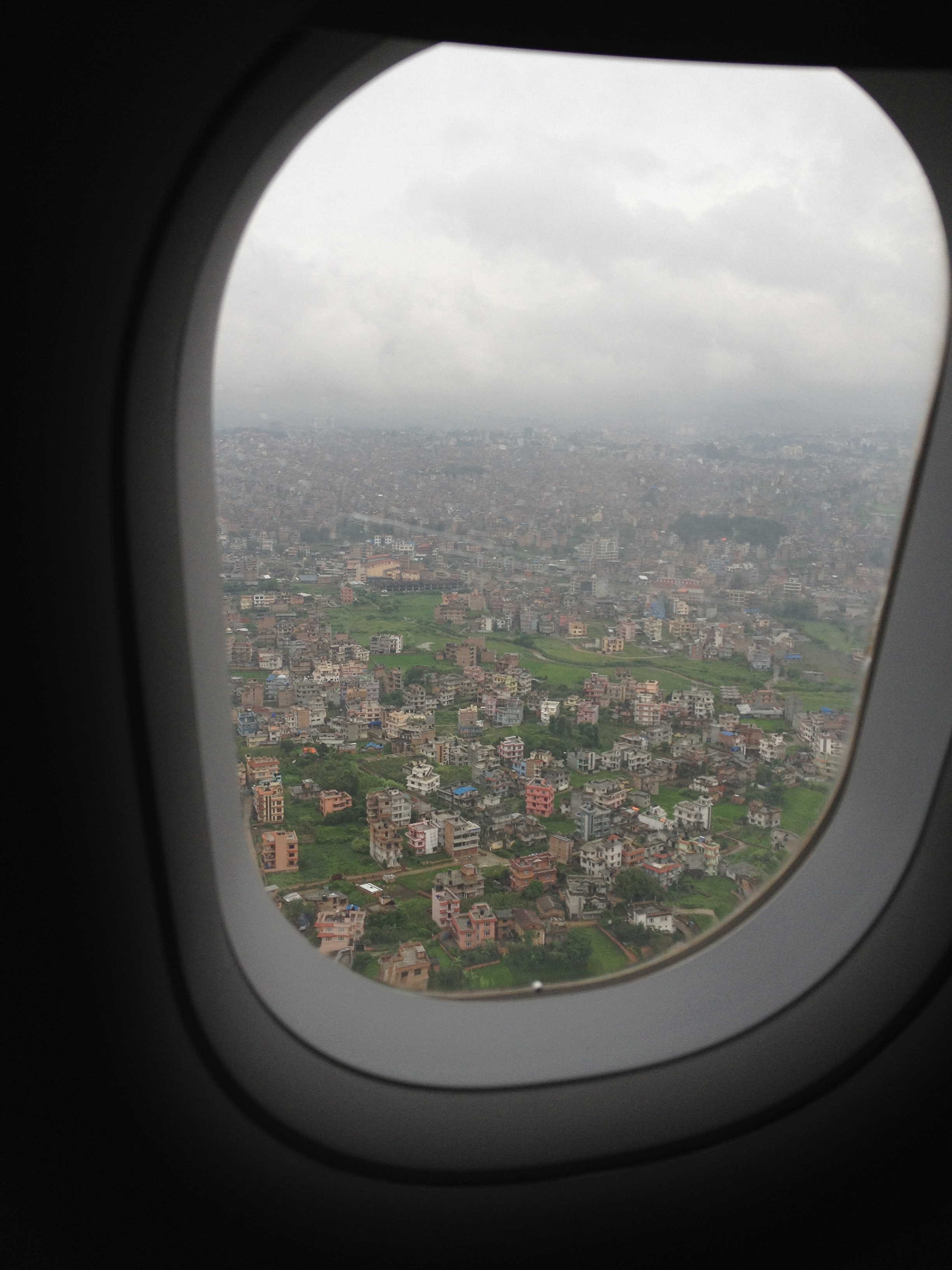
Landing in Kathmandu, a plane crests the hilltops and dives down fast. © Donatella Lorch

Landing in Kathmandu, a plane crests the hilltops and dives down fast. © Donatella Lorch

Kathmandu is a city of 3.5 million, and though air traffic cannot be compared to Delhi or Bangkok, it is not a backwater. Scores of international airlines come everyday, with heavy traffic from India, several Chinese cities, non-stop from as far as Korea and Turkey. Nepal, like Bangladesh, is a major supplier of migrant labor to the Middle East and Malaysia, and their airplanes land here as often as four times a day. If John were commuting from India, he’d have a vast array of airlines and departure times from which to choose.

The airstrip at Tribhuvan International Airport, Kathmandu, Nepal

The airstrip at Tribhuvan International Airport, Kathmandu, Nepal

But my husband is based in Dhaka, Bangladesh’s capital of 12 million. It used to have two airlines plying the Kathmandu route every day but a few months ago, without giving a reason, United BD dropped down to two flights a week, leaving only the national carrier, Biman Bangladesh Airlines, offering (on paper) five flights a week. Bangladesh is the only one of Nepal’s neighbors that offers so few flights. Even Bhutan, a country of 775,000, flies daily to Kathmandu. Filling the plane does not appear to be an issue. So why is it so hard for John to get here?
Monsoon fog hugs the mountains on a recent landing into Kathmandu. © Donatella Lorch

Monsoon fog hugs the mountains on a recent landing into Kathmandu. © Donatella Lorch

Nepal, a land of steep mountains, narrow valleys, unpredictable weather and few paved roads, offers 48 airports, though most are dirt strips precariously cleared on narrow mountain ledges. The Kathmandu valley is circled by hills (the Nepalis call anything under 4000m a ‘hill’) that require a plane to dive sharply down towards the airport. Auto-pilot is not an option here. It is required to be a visual pilot (not co-pilot) landing. The runway also has reoccurring problems, especially during the monsoon rains, when cracks widen and close the airport for hours or even a day or more. The local fauna gets in its dibs as well. Last month an earthworm infestation on the runway attracted so many birds that landings were suspended and planes diverted. Nearby garbage dumping also attracts birds that have cracked a few aircraft windshields. During the three-month long monsoon rains, thunderstorms and wind shear over Kathmandu can force planes to re-route to India and Dhaka.

Flight Radar24 flight patterns on a recent day in Kathmandu

Flight Radar24 flight patterns on a recent day in Kathmandu

A Nepali friend has hooked me onto FlightRadar24, and from the comfort of my Ikea lounge chair, I can follow live-time landings and take-offs into the valley. I have spent way too much time tracking the red loops made by as many as five little planes at a time as they circle over and over and over Chitwan National Park waiting for permission to edge towards Kathmandu.

Even before takeoff, Biman has challenges. State-owned, cash-strapped, with little transparency and a poorly-maintained fleet, its functioning planes get juggled from route to route. The Kathmandu route is a frequent victim. But even then, if and when you take-off, the problems are not always solved. The last week of July, the Nepal-bound flight caught fire when it blew four of its left-side tires as it landed in Kathmandu. No one was injured.

Last Friday, John went to the airport for his 11:00 a.m. Biman flight (Friday is the first day of the Bangladeshi weekend). Once there he was told it had been delayed to 4:00 pm, a common occurrence. The plane then took off on time but after a half hour, an announcement was made in Bangla that the plane had technical difficulties and would have to return to Dhaka. As the plane turned around, John saw a man wearing a Biman pilot’s uniform taking out a prayer rug from the overhead bin and commencing to pray in the aisle. Perhaps for that reason the plane landed safely?

Once back in Dhaka, passengers were then kept in the airport for five hours, with-half hourly promises of updates that never came, until 10:00 pm when Biman, faced by an angry plane-load of people, cancelled the flight. With Sunday a working day in Bangladesh, it didn’t make sense for John to attempt the next day’s flight.

A newspaper article a few days later explained that the A310-300 S2-ADK , the sole Biman craft that flies the Kathmandu route, had had a throttle stagger, a problem with the control that maintains the speed of the plane on landing and take-off. Two days before, this same plane had an unidentified technical glitch that again forced Biman to cancel the daily flight. The acting CEO of Biman had some vague and not very proactive words to share with his airline’s clients. “I have heard of frequent problems on the Dhaka-Kathmandu route and we might have to think about the A310-300 S2-ADK,” said Mosaddique Ahmed to the Daily Star newspaper.

I can hear my sister telling me: “Dony, stop being so pathetic!” In my foreign correspondent days, I flew sitting with chickens, goats, a metal bucket full of garlic- covered raw meat at my feet, standing behind the pilot during nose-dive mountain landings and sitting on bales of Khat in a propeller plane gutted of seats and flown by a pilot wearing a black bowler hat. It’s the frustration really. It means another week not seeing John. It means his having no choice but to take an unsafe airline to do his job. It’s the irony of Bangladesh. In our world of globalization, of instant communication, of apps that do everything but brush your teeth, in the world’s eighth most populated country home to brilliant novelists and poets, Nobel prize winners, world famous NGOs, the national airline can’t even maintain good connections with its neighbors.
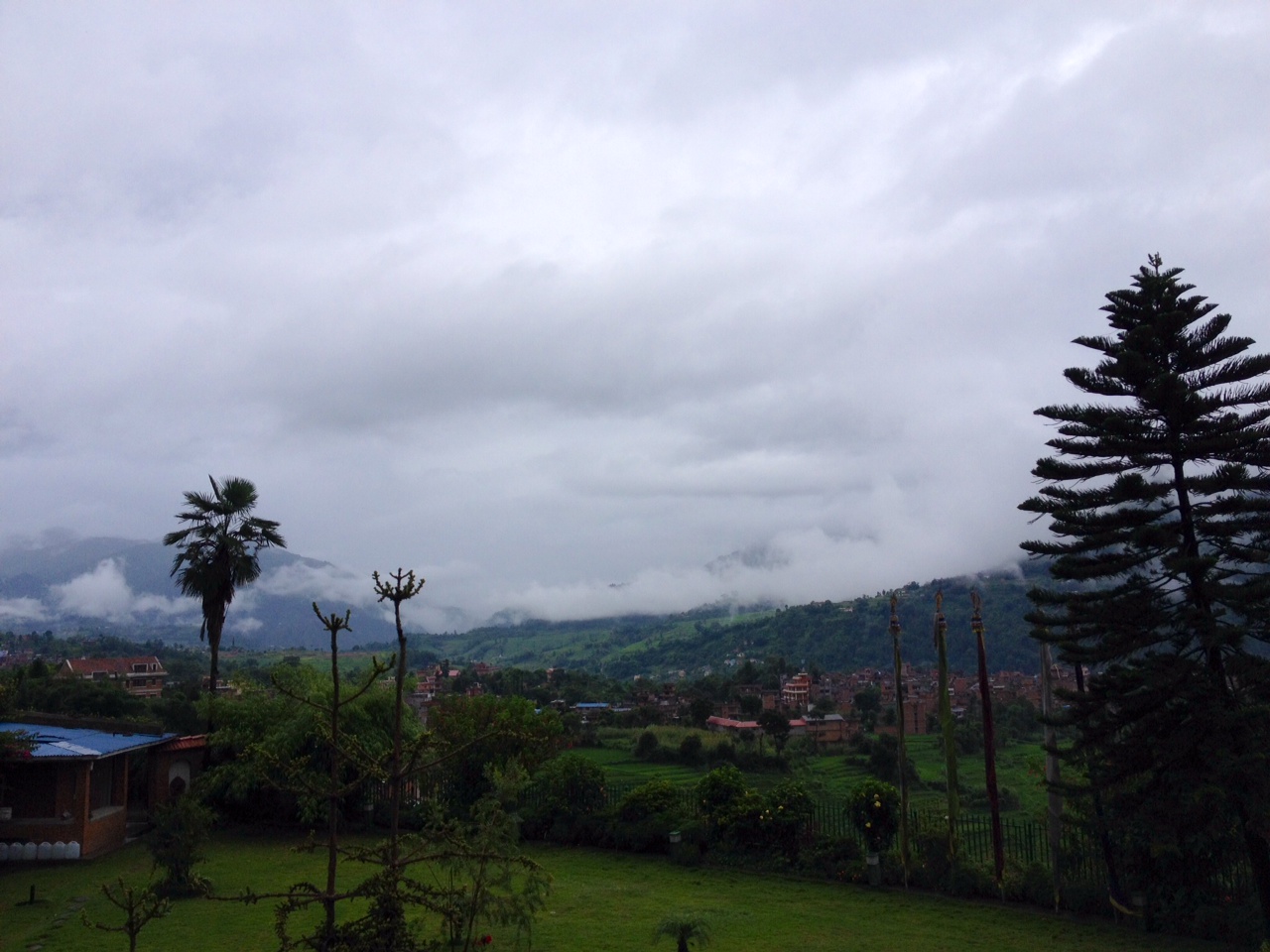
Fog rolls into the valley burying the mountains that encircle Kathmandu in a thick white veil © Donatella Lorch

Fog rolls into the valley burying the mountains that encircle Kathmandu in a thick white veil © Donatella Lorch

This week, heavy and constant monsoon rains have been coating the region from Bangladesh across Bhutan and Nepal, and the fog enshrouds us here in Kathmandu in a thick white veil. Our house is on the main flight path and the grumble of passing jet engines are a soothing reminder that, yes, planes are still landing. Today a Nepali friend messaged me that he’d stopped for puja (worship) at Pashupatinath, one of the world’s holiest Shiva shrines, just to get a blessing for today’s Biman flight. There were no praying pilots on board this week. The flight circled a number of times over the valley. But the flight made it. A good day for the Dhaka commute.


From Kenyan savannah to Nepali rice fields – two worlds connect with barefoot running

Buffalo herders resting in the fields © Donatella Lorch

Buffalo herders resting in the fields © Donatella Lorch

My father relished recounting the tale of his college sporting efforts. As a freshman, he tried out for the long distance running team and after the first training session the coach pulled him aside: “Lorch,” the coach bellowed. “You run (long pause) as if your were going to a fire (even longer pause) that was going to happen ten years from now!” Poppy switched to tennis. I, like him, was never a big runner. I quit jogging by age 25.

Crossing the finish line at the Lewa Marathon in Kenya. © Donatella Lorch

Crossing the finish line at the Lewa Marathon in Kenya. © Donatella Lorch

Last year, at the end of June, I ran the Lewa half-marathon. It is one of the running world’s most unique marathons, set at 1,700m in Kenya’s Lewa Wildlife Conservancy.  Runners weave across the hilly, tawny savannah, home to a vast array of wild animals including lions, elephant and buffalo. Helicopters, small aircraft and Lewa’s guards keep the animals away from the dirt track. I ran the half-Lewa, just over 20 kms, as one of a series of rituals I had selected to say goodbye to Kenya, my home for four years. But even though I felt the satisfaction of having trained for two months and of having temporarily given up my daily glasses of red wine (which to me was even more impressive than my return to running after 25 years), I didn’t think much of what future running and I had together.

A farmer carries manure to his fields. © Donatella Lorch

A farmer carries manure to his fields. © Donatella Lorch

A month later, we moved to Nepal. I am not particularly athletic by nature. There is a lot of arguing that goes on between my head and my feet to do anything that involves sweat. Let’s not forget my love of red wine. In Nepal I felt disconnected. We chose to live in the southern part of the Kathmandu valley, far enough away from the center of Kathmandu to avoid most of its choking winter smog but also too far for easy access to a gym. There is a loneliness to life in a new country. It was monsoon season and the air was a sticky cloak that left me soaked after a short walk. It took a month before I had exhausted every possible excuse and only then did I take out my Five-Fingered Vibrams, the same ones that had run Lewa.

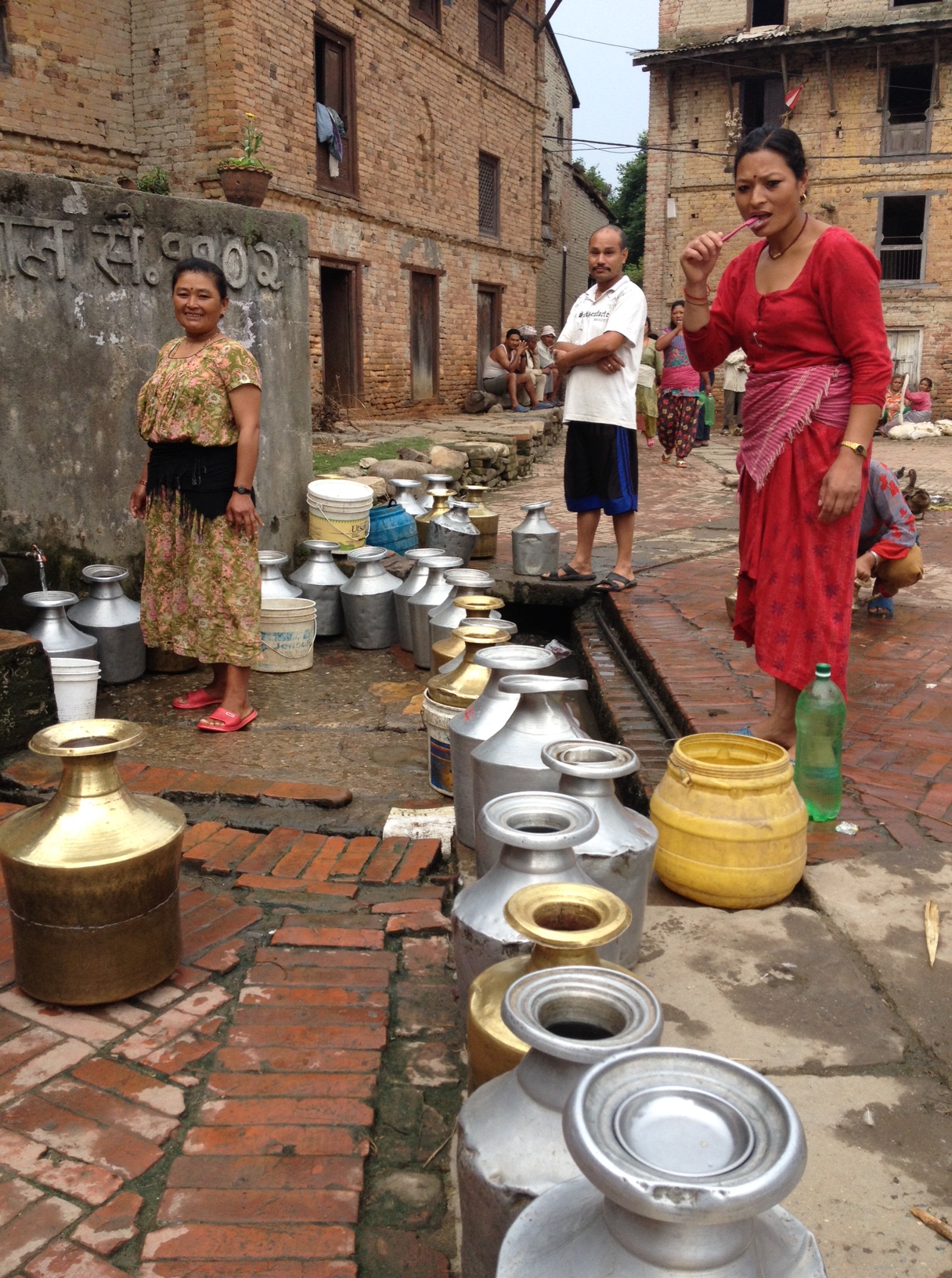
Water gathering at the main square of the village of Sanu Khokana in the Kathmandu Valley. © Donatella Lorch

Water gathering at the main square of the village of Sanu Khokana in the Kathmandu Valley. © Donatella Lorch

There wasn’t a Eureka moment. I fought with every inch of territory. Some mornings I just walked. Oh, the mud. Slippery, heavy, thin, thick, glue-like, ubiquitous mud.  Was that smell cow dung? And is there anywhere flat in Nepal? At some point I must have lifted my head and forgotten briefly the effort of moving forward. Then those moments stretched slowly into half-hour stretches. On my ipod, Cesaria Evora, Adele, Chopin and Jai Ho lured me on. I began to wake up earlier because I wanted to run, though our neighborhood Hindu priest should also take some of the credit for these early rises: his endless 5:00 a.m. chanting and bell-clanking is not conducive to a sleep-in.

I owe a lot to Lewa the same way I owe a lot to Kenya. They both guided me over the stumbling blocks of step-parenthood and the art of getting over a life as a foreign correspondent. But running in Nepal has given me a gift of exploration that did not exist for me in Nairobi. I now run because I learn, because every day, every week, every season I explore the amphitheater of fields below my home and the hills beyond the holy and highly polluted Bagmati River. I watch what the farmers plant, how they break their clay-like soil with ancient-looking hoes with handles that seem to go the wrong direction, their bodies bent in two. I have lived the rice cycle from dry planting of dhan (rice seeds), to transplanting electric-green seedlings into the flooded paddies that quickly turn emerald and finally tawny during harvest. Then comes the potato, bean and corn season.

Feeding baby goats. © Donatella Lorch

Feeding baby goats. © Donatella Lorch

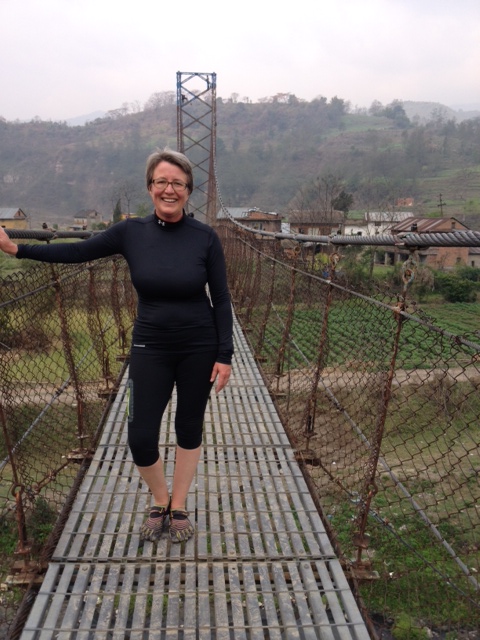
Running across a pedestrian bridge in the early Spring. © Donatella Lorch

Running across a pedestrian bridge in the early Spring. © Donatella Lorch

I run on the inches-wide mud walls that separate the paddies, on roads hand-paved of rough hewn stone, through towns where culture is still ensconced in ancient times, where the buffaloes and goats live on the ground floor of red brick homes, ducks waddle in the narrow alleys and women card wool on their stoops on rickety wooden spindles. Garlic and red chili tresses hang down from third floor windows and winnowed wheat is laid out to dry on any spare square of earth.

I see this all because I run — catching a regular snapshot of a life that has turned familiar and friendly.  I stop here and there to grab an instant with my iphone–that odd, short-haired woman in black lycra pants with those weird multi-colored Five-Fingered Vibrams. Even after all these months, those shoes remain a huge hit.

Carding wool. © Donatella Lorch

Carding wool. © Donatella Lorch

I never tire of my route. Every run, I am reminded that Nepal of today is quickly dying away.  Every month, a little bit more perceptibly fades. In a few decades, much of this world will be gone, consumed by the unregulated, haphazard, massive urbanization that is devouring every green space left in the Kathmandu Valley. The city of four million has already climbed the last hill overlooking my running route.

It is an extinction of history.

Meat-eating vegetarians in the land of the Buddha

Kathmandu Valley streets are a free range for all animals of all sizes.

Kathmandu Valley streets are a free range for all animals of all sizes.

The conversation with a Hindu friend in Kathmandu went something like this:

“Ram, are you a vegetarian?”

“Of course I am,” he answered.

“What is your favorite dish?” I countered.

“Chicken curry but it is very expensive so we mostly eat mutton curry.”

“But aren’t you a vegetarian?” I sputtered.

“Yes of course,” Ram assured me with a big smile. “I don’t eat beef.”

Ubiquitous ducks in certain neighborhoods can make driving tricky. © Donatella Lorch

Ubiquitous ducks in certain neighborhoods can make driving tricky. © Donatella Lorch

Since that first encounter with this new definition of vegetarianism, I’ve heard that explanation many times. It is often followed by a discussion on the holiness of cows. Nepal is a secular state, but just over 80 percent of its people are Hindu and it is illegal to kill cows here. Penalties are similar to those for manslaughter, so be extra careful when you drive around the Kathmandu Valley:  city streets are a free range for all animals of all sizes, holy or not. This includes some 20,000 stray dogs as well as goats, ducks, geese, chickens, buffaloes, and many wandering cows – all accompanied by the ubiquitous cacophany of murders of crows that have given the capital one of its nicknames: Crowmandu.

I wondered whether my preconception of religious Hindus as complete vegetarians was misplaced, or whether Nepalis aren’t so religious after all?  Yet, living in Nepal, I see, hear and smell religion everywhere.

Mornings can be very busy with Gods everywhere. © Donatella Lorch

Mornings can be very busy with Gods everywhere. © Donatella Lorch

Nepalis are believers, of a kind, and even the Maoists and Marxist Leninists seem to have overlooked the Marxist dictum that religion is an opiate of the masses. There are 330 million gods worshipped in this country, where only 10 percent of the people are Buddhist and a tiny percentage Muslim or Christian. At Christmas, my Hindu friend Jyoti, wanting me as a Catholic to feel included in Nepali life, assured me that: “Your God is my God.” With 330 million gods already in the panoply, I had to admit that adding one more didn’t seem to be much of a stretch.  Though Buddhist numbers are small, Buddhism remains a cornerstone of Nepali identity. Tourism brochures proudly boast Nepal as the “Birthplace of Lord Buddha.  Just this week, the government announced a plan to transform the birthplace, the town of Lumbini, into a “global peace hub,” hopefully giving it a desperately needed facelift. By the way, Buddhists here also love their meat. There is a twist to the “can’t kill a cow” law. In Nepal, it is not illegal to eat a cow and many Tibetans here love their beef. But, given the lack of beef vendors, it comes at a steep price. I buy mine from a lone store that ships it in frozen from Australia. There is of course also an underground black market.

I'm Holy.

I’m Holy.

Friends often ask me what I like about living in Nepal. Though this is a multi-layered complex question without a straightforward answer, I often say that I am inspired by the way Hinduism and Buddhism are not only integrated in every aspect of daily life but that Nepal appears to be the most religiously tolerant country I have ever visited or inhabited. It is also a place where religion is alive and intimate. Buddhists and Hindus share hundreds of festivals and shrines of all shapes and sizes that are everywhere, from huge Durbar squares declared UNESCO World Heritage sites, to hidden stupas in tiny alleyways, a lingam or a rock in the middle of a paved road (surrounded by railings that oblige cars to go around it) or a towering Buddhist vihara on a hillside. There is not one but several Buddhist ‘Living Goddesses’ that are worshipped by Hindus on a daily basis. These pre-pubescent girls, called Kumari, are allowed out of their homes only on festivals, lathered in makeup and weighed down by jewelry. Their feet are never allowed to touch the ground.

Puja, or worship, is constant and everywhere. In the early mornings, the streets are full of women carrying rice, flowers, red thika and food to various neighborhood shrines. Beware of Kathmandu’s hordes of motorcyclists maneuvering through heavy traffic:  many drivers will suddenly bow their heads and lift a hand to their forehead to acknowledge a holy site that is being passed. What, you didn’t spot the holy rock? Apparently, if you are deeply religious, it is also necessary briefly to close your eyes as you drive past.  Adds a certain adventure to the driving experience.

For this Puja, I got off my motorbike. © Donatella Lorch

For this Puja, I got off my motorbike. © Donatella Lorch

Meat, a major business in Nepal, is an integral part of religious festivals, in particular during the October Dasain Festival, beginning the first day with the army sacrificing buffaloes at a central shrine, and continuing with the family butchering of a goat or, if affordable, a buffalo.  Animal sacrifice at temples is practiced year round as well. Even with an outbreak of avian flu that made chicken production fall by 20 percent, the Valley produced over 49,000 tons of meat in the six-month period between mid-July 2013 and mid-January 2014. Buffalo is the most popular meat, taking 45 percent of the market share, with mutton in second place.

Fresh buffalo, anyone? © Donatella Lorch

Fresh buffalo, anyone? © Donatella Lorch

These animals, both dead and alive, are a visible and integral part of Kathmandu life. Many butcher shops are just shacks on the side of the roads, their soon-to-become muttons tethered live on the stoop, whiling away their last few hours chewing on tree branches in uneasy companionship with the stray dogs sitting nearby, patiently waiting for their friends to become food. Early every morning in my neighborhood, a bent old man walks half a dozen young buffaloes single-file down the hill and into the courtyard of a red brick house. Within an hour, dripping meat is piled on a wooden table outside in the company of black flies waiting for customers. Even after a year here, I still feel deeply unsettled looking at the goats just feet away from their guillotine.

Just waiting for the butcher at the local shop. © Donatella Lorch

Just waiting for the butcher at the local shop. © Donatella Lorch

I am also constantly visually reminded that cows are holy, but not their bull calves. Abandoned, the calves try to survive, skinny, listless, parched under the torrid pre-monsoon heat, eating garbage and plastic bags, lazing in the middle of a congested street.

The girls may be holy but we're not. © Donatella Lorch

The girls may be holy but we’re not. © Donatella Lorch

It is not only religion that is intimately lived here, but also our relationship with the animals we eat. Even politics gets involved. This week, Hindu right-wingers–wanting to create a Hindu state, ban the sale of beef and declare it a crime for Hindus to convert to another religion–tried to paralyze the capital by declaring a two-day ban on vehicular traffic. Happily, everyone ignored the ban. Another reason I love Nepal.

“Way to Massacre Place” – We know the Where. Please fill in the Who, What, Why

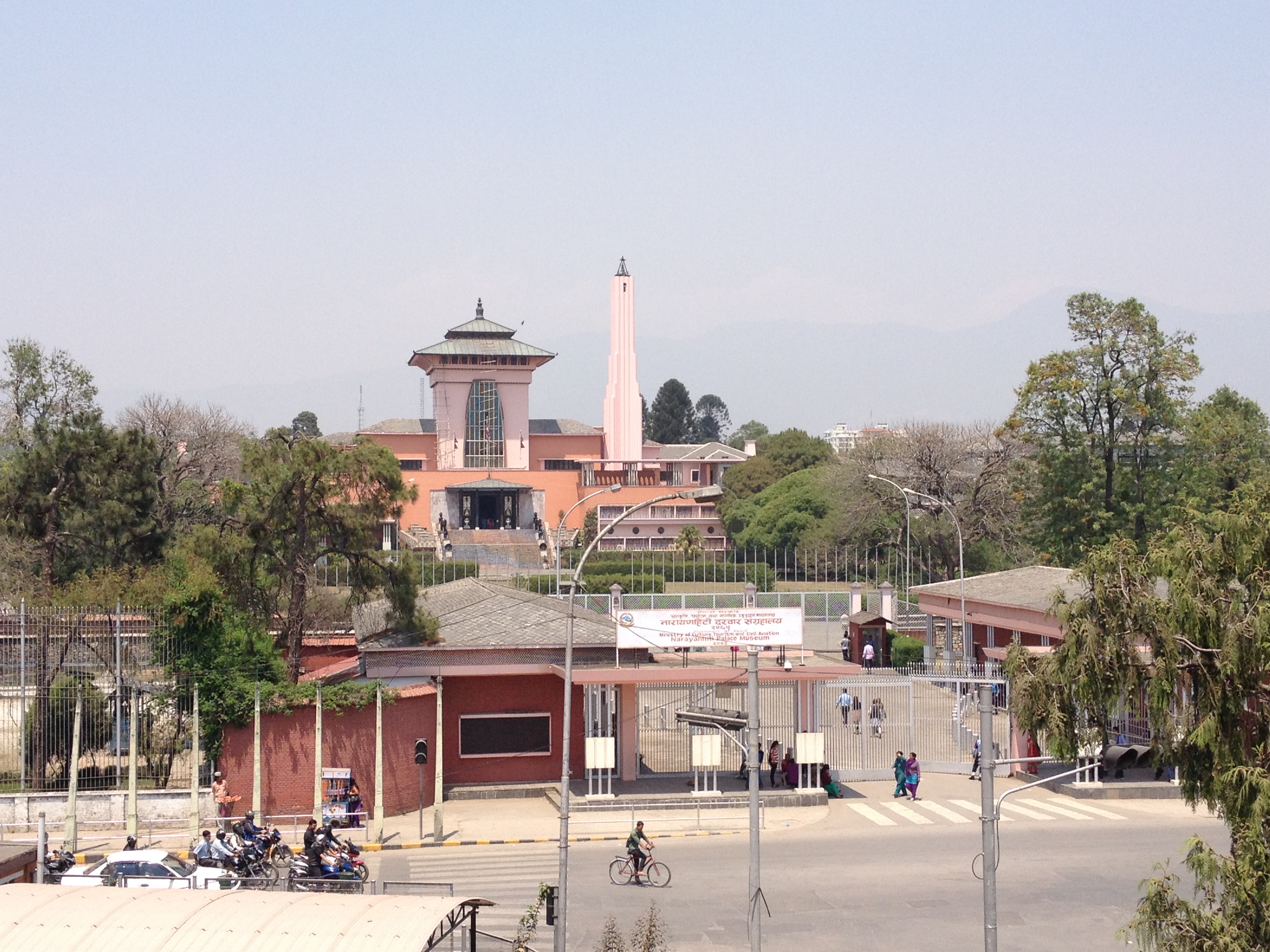
The Narayanhiti Palace, now a museum and a former residence of Nepali kings. ©Donatella Lorch

The Narayanhiti Palace, now a museum and a former residence of Nepali kings. ©Donatella Lorch

The sign is nondescript and small. For my nine-year-old son, it is the first tantalizing hint of what lies ahead. “Way to Massacre Place,” it declares, an arrow pointing right, followed a few meters beyond by “Location of Royal Palace Massacre,” in case somehow visitors manage to deviate from the one-way path guarded by an armed soldier. Personally, I was already having an Alice-down-the-rabbit-hole moment. This was my second visit – a palace massacre recidivist – scribbling notes on a wrinkled sheet of paper, as all visitors have to surrender their bags, their cameras and their phones before entering.

In Nepal, an absolute monarchy not that long ago, the 2001 royal massacre is the stuff of legends. A large crowd of Nepalis queue regularly in front of the elegant metal gate of the Narayanhiti Palace, now a museum, but until 2001 the primary residence of Nepal’s kings. It does not seem to have the same magnetism for foreign tourists, even though it is walking distance from Thamel, the humming hub for all things touristy.

On June 1, 2001 (according to the official version), King Birendra Bir Bikram Shah Dev, 55, considered to be an incarnation of Lord Vishnu, was gunned down during a family dinner party here by his 30-year-old son, Crown Prince Dipendra. In swift succession, Dipendra, dressed in camouflage and armed with an M-16 and a collection of various deadly automatic weapons, killed nine family members, including his mother, brother and sister. He then turned the gun on himself. He lived long enough after he shot himself to be declared king–but as he lay dying the 240-year-old monarchy was dying as well. In 2008, Birendra’s brother and Dipendra’s successor, abdicated, and Nepal became the newest democracy on the South Asian block. But in many ways, the massacre and its aftermath, coupled with an ever-growing plethora of conspiracy theories, remains an emblem of the ethnic and political complexities, traditions, superstitions, conflicts and distrust that pervades today’s Nepali society.

King Birendra (left), Queen Aishwarya and Crown Prince Dipendra (middle)

King Birendra (left), Queen Aishwarya and Crown Prince Dipendra (middle)

To get to the massacre signs, you first walk through a collection of meeting rooms and bedrooms frozen in a 1970s décor, part ski chalet, part genteelly-rundown villa. Stuffed dusty tigers, lions, stag heads, paintings of former kings, elephant feet used as footstools, antelope-hoof candleholders, a gigantic Gharial crocodile nailed to a wall. The portrait hallway has the Nepali King and Queen posing with various international visitors, such as Marshal Josip Broz Tito, Zia ul Haq, Nicolae Ceausescu, Francois Mitterand , and some of lesser fame such as the president of the Swiss Federation. The bookshelves in other rooms mix biographies of the Dalai Lama with classics such as Lord Jim and Kitty Kelley’s The Royals. White mothballs decorate the carpets and chairs and, whether it’s to ward off the densely humid monsoon weather or to mummify time, every room greets me with the pervasive smell of naphthalene.

On the ill-fated evening of the massacre, Eton-educated Dipendra was hosting his extended family. Dipendra (known widely as ‘Dippy’) had issues, according to published reports. He drank hard, loved hashish, liked to torture animals and watch them die, and didn’t get along with his mother Queen Aishwarya, who disapproved of the woman he wanted to marry. His bedroom closet was stocked with a vast array of weaponry and ammunition. Survivors described him as single-mindedly going after his victims one by one and even leaving the room to switch weapons. He shot his mother and brother in the garden before killing himself. You can see re-enactments on YouTube.

The Western world had the Empiricists, the Rationalists, the Scholastics, the Logical Positivists, the Imperialists. In the U.S. we added the Survivalists who believe that black United Nations helicopters will invade America. Post-massacre Nepal gave an orchestra seat to the Bollywoodists.

The initial palace reaction was a public relations disaster, a critical weakness that only enhanced the belief that they were disconnected from life outside their gate. The official statement said a gun had accidentally misfired, killing the king. Dipendra, then in a coma, was named king, and held that position for three days. Subsequently, the building where the shooting took place was razed and the victims cremated, without any autopsies. Later, an official inquiry, headed by the chief justice and one other Nepali, produced a 200-page report that identified Dipendra as the gunman but left many unanswered questions.

Nepal was isolated from the outside world until the 1950s. Citizens, like this woman, knew no government other than an absolute monarchy and a king who was considered a god. ©Donatella Lorch

Nepal was isolated from the outside world until the 1950s. Citizens, like this woman, knew no government other than an absolute monarchy and a king who was considered a god. ©Donatella Lorch

While the masses outside the gates may have believed in the divinity of their king, they didn’t believe the palace’s story. Thirteen years on, interest has not waned. This week, yet another book was published further promoting the mystery with the underlying theory that if you can’t prove it and no one will admit to it, it must be right.

When things go wrong in Nepal, India is usually high on the list of culprits. Some of the paranoia is founded in fact. India is the huge neighbor next door and they have a history of bullying their tiny neighbors. Many Nepalis believe that it was not Dipendra who did the killing but rather India’s intelligence agency, the Research and Analysis Wing or RAW (for good measure the CIA is also included in some conspiracies), whose agents have, I am often told, totally infiltrated the country. RAW allegedly paid off King Birendra’s brother, Gyanendra, who later became king (an unpopular one), to organize the killing. Many of my Nepali friends say the unquestionable proof is that Gyanendra was not present at the massacre and his son survived the shooting. Another conspiracy centers on the popular Bollywood make-up artist Oscar-winning act. A cook, who was present that night but has since disappeared, claims several men in camouflage wearing Dipendra masks entered the gathering and opened fire. These mask wearers are the ones who allegedly also killed Dipendra. This links with the story-line that Dipendra had not one but two bullets in the head. (and remember — there was no autopsy. Hmmm!)

Today, Nepal is struggling with political disarray, corruption and a booming population that wants its government to supply the basics of water, fuel and electricity. Many opinion makers hark back to the halcyon days of the monarchy as the pillar of Nepali identity and sovereignty, especially when India-phobia resurfaces. Yet, many handily forget that in a democracy, sovereignty is vested in the people, not in the divine right of kings. Democracy in Nepal has an enormously difficult legacy to overcome. The monarchy was in its last throws, a spent force, with poor leadership, a dysfunctional family that was disconnected from its desperately poor subjects and the growing Maoist uprising across the country. Yet all these conspiracies could help also a royal comeback.

Nepal has come a long way from denying Dipendra’s role to posting signs to guide tourists to the royal massacre site. They now highlight the bullet holes in the concrete wall where Dipendra shot his brother. Nepali crowds flock to the palace, a once Forbidden City, where they can witness the lives of people they believed were gods. A high point is the map that details the locations where everyone was killed. Even so, the official four-page brochure handed out at the gate provides only two short sentences on the royal massacre.

The most difficult legacy of the palace massacre may be that most Nepalis are left just with a myth, anecdotes, various story lines and the looming blue Genie of the RAW. Mothballs preserve the only history they can still see.

Vietnam – in my mind, in my soul and now a place I’ve been

The Mekong Delta © Donatella Lorch

The Mekong Delta
© Donatella Lorch

From 10,000 feet, the Mekong Delta stretches glass flat, large brown snaking rivers interconnecting with shrinking and swelling zigzagging tributaries. The land is dark green, leaking into an aquamarine South China Sea. The clouds, miniature white fluffs, are not even big enough to cast shadows on the earth. My mind is wandering. One moment I look hard for physical signs of a war almost 40 years gone. Then the utter flatness below fills me with sadness too. The Mekong Delta is on the path of our rising oceans and scientists predict it will disappear in a few decades. But as my plane touches down, in the heart of Ho Chi Minh City, I am mostly anticipating.

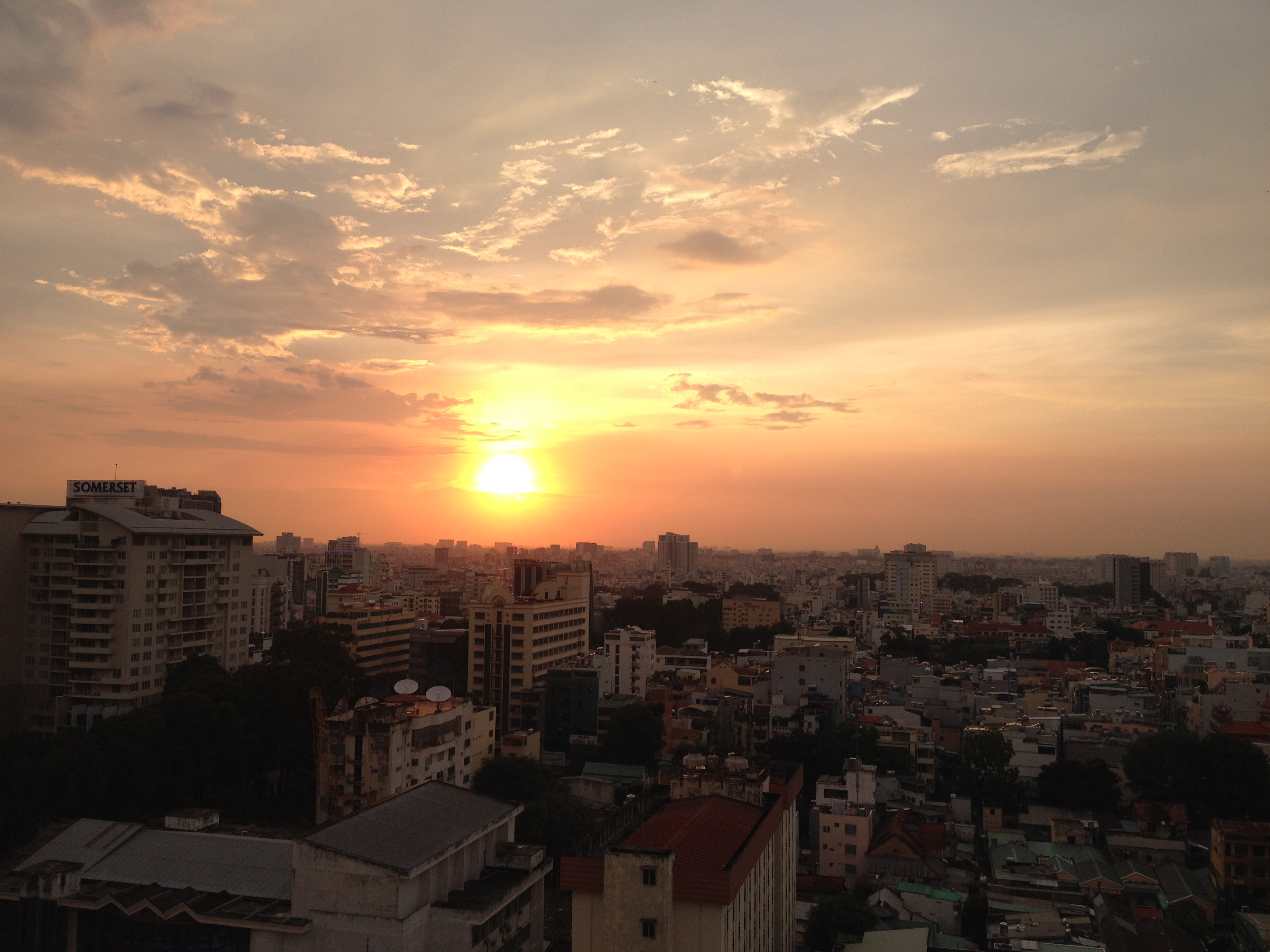
Ho Chi Minh City/Saigon at sunset. ©Donatella Lorch

Ho Chi Minh City/Saigon at sunset. ©Donatella Lorch

This is my first trip to Vietnam. When I was 15, Vietnam was the only place I wanted to visit. It was the summer of 1977 and my father’s work had brought us to Medellin in Colombia. I came face to face with the war in a bedroom closet of our rented house where I had gone to forage and explore on a hot lazy afternoon. In a dark corner was a pile of dusty Life magazines. I sat down next to them, the closet door letting in just enough light to read, and for the next few hours, and for many weeks after that, I leafed through pictures of dust, heat, blood, tanks and helicopters, faces contorted in pain and desperation or just impenetrable. 1966, 1967, 1968. Tet, Hue, Khe Sanh, the Perfume River, Ben Tre, Dien Bien Phu. Dates and names that grabbed and held.

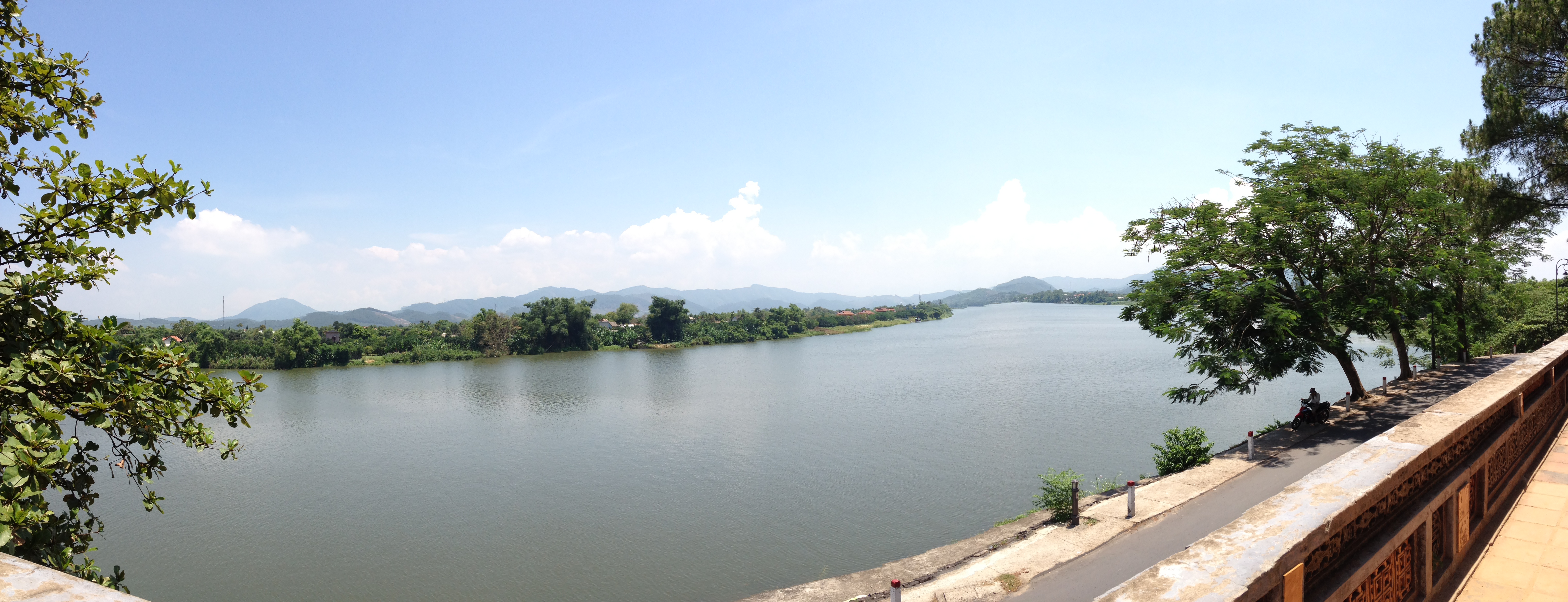
The Perfume River in Hue. Yard by yard it was one of the Marine's most costly battles in Vietnam. ©Donatella Lorch

The Perfume River in Hue. Yard by yard it was one of the Marine’s most costly battles in Vietnam. ©Donatella Lorch

It is not that the Vietnam War was an unknown quantity. As a family, we listened religiously to the news on WQXR. I remember exactly where I was sitting when I watched on TV as American helicopters were pushed off aircraft carriers into the South China Sea. My parents talked about the war at dinner and in our weekend commutes to the Catskills. Wars, or rather the images of war, had in one way or another always been part of my childhood. On long car rides, my mother would weave me her stories of joining the Italian resistance during World War II in Rome and of being arrested and imprisoned by the Germans. On rainy summer days, my cousin Carlo and I pored over his magazines of World War II Pacific battles. My older sister had decapitated all the family dolls but it never occurred to me to ask for new ones. I played with Carlo’s GI Joes.

But that summer in 1977, Vietnam became personal. I didn’t want to be a passive observer. So without knowing what it entailed, or how I was supposed to get to the finish line, I decided that I wanted to be a war correspondent. Hopelessly naïve? Yes. Innocent? For sure. Clueless? Definitely. I spent hours and days learning every detail of those pictures. Back in New York, I made my mother escort me to Columbia Univeristy’s Butler Library so I could use her ID card and take out military books on Vietnam’s battles. At 16, my mother gave me my most memorable Christmas gift: Michael Herr’s Dispatches. I have since read it over a dozen times. It has travelled with me to four continents. The spine is cracked, the pages marked so I can grab a quick high from his explosive, taunting, cutting, visceral and utterly visual prose. If I wanted to get high, I didn’t need drugs. I had Dispatches.

On the outskirts of Kabul, 1989 with the Afghan Mujaheddin. ©Donatella Lorch

On the outskirts of Kabul, 1989 with the Afghan Mujaheddin. ©Donatella Lorch

It took me until May 2014 to make it to Vietnam. By then war was something I had already done. The romance was long gone. I had coped–not always successfully–with all the intangibles that came with it. My sister says I became a journalist because I didn’t know what else to do. My Italian cousin, also a journalist, warned me that what made front page in the morning wrapped the fish at night. Not sure whether I could ever figure out how to be a journalist, I had studied Chinese, worked as a tour guide in mainland China, danced for a Taiwanese rock band, tried (unsuccessfully) to get a PhD in Indic Studies and then in 1987 went to Afghanistan where I spent two years traveling and writing about the Mujaheddin.

Interviewing demobilized Somali militia near Hergeisa, Somaliland © Donatella Lorch

Interviewing demobilized Somali militia near Hergeisa, Somaliland © Donatella Lorch

Twenty five years: big wars, small wars, a genocide, inner city crime, inheriting three children when I married a widower, adding on another one. Having three teenagers at home. Living in Kenya and now in Nepal. Sometimes I felt I’d been put in a blender that overheated and stalled before the final smooth product was ready. I still felt the need to see the Vietnam I had housed in my head for all those years.

I don’t know what I expected Vietnam to give me. On the surface, the war is long gone. Three million Vietnamese (two million civilians) and over 58,000 Americans dead. Today, the majority of Vietnamese are young—born after the war ended, they are too young to know the past intimately. For some of them, it is now just a backdrop.

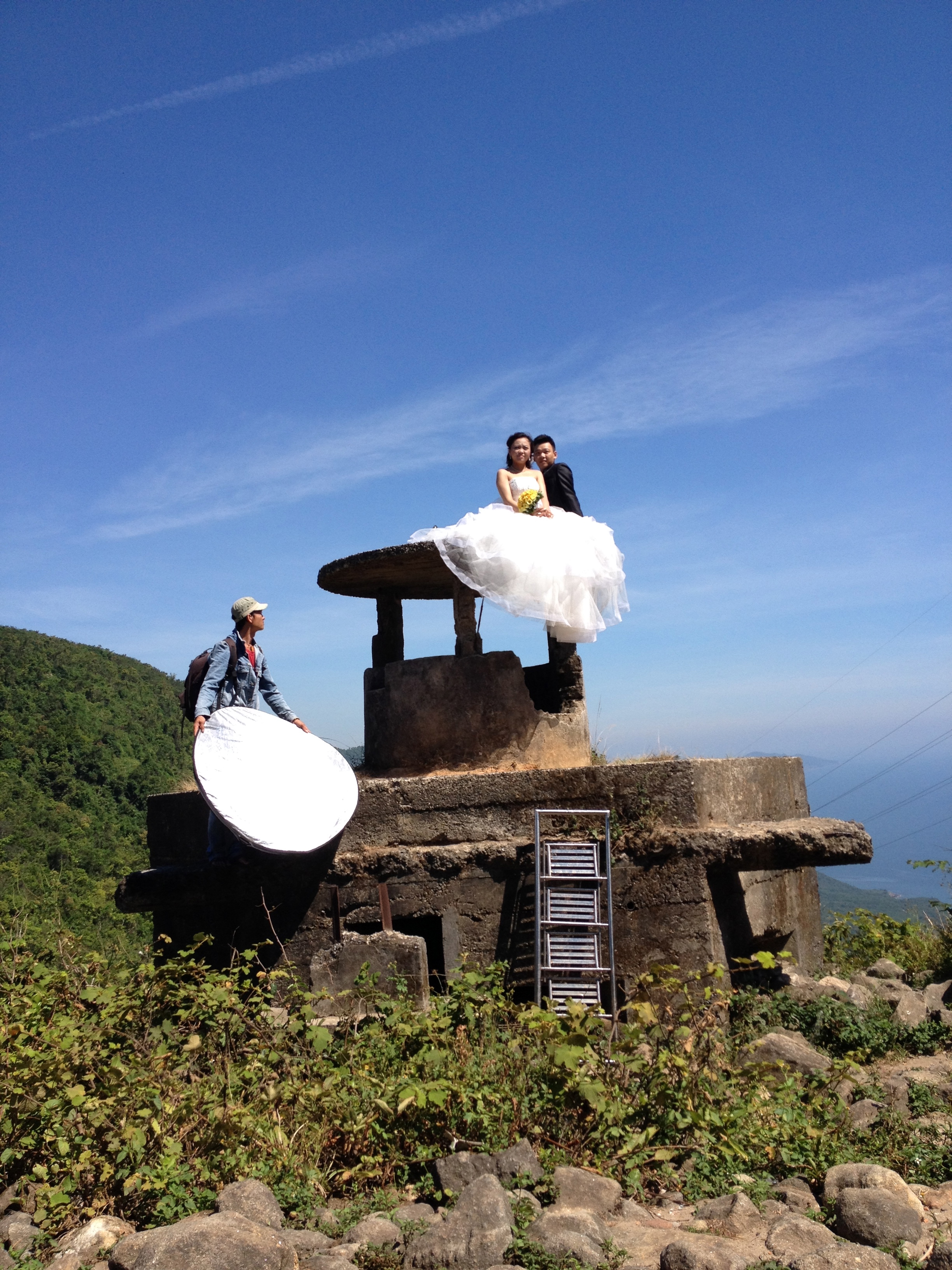
Wedding photo shoot on an old U.S. bunker. Highway 1 heading to Hue ©Donatella Lorch

Wedding photo shoot on an old U.S. bunker. Highway 1 heading to Hue ©Donatella Lorch

On Highway 1 between Danang and Hue, I saw a young Vietnamese couple pose for a wedding photo shoot on a decaying American bunker. The battle fields in Hue are unfindable. The Continental Hotel, in Saigon, is such a posh hotel that I felt an imposter as I walked through the lobby. China Beach is in the process of becoming a shoulder-to- shoulder high-end collection of resorts. Beautiful roads, strict traffic rules, 24-hour electricity, clean sidewalks, tree-lined avenues (puts Nepal to shame)–a communist country where the triumphs of capitalism are visible everywhere. A Lamborghini store is scheduled to open soon in Ho Chi Minh City.

Endless sand on China Beach ©Donatella Lorch

Endless sand on China Beach ©Donatella Lorch

Vietnam is a beautiful land wrapped in delectable food with a coffee shop on every corner. I became a war tourist of sorts. I dripped sweat all day and thought of soldiers humping through the jungle with 50lbs packs, flak jackets and leeches.

Dropping down into a camouflaged Viet Cong tunnel, Cu Chi, Vietnam ©Donatella Lorch

Dropping down into a camouflaged Viet Cong tunnel, Cu Chi, Vietnam ©Donatella Lorch

Alongside my 9-year-old son, I was mesmerized by the Cu Chi tunnel network. I wiped away tears at the War Remnants Museum and insisted on walking and re-walking Le Loi and Tu Do Avenues.

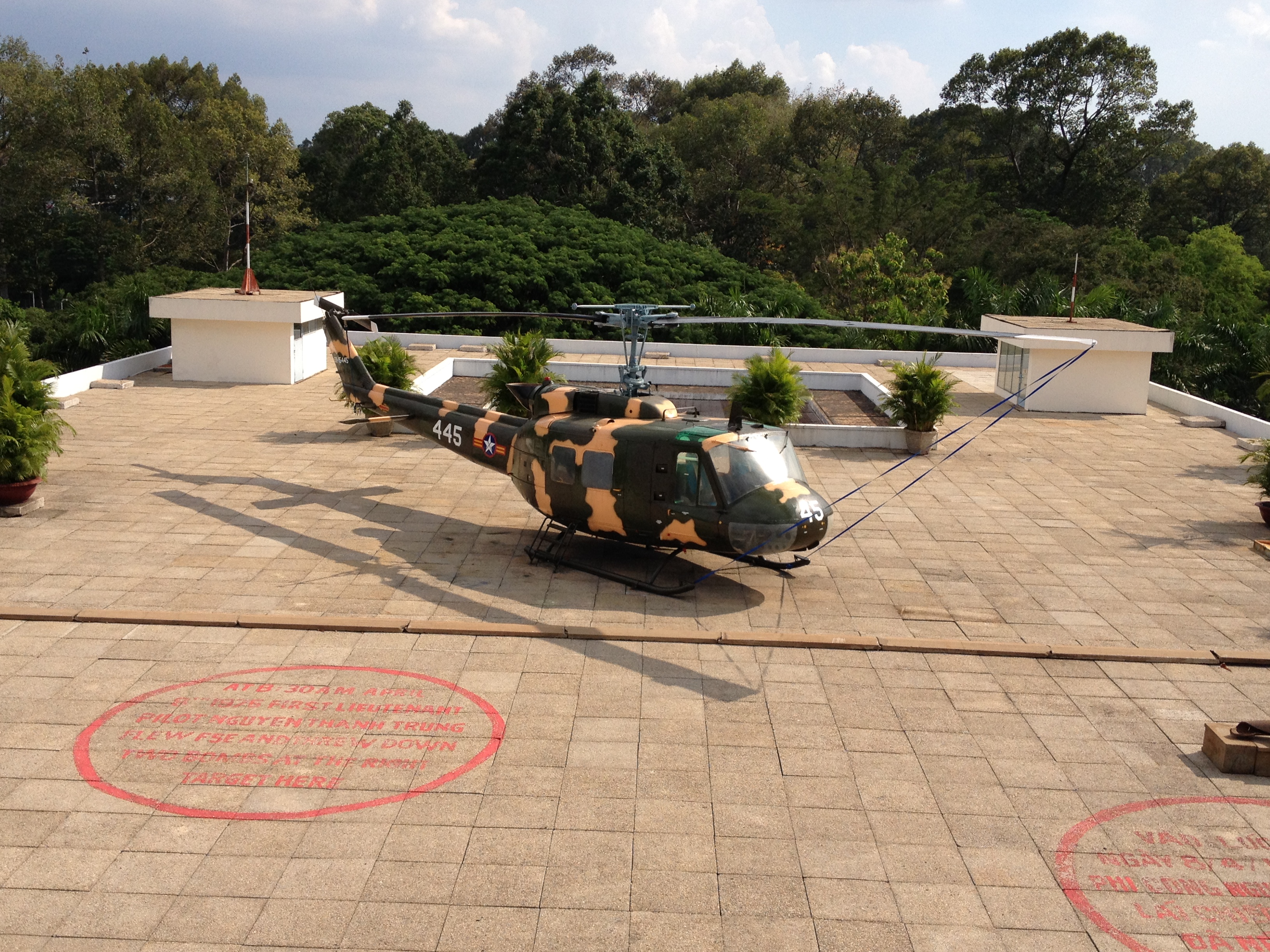
And every Huey and Chinook helicopter I saw (and there are many parked on the grounds of Ho Chi Minh City museums), reminded me of my long standing love-affair with these hulking beasts. I first met them in Dispatches – “Savior- Destroyers” Herr called them.

Love those Hueys.  On the rooftop of "Reunification Palace" -- the former South Vietnamese presidential palace. ©Donatella Lorch

Love those Hueys. On the rooftop of “Reunification Palace” — the former South Vietnamese presidential palace. ©Donatella Lorch

It was an arranged marriage on paper and later I fell for them hard in Somalia, Rwanda, Afghanistan, flying night missions in Black Hawks, scrunched in the gunners seat in Gunships and in Hueys, door open, feet dangling, music blaring, flying Nap of the Earth along Rwanda’s rivers. Grit- whipping terror, sweaty dank canvas, every part of my body on edge.

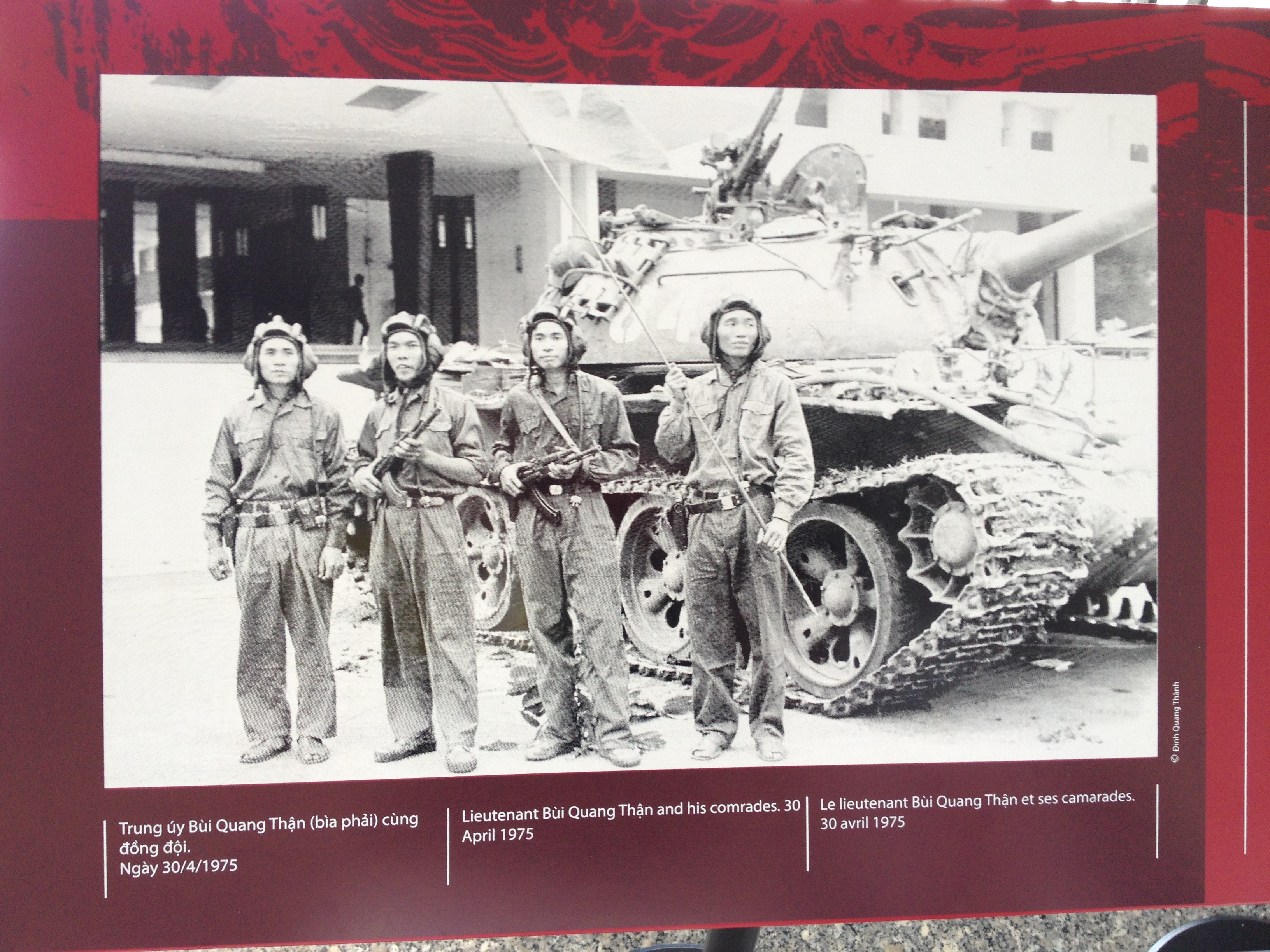
The first North Vietnamese soldiers to storm the presidential Palace, Saigon, April 1975

The first North Vietnamese soldiers to storm the presidential Palace, Saigon, April 1975

Some local history is scrubbed so clean that I only realized later that my Ho Chi Minh City hotel, selected because it was near the local office of my husband’s company, was just one block from the site of the former US Embassy. I was 13 years old in April 1975 when the last American helicopter lifted off into a slate sky in a final desperate evacuation.

Everyone has their own war story, their own angle of vision, and none of my wars have been like Vietnam. Long ago, I’d agonized that I had missed it, that I was born too late. But that doesn’t matter anymore. War is memory and it must never be forgotten.


Worshipped yes — But in Nepal, it’s a tough life to be a dog.

Mitho taking a rest on our run together © Donatella Lorch

Mitho taking a rest on our run together © Donatella Lorch

I met him by chance on one of my morning runs. Three black dogs sleeping in front of a gate, a fixture on my trail for almost a year, had lifted their heads briefly as I greeted them but I didn’t notice the small tan and white newcomer trotting behind me until he almost tripped me. He stopped when I stopped, sitting and cocking his head and looking up quizzically. He had mange on his lower back and he was rather skinny but he wasn’t aggressive or pushy. For the next four miles, as I zigzagged through a small village and terraced golden wheat fields, he tagged along by my right heel, never passing and immediately sitting when I’d stop to check on him. Our conversation was rather one-sided as I outlined for him all the reasons I could not keep him. By the time I got to my front gate, I had named him Mitho (pronounced Mee-toe), Nepali for ‘sweet.’ He gulped down the food and water I gave him but when I checked on him half-hour later he was gone.

Stray dogs in mid-morning, sleeping during the daytime hours. ©Donatella Lorch

Stray dogs in mid-morning, sleeping during the daytime hours. ©Donatella Lorch

In Nepal, there is a special day dedicated to dog worship. On Kukur Puja, many of the city’s dogs are garlanded with marigolds and are fed sweet rice cakes. But this warm feeling does not seem to last long. Mitho is one of hundreds of stray dogs that live on the streets of my neighborhood on the southern edge of the Kathmandu Valley. He is one of more than 30,000 stray dogs that call greater Kathmandu home. They sleep through the day, mounds of brown, black and white fur, oblivious of traffic that is forced to detour around them. They howl and fight at night, dodge traffic and beg for food and water from shopkeepers. Their favorite hangouts are the three-sided one-room roadside butcher shops where I frequently spot three or four dogs politely sitting at a discreet distance hoping for scraps while keeping an uneasy friendship with the tethered goats outside awaiting the knife. You’ll find the dogs scavenging in the garbage-filled plastic bags in the city’s ubiquitous open-air roadside dump sites. In winter, they shiver from the bitter cold and the weaker ones die off; in the summer, they suffer from dehydration in the torrid heat. Unvaccinated and mostly un-neutered, they succumb to parasites and nasty skin infections. They are frequently abused, kicked, hit and even scorched by boiling water. They are maimed and killed by motorcycles, cars and trucks. Fifty percent of their puppies die.

Stray mother and children in the countryside in Southern Kathmandu Valley. ©Donatella Lorch

Stray mother and children in the countryside in Southern Kathmandu Valley. ©Donatella Lorch

I had a healthy fear of stray dogs when I moved here ten months ago. There were two main reasons. Dog-carried rabies is prevalent in Nepal, killing over 200 people a year. Since the mere trace of an infected dog’s saliva on an open cut can give you rabies, a disease which is more than 99% fatal once the symptoms appear, we dutifully received our three anti-rabies shots. Let’s note here that the shots only delay the symptoms and give you a slightly larger window to get more shots. I warned my nine-year-old never to pet a stray dog.

My dog, Biko, gets worshipped on Kukur Puja, and receives a garland, a Tikka and sweet rice cakes. © Donatella Lorch

My dog, Biko, gets worshipped on Kukur Puja, and receives a garland, a Tikka and sweet rice cakes. © Donatella Lorch

But perhaps more immediately relevant for me was my large, 85 lb Rhodesian Ridgeback, Biko, that my four kids insist is my main love. I am not ashamed and can openly admit it: I am a dog lover. Biko was a four-year-old bundle of energy when we arrived in Kathmandu, and he needed daily walks. But how do you walk a pampered house dog through a city littered with strays? The stray dogs in Kathmandu mostly ignore humans, but they are very attentive to any outside dog that comes into their territory, and—though they may be feigning sleep when we walk abreast of them—they often turn into barking, howling, snarling villains when our outside dog passes by. Think dog fights—our house dog against a pack of street-hardened dogs. Think rabies. We quickly learned that there was only one way to proceed: with intimidation. We had to convince the stray dogs in our neighborhood that Biko belonged to our pack, and that our pack was as tough, or tougher, than theirs. In our tentative first efforts, four of us armed with long sticks escorted Biko on his walk, a Nepali version of armed Kenyan rangers protecting individual Rhinos. Most of our neighborhood dogs now grudgingly let us through. Today, I may still carry a stick but I walk Biko alone.

Guarding Biko our first weeks in Kathmandu ©Donatella Lorch

Guarding Biko our first weeks in Kathmandu ©Donatella Lorch

I am no longer scared of the dogs I meet. Mostly it makes me sad to see so much loveless suffering. I may not pet them but I talk to them and bring them scraps from restaurants. I have my favorites like the Tibetan Mastiff mix outside the Roadhouse Café in Patan, or the gaunt timid bitch down the street who has obviously had too many litters and submissively lies down wagging her tail when I pass.

The world of the Nepal stray dog is divided into societal gradations. The biggest group is the community dog. They do not necessarily belong to individuals but are outdoor dogs with a narrow territory and the community feeds them scraps and leftovers. These are the nighttime howlers and many become outcasts when they are maimed in dog fights, hit by vehicles, or acquire mange and other disfiguring skin infections. Some dogs are tightly chained to buildings with barely the ability to lie down. The smallest group is the dog as personal pet. Many Nepalis fear dogs and are incredulous at the affection I show Biko and how I care for him.

Twenty years ago, the government poisoned stray dogs to keep the dog population in check. Death came after hours of convulsions. Small NGOs reliant almost entirely on donations, bring in some dogs for neutering and spaying and then return them to their area. Most often it is the volunteer work of a few for the many.

A dog is recovering after being run over by a motorcycle at Kate Clendon's "Community Dog Welfare, Kopan" ©Donatella Lorch

A dog is recovering after being run over by a motorcycle at Kate Clendon’s “Community Dog Welfare, Kopan” ©Donatella Lorch

Biko’s Nepali vet runs an animal shelter and volunteers to treat injured animals. Kate Clendon, a New Zealander who is a longtime resident of Kathmandu, is now housing 31 dogs at her Community Dog Welfare Kopan. She eases the last days of the ones with blood parasites, finds sponsors for the ones with disabilities. She does community outreach and last year vaccinated 150 dogs. Neighbors now bring her injured dogs. She is looking after newborn puppies abandoned in the middle of the night at her doorstep. Each dog has a name and history that Kate can relate in detail. Leo has two broken legs and is getting a wheelchair from a Swedish sponsor.

Jade has mange that has not responded to medical treatment. ©Donatella Lorch

Jade has mange that has not responded to medical treatment. ©Donatella Lorch

Kare and Dorje, Community Dog Welfare Kopan in Northern Kathmandu. © Donatella Lorch

Karen and Dorje, Community Dog Welfare Kopan in Northern Kathmandu. © Donatella Lorch

Tiger had his back sliced by a Kukri (a curved Nepali knife), Jade has mange, Dorje was beaten and has joint problems. Kate knows what she does is a drop in the ocean. “To have a long term impact it’s more about changing attitude,” Kate insists. “Nepalis need to be more responsible and have more respect for dogs.”

As Mitho ran with me, I made a list of what he needed: rabies test and vaccines, deworming, delousing, a bath and lots of food. That I could do. But he could not live with me. My husband has threatened divorce if another dog enters the house. I toyed with the idea of placing Mitho’s photo on Facebook and convincing friends to foster him or even adopt him.

Hugging Biko at the end of the day. ©Donatella Lorch

Hugging Biko at the end of the day. ©Donatella Lorch

But even I knew that was daydreaming. I went home and I hugged Biko.

No news from Everest? What could be happening in Nepal?


Nepal transport -- I love Nepal because I learn every day. © Donatella Lorch

Nepal transport — I love Nepal because I learn every day. © Donatella Lorch

There is an allure to the mere word “Nepal.” I first came here in 1983, a single 20-something in search of adventure, which I thought I’d find on the trekking trail. I’d met three tall, muscled Australian guys on the flight to Nepal and one of our most memorable moments together was getting mugged our first evening in Kathmandu. The Aussies managed to catch one of our muggers and at 9p.m., on Kathmandu’s desolate main avenue, a traffic policeman commandeered a passing car and stuffed all four of us in it. He then managed to scrunch the mugger onto my lap for the trip to the central police station. Three decades later Nepal lured me back.

If the news is not about Everest, Nepal does not garner frequent attention from the International media. I get the question all the time: “What is it like to live in Kathmandu?” For me, living in KTM, as many call it, is not about Everest. I am not a climber and though I have Sherpa friends, they are what they call “Kathmandu Sherpas” and many do not even speak their ethnic language. I was raised in a French school that had me reciting the altitude of the Mont Blanc, 4,807 meters, and I am not planning to go above it. This is a potential challenge as Nepal offers 1,500 peaks above 5,000meters. My nine-year-old son is obsessed with Kanchenjunga (#3 highest in the world and by far the most unexplored of the high peaks). So Nepal? Well Nepal is quirky, fascinating, ever changing. I often feel that my everyday is an immersion in history, sociology, live-time economics lessons and human struggle. Never in my 15 years living overseas have I been so overwhelmed, mesmerized, inspired, exhausted and at times confused. I love it because I learn every day.

The Rato Machchendranath chariot, almost ready to be pulled through the streets of Patan ©Donatella Lorch

The Rato Machchendranath chariot, almost ready to be pulled through the streets of Patan ©Donatella Lorch

So let’s just leave Everest aside for a while. What happens on an average week in Nepal? You are always guaranteed a religious festival. The Rato Machchendranath (or Red God) will be on for most of May, a mix of Hinduism and Tantric Buddhism with a hand-made wooden chariot topped by a teetering rope turret and pulled daily by scores of volunteers around the streets of Patan.

The Maosits can’t make up their minds to get along while the Marxist Leninists are having trouble setting a date for a party meeting. Then it’s the economy. Nepal is a land of strikes – called Bandhs or closures – successfully executed by the Maoists for years as they hermetically closed down the country.

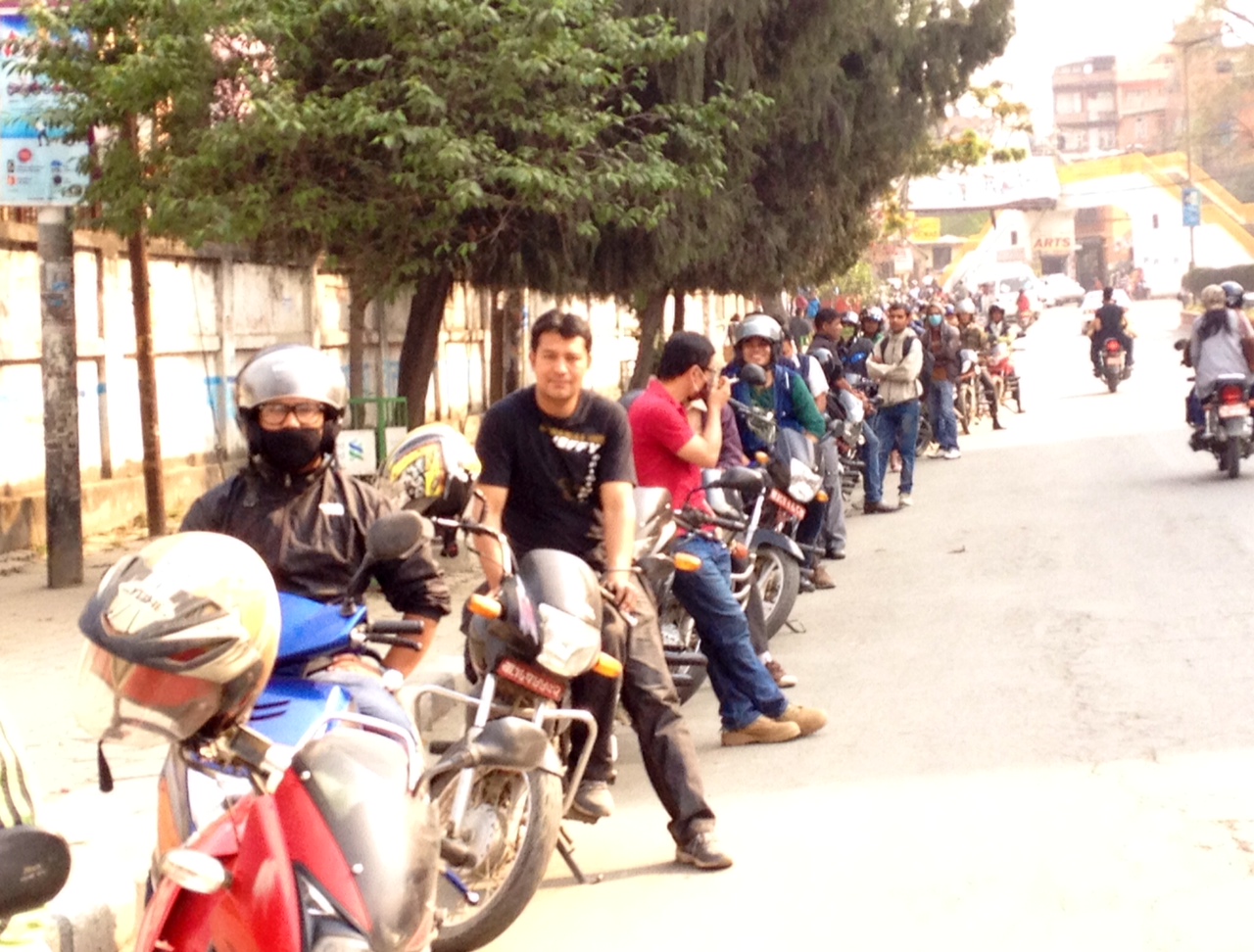
Fuel lines snake around the block - a standard sight in Kathmandu where fuel shortages are commonplace © Donatella Lorch

Fuel lines snake around the block – a standard sight in Kathmandu where fuel shortages are commonplace © Donatella Lorch

This week street vendors want to block all road traffic in three Nepali cities to protest the new government registration requirement. Fast-onto-death hunger strikes are very common as well protesting police and government corruption and most recently two cement workers went on hunger strike demanding contracts directly from the industry. Miraculously we have diesel and petrol this week as the always-broke Nepal Oil Corporation borrowed from the government to pay the Indians the February oil import bill. But even then, some of the tanker drivers run thriving siphoning off businesses and even the owners of the gas stations tamper with their gauges.

Not paying taxes is becoming a dangerous game for some big businesses. In Kathmandu, the battle is between the administration of Kathmandu Metropolitan City (KMC) and the city’s plush five star hotels. Apparently foreign favorites such as the Hyatt, the Shangri-la, the Yak & Yeti and the Radisson have not been paying their property taxes.

From which hotel? ©Donatella Lorch

From which hotel? ©Donatella Lorch

Even worse, they have been ignoring bills from the KMC. Little was known about this on-going battle until the KMC stopped collecting the hotels’ garbage this week. In the stand off, it is unclear where the large amounts of hotel waste is ending up. Everyone’s guess is that it is joining the 60 percent of Kathmandu Valley’s garbage: in open dumping sites such as river banks, road sides and in any empty lot in the city. A great technique for attracting more tourists and more hotel reservations.

Last month, the tax authority closed down a wide range of casinos that had not paid hundreds of thousands of dollars in back-taxes. Not to be outdone, the Nepal Electricity Authority is chasing down defaulting government ministries and threatening to cut their electricity unless they pay back bills. Nepalese are quick to point out that electricity cuts might not be noticed as the valley already has 12 hours of load shedding a day.

Driving home in the recent storm © Lucas Zutt

Driving home in the recent storm © Lucas Zutt

Then there is the rain. Bad weather this week had been predicted to last at least six days. Occasional thunderstorms culminated in a storm that stretched into hours of unrelenting torrential rain, whipped left and right by winds while thunder rolled uninterrupted across the mountains circling Kathmandu. Sheet lightning alternated with grand Hollywood style blue bolts zig zagging across the skies. Newspapers reported that 82 people across the country were killed by lightning including one sherpa survivor of the Everest ice avalanche.

In Kathmandu, where many roads have been paved in the past few months in a city-wide road-widening project, it seems the contractors skimped on side ditches and connections to sewage systems. The city flooded. Driving home in close to zero visibility, I could hear the water lapping against the car while mini-rivers made of garbage and plastic bags overflowing from the drainage ditches that double as open sewers, rushed down into the intersections. Always looking on the bright side, the government declared that the rains were good news as now officials could identify before the monsoon hits the locations of the worst flooding.

© Nepali Times

© Nepali Times

The sad news is that KTM’s Tribhuvan International Airport removed a collection of Ruslan Vodka advertisements that greeted all arrivals and touted interesting facts about Nepal. “There are 48 airports in Nepal,” read one. The Nepali Times that ran a hilarious photo essay in turn commented: “Only 8 of them have bathrooms.”


Everest tragedy means book deals for some and lost livelihoods for others

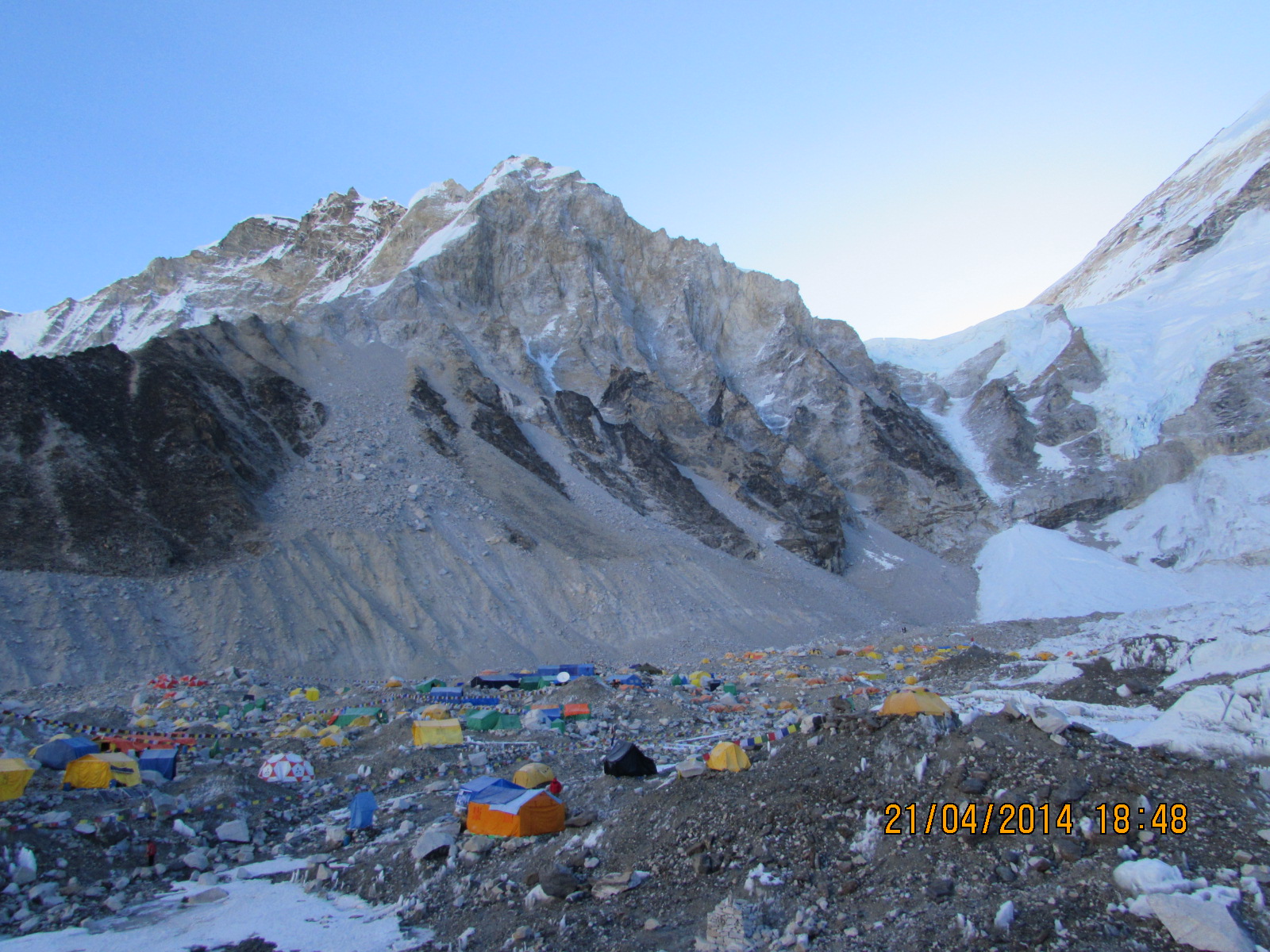
View of Everest Base Camp just before expeditions left for the season © Karma Sherpa

View of Everest Base Camp just before expeditions left for the season © Karma Sherpa

Tragedies have a way of temporarily opening up windows on worlds we never knew, giving us a peek into how people we never thought of live and die. If we are lucky we will remember a face or a story, or the color of the sky or a smell that triggers good or bad. And sometimes it is the most seemingly banal detail that can set an event into perspective.

Everest has been my teacher this year. We all know Everest, The myth. The mountain. If you live in Kathmandu, you are never allowed to forget. It is on many of my son’s t-shirts, it is the “Top of the World” coffee shop where fellow school mothers come for the wi-fi and a catch-up, it is there at “Le Sherpa” restaurant or at the “Sherpa Adventure Gear” store. It follows you in the fish-eye photo prints that line the streets of Thamel and the ubiquitous highly imaginative oil on canvas paintings that have a tiny yak crossing a rope bridge in the shadow of the world’s highest mountain.


The Khumbu Icefall seen from EBC © Karma Sherpa

The Khumbu Icefall seen from EBC © Karma Sherpa

The Sherpas call the mountain Sagarmatha and this year they believe the goddess that lives there is angry. An ice Avalanche on April 18 on Mt. Everest killed 16 Nepalese high altitude climbers, most of them Sherpas, made international news for more than a week and opened a window on the dangerous work conditions, low pay, miserly injury insurance and death benefits of the Nepalese who make it possible for all the foreign climbers to get up the mountains. Within days, as tension mounted at Everest Base Camp (EBC) between sherpas, the climbing season on Everest ended before it really began. Though the disappointment of foreign climbers was widely read on blogs, very little was heard from the vast majority of Sherpas up on the mountain.

My assignment for National Geographic was to find survivors of the avalanche in Kathmandu and tell their story. As a story goes, it was straight forward reporting. I tracked down two survivors in two hospitals. I had no child-care that day so my nine-year-old followed me into the ICU and sat next to Kaji Sherpa, at one point holding his hand and asking his own questions. I did phone interviews later at home with other Sherpas in town and international expeditions owners. I went to the expeditions website and read climber blogs.

Lucas with Kaji Sherpa at  Kathmandu hospital. ©Donatella Lorch

Lucas with Kaji Sherpa at Kathmandu hospital. ©Donatella Lorch

Neither Kaji Sherpa nor Ang Kami Sherpa had a formal education. But this job, as one of the luggers of heavy gear up to Camp 1 and 2, was the only option in their desperately poor villages to finance an education for their children and a better future for the extended family. On Everest, Sherpas work as guides that assist the climbers to summit but the majority set the ropes, lay the ladders across the dangerous crevasses of the Khumbu Icefall, lug up tents, cooking gas, oxygen, food even the toilets for the clients. Then at the end of the season, they bring everything back down including in some cases the client’s excrement. One climbing company advertises that it provides two Sherpas per climber to summit the mountain. When I asked a Sherpa friend why two were needed, he explained that one was there to push and the other to pull and if needed to carry extra oxygen. While foreign climbers who summit write books and go on talking circuits, little is known about the much larger number of Sherpas who go to the top over and over again. There are Sherpas that have summited Everest ten times or more, families where four and five brothers have all been to the top, others where three generations have gone all the way up.

Communication, or rather lack of, with EBC is what made this story frustrating. I was forced to rely on climber blogs and people in Kathmandu relating to me wildly different versions of tensions and arguments. EBC, has excellent internet connection though as yet no 3G so I couldn’t call Sherpas there to hear their perspectives and as of today many are still at EBC closing camp. The elusive and

Sushi preparations at EBC on the Website of Altitude Junkies

Sushi preparations at EBC on the Website of Altitude Junkies

rarified world of climbers came in snippets of life through posted pictures and diary-like entries. On expedition websites, I learned that a foreign climber enjoys carpeted toilets, hot showers, movies, happy hours and for some even sushi appetizers at EBC.

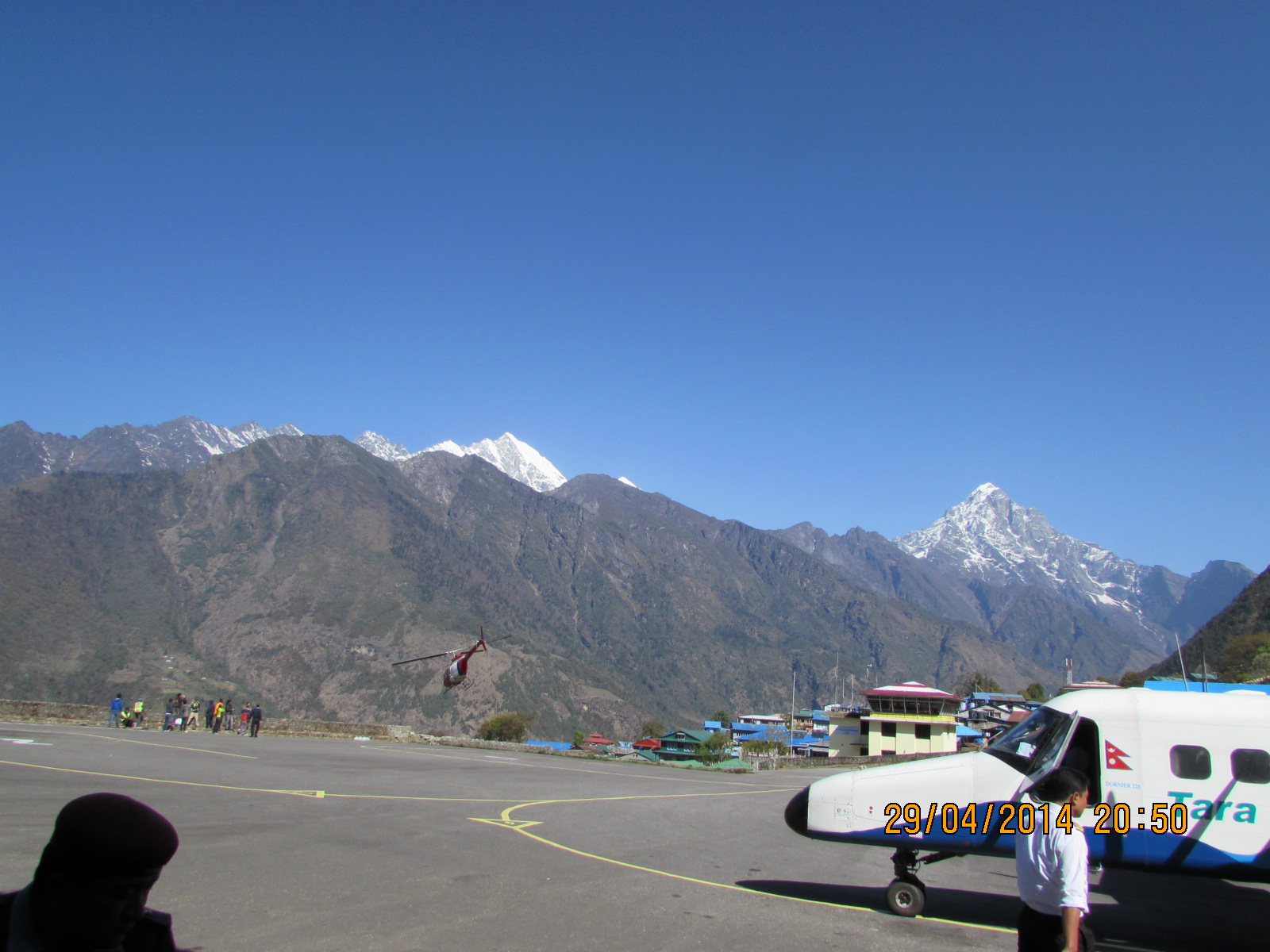
But I didn’t quite understand the logistics of what it means to climb Everest until the camp started to be dismantled. While Sherpas will stay behind to pack camp, scores of climbers and western guides hiked days to Lukla, the closest airport, a single strip of tarmac sandwiched between a precipice and a mountainside and dubbed by some ‘the world’s most

Lukla Airport runway ©Karma Sherpa

Lukla Airport runway ©Karma Sherpa

dangerous airport.’ Then for several days, bad weather stopped the 19-seater flights, duffel bags backed up stacked high against the walls and in any available space. The departure area looked more like Heathrow during Easter weekend than a single room on a village hilltop. Usually there are only a couple of flights a day that land and take-off before the winds pick up mid-morning. Yesterday, four Nepalese airlines scheduled 18 flights to Lukla.

Climbers  crowding the airport at Lukla trying to get on a flight to Kathmandu. © Karma Sherpa

Climbers crowding the airport at Lukla trying to get on a flight to Kathmandu. © Karma Sherpa

Some agencies chartered. Though there were many Sherpas trying to get to Kathmandu as well, foreign climbers were given priority.

While their clients were heading to hotels in Kathmandu, eight international teams were figuring out how to rescue tons of equipment that had been pre-positioned in Camp 1 and Camp 2 above the Khumbu Icefall that was now deemed impassable. Alpine Ascents had in addition to regular gear, the added tonnage for Discovery Channel’s planned “Live” jump off of Everest. As non-emergency evacuation helicopter flights are not allowed above EBC, they had to get a special government permit to charter a B3 helicopter for a total of 20 flights that inserted team Sherpas to pack, repack and move the gear. No doubt an expensive venture for an already hurting industry.

This week at a condolence ceremony in Kathmandu for the 16 dead, their families asked for better death and injury benefits. Kaji Sherpa hopes to be able to make the trip home to his village in Solu Khumbu soon and to see his wife and three children. He never wants to climb Everest again.

Banners welcoming Everest expeditions still line the parking lot walls at the Yak&Yeti Hotel in Kathmandu © Donatella Lorch

Banners welcoming Everest expeditions still line the parking lot walls at the Yak&Yeti Hotel in Kathmandu © Donatella Lorch

Nowadays, the hi-end Yak&Yeti hotel is home to many of the teams. Banners welcoming Everest expeditions still line the brick walls in the parking lot. And the duffel bags from the Lukla airport are heaped in matching pyramids in the elegant lobby. There is talk of book deals from climbers and guides. But sadly none of them are Sherpas.

Arguments at Everest Base Camp as Nepal’s climbing world in turmoil

With only days left in the narrow starting window for the Everest climbing season in Nepal, a small group of Sherpas at Base Camp have been intimidating other Sherpas and trying to force them to leave the camp, expedition leaders, company owners and climbing clients report. It is unclear what this group wants to achieve but their techniques, threatening violence and “repercussions”, are described as mirroring techniques used by Maoist cadres during Nepal’s ten-year civil war.

This added upheaval comes as several more expedition companies, including International Mountain Guides, have announced that, after consulting with their Sherpa teams, they are pulling out for the season, even as discussions with the Nepal government and Sherpas continue regarding demands for higher death and disability benefits as well as insurance.

The climbing world here in Nepal is in turmoil. It has been almost a week since an ice avalanche broke off the mountain, killing 16 sherpa high-altitude climbers on the Khumbu Icefall, the highest number of deaths in a single day on Everest. Buddhist funeral rituals and cremations have taken place in isolated mountain villages and in Kathmandu. Grief is still raw among the tightly knit Sherpa community, the group that takes the greatest risks on the mountain, as it struggles to come to terms with the death of loved ones. The unfolding anger and tension at Base Camp shed light on a critical turning-point for the local climbing industry, which has been for decades the main income earner for extended families across the desperately poor Solu Khumbu region. International climbers will not get refunds as their fees have already gone to the costs of preparing the expeditions, buying food and equipment, and hiring sherpas. The decision on sherpa salaries will be made individually by the companies employing them. But stakeholders are already raising the question of what will happen next year?

At Everest Base Camp, many are asking whether the mountain is even climbable this season. By this time last year, international climbers were already staying at Camp 2 to acclimate. The sherpas known as “icefall doctors”, who set the ropes up the Khumbu Icefall, could in theory reset it on top of the old route that was hit by the ice avalanche. There is enough time to make it work, but they have said that the route remains unstable and dangerous. Setting a different route along the more central one used in the 1990s would require more time and equipment, neither of which they have. The extensive melting of the Khumbu Icefall, due to climate change, has made this central route more fragile and dangerous. The companies that have pulled out are, for the most part, old-time experts on the mountain who provided the core sherpa workforce that in previous seasons worked together to provide ropes, climbs and rescues. The weather is also a wild card.

Everest will be summited this year, but in a big blow to Nepal’s mountaineering image, it may solely be scaled from China. Guy Cotter, CEO of Adventure Consultancies, like many other high-end companies, says he will definitely return to Nepal next year. Everest business funds his company’s other climbs and his staff spend six months a year organizing the season. But he foresees that the fees will increase and the client numbers decrease, and so fewer sherpas will be hired and international clients will be more tempted to cross the border to China.

The image of Nepal, “birthplace of the Buddha and home to the world’s highest mountain”, may be damaged as well. The iconic trek to Everest ‘s peak on the Nepal side is one of the most spectacular in the world. By contrast, the trek on the China side is through an arid austere part of Tibet. But in China, the climb is government-organized and bureaucratically much simpler and faster than in Nepal. If climbers head to China, the sherpas lose critical money-earning potential that has helped communities put their children in schools and start small businesses, a step beyond their traditional potato and barley fields. Though the government of Nepal‘s direct income from Everest tourism is only about $4 million a year, the actual benefit to the Sherpa community is closer to $12 million. The goal of many of these high-altitude Sherpa climbers is to make sure their children can get an education and find other careers away from the slopes of Mt. Everest.

If the threats at base camp escalate, then the Sherpas’ quasi-mythical reputation – a positive stereotype of hard-working, trusted mountaineers that has been used by almost every climbing company and written about extensively in climbers blogs – will have to battle, like the rest of Nepal, with the dark underbelly of a country still grappling with the consequences of a decade of civil war.


What 2071 means to me or how I am learning the art of living in Nepal

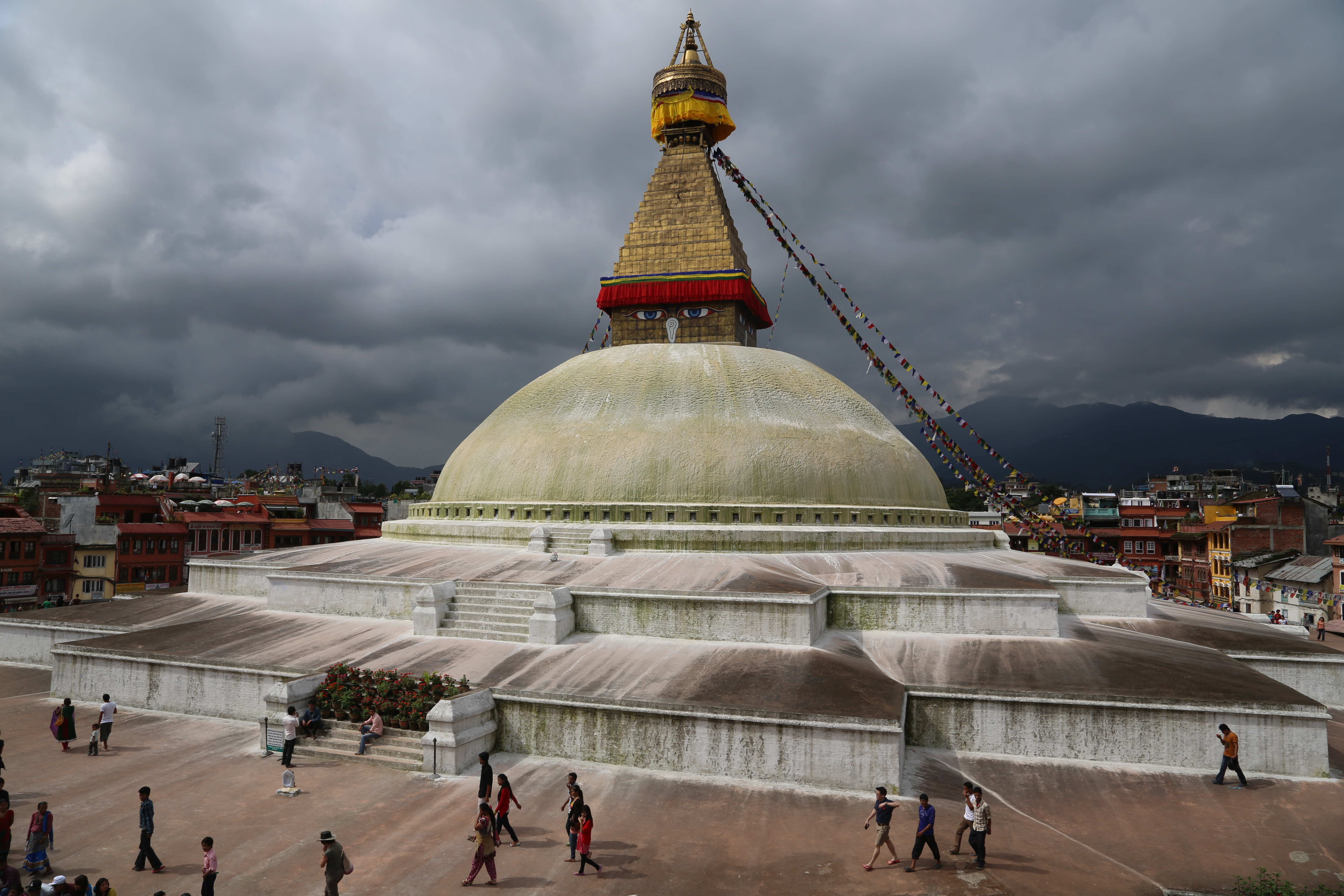
Bodhnath Stupa, a UNESCO World Heritage site is an island of calm in the chaos of Kathmandu. ©Donatella Lorch

Boudhanath Stupa, a UNESCO World Heritage site is an island of calm in the chaos of Kathmandu. ©Donatella Lorch

It’s New Years this week in Nepal. Welcome to the year 2071. It has taken me almost a year to move the Gregorian calendar aside and understand strange names of months that now begin in what my previous life considered mid-month. Luckily my cell phone has helped me cope with the transition: ”Dear customer,” it told me on April 14th, “Applicable monthly charges will be deducted tomorrow on the 1st of Baisakh.”

I’ve had to do a lot of mental gearshifts. I used to think that having a New Year’s Eve celebration was normal but in Nepal there are seven New Years, each with their own celebration. Nepali culture is based on festivals: your god, my god, their god — any occasion is good.

During Laxmi Puja, a festiva; that celebrates Laxmi, the Goddess of Wealth, Nepalese light up they city with butter lamps and worship her in the temples. ©Donatella Lorch

During Laxmi Puja, a festival that celebrates Laxmi, the Goddess of Wealth, Nepalese light up the city with butter lamps and worship her in the temples. ©Donatella Lorch

My dog, Biko, gets worshipped on Kukur Puja, and receives a garland, a Tikka and sweet rice cakes. © Donatella Lorch

My dog, Biko, gets worshipped on Kukur Puja, and receives a garland, a Tikka and sweet rice cakes. © Donatella Lorch

For a monotheist like myself who is only a church goer on three days a year (Christmas, Easter and a spare extra for good measure), who has also lived extensively in Islamic countries and who grew up in Manhattan where Jewish holidays were greeted by my father with a sigh of relief as alternate side of the street parking was suspended, I had never lived before with 330 million Hindu gods as well as Buddhist deities, demons and demonesses shared by both faiths. Early on, I started outlining in my diary Super God family trees as the top three male and female deities have multiple incarnations with their own offspring. There are official God festivals that can last more than a week. There are holy days for cows, dogs, crows and even airplanes.

Festival celebrants parade through Bakhtapur Durbar Square. © Donatella Lorch

Festival celebrants parade through Bakhtapur Durbar Square. © Donatella Lorch

Even if I wanted to, it is impossible to ignore these festivals and to continue life as it used to be in early 2013. Temples and Buddhist stupas are absolutely everywhere from sprawling ancient Hindu compounds to a stubby lingam that has split a paved road in two, a rock and a bell on the side of a road to the scores of huge ancient and holy pipal trees wrapped with string by worshippers. There are grass covered and white washed stupas dating back centuries whose gentle and humble elegance graces the chaotic polluted city of Kathmandu. Valley hillsides are dotted with gold painted rooftops that end in the airborne curling eves of Buddhist monasteries and nunneries.

The main prayer hall at Kopan Monastery, one of Nepal's biggest Buddhist monasteries. © Donatella Lorch

The main prayer hall at Kopan Monastery, one of Nepal’s biggest Buddhist monasteries. © Donatella Lorch

There is an inclusiveness and a temperance to Nepal’s two main religions that is inspiring and beautiful. Tantric Buddhism is often the bridge between the two and whenever I visit a Hindu temple which often has a Buddhist stupa or icon on the premises, I always feel gratitude to have found a place where religions coexist.

Yet all these festivals, colorful, cacophonous, crowded, and often surreal from my western perspective, easily run week into week and can be a serious drag on economic growth in Nepal. There is no sense of urgency here but rather an overwhelming sense of fatalistic Karma. Whatever will be will be. National holiday or not, businesses and shops close without notice, people don’t show up for work, teachers as well as students can easily skip school. Government offices work on skeleton staffs and restaurants can close down for days on the big holidays of Dasain and Tihar. You don’t really notice this as a tourist (the tourism industry functions on a slightly more energized schedule) but living here sometimes becomes a frustrating effort at getting work done. It is also a sad statement about Nepal’s regional future. Labor productivity is a measure of economic growth and Nepal has one of the lowest labor productivity levels in the world. It has 22 percent unemployment. An inefficient, badly equipped education system means only 11 percent of students complete their secondary education creating a vast unskilled labor force where 25 percent of young Nepalese mostly men aged 20 to 39 have migrated to foreign countries as manual laborers. Government economic policies coupled with corruption hamper more than help the economy. The cost of doing business here is 23 percent more expensive than in China and 15 percent more than in India, its two huge and rather overbearing neighbors.

A solitary Shiva shrine sits amid wheat fields on the southern edge of the capital, Kathmandu. © Donatella Lorch

A solitary Shiva shrine sits amid wheat fields on the southern edge of the capital, Kathmandu. © Donatella Lorch


There is a phrase used often here, more of a philosophical statement about life in general that is accompanied by a resigned shoulder shrug. “Khe Garne?” loosely translates as “What can one do?” No answer is expected. I catch myself increasingly using that line. Have I surrendered? I wear a red string wrapped around my wrist blessed by a Buddhist monk. I’ll clank the bell at Shiva temples and when I run past mini Hindu shrines along village paths in Kathmandu’s outskirts, I think about how a touch of the forehead can express such powerful devotion.

A Buddhist monk blesses me at Boudhanath Stupa in  Kathmandu. © Donatella Lorch

A Buddhist monk blesses me at Boudhanath Stupa in Kathmandu. © Donatella Lorch

I do believe that the Middle Way offers a beautiful path but I haven’t yet mastered mindfulness and compassion. And I have the greatest admiration for the owner of “The Secret Bakery”, one of Patan’s best bakeries. He is open through festivals, strikes and national holidays. Now that is a businessman with Chutzpah! Happy 2071.