Tag Archives: Kathmandu

Worshipped yes — But in Nepal, it’s a tough life to be a dog.

Mitho taking a rest on our run together © Donatella Lorch

Mitho taking a rest on our run together © Donatella Lorch

I met him by chance on one of my morning runs. Three black dogs sleeping in front of a gate, a fixture on my trail for almost a year, had lifted their heads briefly as I greeted them but I didn’t notice the small tan and white newcomer trotting behind me until he almost tripped me. He stopped when I stopped, sitting and cocking his head and looking up quizzically. He had mange on his lower back and he was rather skinny but he wasn’t aggressive or pushy. For the next four miles, as I zigzagged through a small village and terraced golden wheat fields, he tagged along by my right heel, never passing and immediately sitting when I’d stop to check on him. Our conversation was rather one-sided as I outlined for him all the reasons I could not keep him. By the time I got to my front gate, I had named him Mitho (pronounced Mee-toe), Nepali for ‘sweet.’ He gulped down the food and water I gave him but when I checked on him half-hour later he was gone.

Stray dogs in mid-morning, sleeping during the daytime hours. ©Donatella Lorch

Stray dogs in mid-morning, sleeping during the daytime hours. ©Donatella Lorch

In Nepal, there is a special day dedicated to dog worship. On Kukur Puja, many of the city’s dogs are garlanded with marigolds and are fed sweet rice cakes. But this warm feeling does not seem to last long. Mitho is one of hundreds of stray dogs that live on the streets of my neighborhood on the southern edge of the Kathmandu Valley. He is one of more than 30,000 stray dogs that call greater Kathmandu home. They sleep through the day, mounds of brown, black and white fur, oblivious of traffic that is forced to detour around them. They howl and fight at night, dodge traffic and beg for food and water from shopkeepers. Their favorite hangouts are the three-sided one-room roadside butcher shops where I frequently spot three or four dogs politely sitting at a discreet distance hoping for scraps while keeping an uneasy friendship with the tethered goats outside awaiting the knife. You’ll find the dogs scavenging in the garbage-filled plastic bags in the city’s ubiquitous open-air roadside dump sites. In winter, they shiver from the bitter cold and the weaker ones die off; in the summer, they suffer from dehydration in the torrid heat. Unvaccinated and mostly un-neutered, they succumb to parasites and nasty skin infections. They are frequently abused, kicked, hit and even scorched by boiling water. They are maimed and killed by motorcycles, cars and trucks. Fifty percent of their puppies die.

Stray mother and children in the countryside in Southern Kathmandu Valley. ©Donatella Lorch

Stray mother and children in the countryside in Southern Kathmandu Valley. ©Donatella Lorch

I had a healthy fear of stray dogs when I moved here ten months ago. There were two main reasons. Dog-carried rabies is prevalent in Nepal, killing over 200 people a year. Since the mere trace of an infected dog’s saliva on an open cut can give you rabies, a disease which is more than 99% fatal once the symptoms appear, we dutifully received our three anti-rabies shots. Let’s note here that the shots only delay the symptoms and give you a slightly larger window to get more shots. I warned my nine-year-old never to pet a stray dog.

My dog, Biko, gets worshipped on Kukur Puja, and receives a garland, a Tikka and sweet rice cakes. © Donatella Lorch

My dog, Biko, gets worshipped on Kukur Puja, and receives a garland, a Tikka and sweet rice cakes. © Donatella Lorch

But perhaps more immediately relevant for me was my large, 85 lb Rhodesian Ridgeback, Biko, that my four kids insist is my main love. I am not ashamed and can openly admit it: I am a dog lover. Biko was a four-year-old bundle of energy when we arrived in Kathmandu, and he needed daily walks. But how do you walk a pampered house dog through a city littered with strays? The stray dogs in Kathmandu mostly ignore humans, but they are very attentive to any outside dog that comes into their territory, and—though they may be feigning sleep when we walk abreast of them—they often turn into barking, howling, snarling villains when our outside dog passes by. Think dog fights—our house dog against a pack of street-hardened dogs. Think rabies. We quickly learned that there was only one way to proceed: with intimidation. We had to convince the stray dogs in our neighborhood that Biko belonged to our pack, and that our pack was as tough, or tougher, than theirs. In our tentative first efforts, four of us armed with long sticks escorted Biko on his walk, a Nepali version of armed Kenyan rangers protecting individual Rhinos. Most of our neighborhood dogs now grudgingly let us through. Today, I may still carry a stick but I walk Biko alone.

Guarding Biko our first weeks in Kathmandu ©Donatella Lorch

Guarding Biko our first weeks in Kathmandu ©Donatella Lorch

I am no longer scared of the dogs I meet. Mostly it makes me sad to see so much loveless suffering. I may not pet them but I talk to them and bring them scraps from restaurants. I have my favorites like the Tibetan Mastiff mix outside the Roadhouse Café in Patan, or the gaunt timid bitch down the street who has obviously had too many litters and submissively lies down wagging her tail when I pass.

The world of the Nepal stray dog is divided into societal gradations. The biggest group is the community dog. They do not necessarily belong to individuals but are outdoor dogs with a narrow territory and the community feeds them scraps and leftovers. These are the nighttime howlers and many become outcasts when they are maimed in dog fights, hit by vehicles, or acquire mange and other disfiguring skin infections. Some dogs are tightly chained to buildings with barely the ability to lie down. The smallest group is the dog as personal pet. Many Nepalis fear dogs and are incredulous at the affection I show Biko and how I care for him.

Twenty years ago, the government poisoned stray dogs to keep the dog population in check. Death came after hours of convulsions. Small NGOs reliant almost entirely on donations, bring in some dogs for neutering and spaying and then return them to their area. Most often it is the volunteer work of a few for the many.

A dog is recovering after being run over by a motorcycle at Kate Clendon's "Community Dog Welfare, Kopan" ©Donatella Lorch

A dog is recovering after being run over by a motorcycle at Kate Clendon’s “Community Dog Welfare, Kopan” ©Donatella Lorch

Biko’s Nepali vet runs an animal shelter and volunteers to treat injured animals. Kate Clendon, a New Zealander who is a longtime resident of Kathmandu, is now housing 31 dogs at her Community Dog Welfare Kopan. She eases the last days of the ones with blood parasites, finds sponsors for the ones with disabilities. She does community outreach and last year vaccinated 150 dogs. Neighbors now bring her injured dogs. She is looking after newborn puppies abandoned in the middle of the night at her doorstep. Each dog has a name and history that Kate can relate in detail. Leo has two broken legs and is getting a wheelchair from a Swedish sponsor.

Jade has mange that has not responded to medical treatment. ©Donatella Lorch

Jade has mange that has not responded to medical treatment. ©Donatella Lorch

Kare and Dorje, Community Dog Welfare Kopan in Northern Kathmandu. © Donatella Lorch

Karen and Dorje, Community Dog Welfare Kopan in Northern Kathmandu. © Donatella Lorch

Tiger had his back sliced by a Kukri (a curved Nepali knife), Jade has mange, Dorje was beaten and has joint problems. Kate knows what she does is a drop in the ocean. “To have a long term impact it’s more about changing attitude,” Kate insists. “Nepalis need to be more responsible and have more respect for dogs.”

As Mitho ran with me, I made a list of what he needed: rabies test and vaccines, deworming, delousing, a bath and lots of food. That I could do. But he could not live with me. My husband has threatened divorce if another dog enters the house. I toyed with the idea of placing Mitho’s photo on Facebook and convincing friends to foster him or even adopt him.

Hugging Biko at the end of the day. ©Donatella Lorch

Hugging Biko at the end of the day. ©Donatella Lorch

But even I knew that was daydreaming. I went home and I hugged Biko.

No news from Everest? What could be happening in Nepal?


Nepal transport -- I love Nepal because I learn every day. © Donatella Lorch

Nepal transport — I love Nepal because I learn every day. © Donatella Lorch

There is an allure to the mere word “Nepal.” I first came here in 1983, a single 20-something in search of adventure, which I thought I’d find on the trekking trail. I’d met three tall, muscled Australian guys on the flight to Nepal and one of our most memorable moments together was getting mugged our first evening in Kathmandu. The Aussies managed to catch one of our muggers and at 9p.m., on Kathmandu’s desolate main avenue, a traffic policeman commandeered a passing car and stuffed all four of us in it. He then managed to scrunch the mugger onto my lap for the trip to the central police station. Three decades later Nepal lured me back.

If the news is not about Everest, Nepal does not garner frequent attention from the International media. I get the question all the time: “What is it like to live in Kathmandu?” For me, living in KTM, as many call it, is not about Everest. I am not a climber and though I have Sherpa friends, they are what they call “Kathmandu Sherpas” and many do not even speak their ethnic language. I was raised in a French school that had me reciting the altitude of the Mont Blanc, 4,807 meters, and I am not planning to go above it. This is a potential challenge as Nepal offers 1,500 peaks above 5,000meters. My nine-year-old son is obsessed with Kanchenjunga (#3 highest in the world and by far the most unexplored of the high peaks). So Nepal? Well Nepal is quirky, fascinating, ever changing. I often feel that my everyday is an immersion in history, sociology, live-time economics lessons and human struggle. Never in my 15 years living overseas have I been so overwhelmed, mesmerized, inspired, exhausted and at times confused. I love it because I learn every day.

The Rato Machchendranath chariot, almost ready to be pulled through the streets of Patan ©Donatella Lorch

The Rato Machchendranath chariot, almost ready to be pulled through the streets of Patan ©Donatella Lorch

So let’s just leave Everest aside for a while. What happens on an average week in Nepal? You are always guaranteed a religious festival. The Rato Machchendranath (or Red God) will be on for most of May, a mix of Hinduism and Tantric Buddhism with a hand-made wooden chariot topped by a teetering rope turret and pulled daily by scores of volunteers around the streets of Patan.

The Maosits can’t make up their minds to get along while the Marxist Leninists are having trouble setting a date for a party meeting. Then it’s the economy. Nepal is a land of strikes – called Bandhs or closures – successfully executed by the Maoists for years as they hermetically closed down the country.

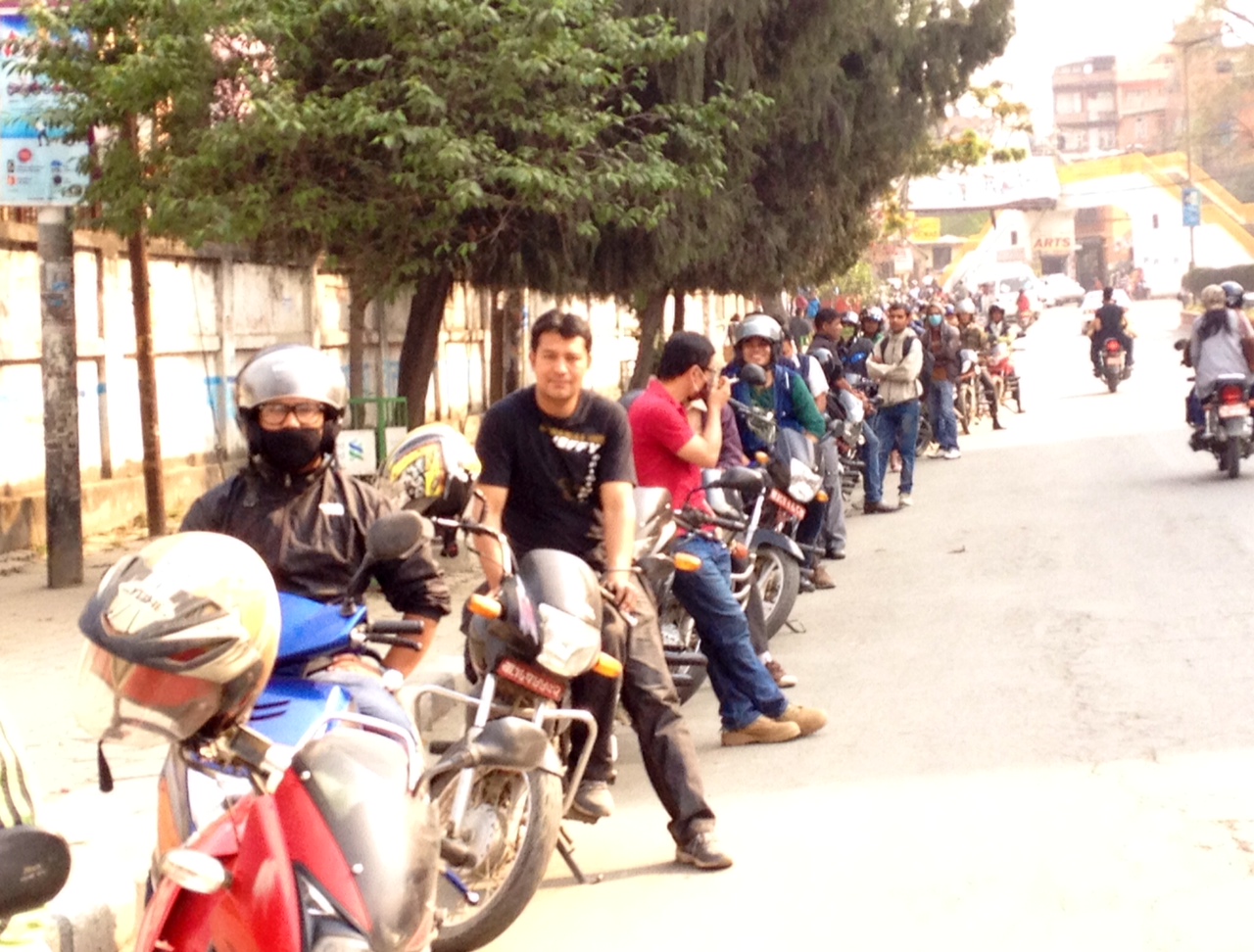
Fuel lines snake around the block - a standard sight in Kathmandu where fuel shortages are commonplace © Donatella Lorch

Fuel lines snake around the block – a standard sight in Kathmandu where fuel shortages are commonplace © Donatella Lorch

This week street vendors want to block all road traffic in three Nepali cities to protest the new government registration requirement. Fast-onto-death hunger strikes are very common as well protesting police and government corruption and most recently two cement workers went on hunger strike demanding contracts directly from the industry. Miraculously we have diesel and petrol this week as the always-broke Nepal Oil Corporation borrowed from the government to pay the Indians the February oil import bill. But even then, some of the tanker drivers run thriving siphoning off businesses and even the owners of the gas stations tamper with their gauges.

Not paying taxes is becoming a dangerous game for some big businesses. In Kathmandu, the battle is between the administration of Kathmandu Metropolitan City (KMC) and the city’s plush five star hotels. Apparently foreign favorites such as the Hyatt, the Shangri-la, the Yak & Yeti and the Radisson have not been paying their property taxes.

From which hotel? ©Donatella Lorch

From which hotel? ©Donatella Lorch

Even worse, they have been ignoring bills from the KMC. Little was known about this on-going battle until the KMC stopped collecting the hotels’ garbage this week. In the stand off, it is unclear where the large amounts of hotel waste is ending up. Everyone’s guess is that it is joining the 60 percent of Kathmandu Valley’s garbage: in open dumping sites such as river banks, road sides and in any empty lot in the city. A great technique for attracting more tourists and more hotel reservations.

Last month, the tax authority closed down a wide range of casinos that had not paid hundreds of thousands of dollars in back-taxes. Not to be outdone, the Nepal Electricity Authority is chasing down defaulting government ministries and threatening to cut their electricity unless they pay back bills. Nepalese are quick to point out that electricity cuts might not be noticed as the valley already has 12 hours of load shedding a day.

Driving home in the recent storm © Lucas Zutt

Driving home in the recent storm © Lucas Zutt

Then there is the rain. Bad weather this week had been predicted to last at least six days. Occasional thunderstorms culminated in a storm that stretched into hours of unrelenting torrential rain, whipped left and right by winds while thunder rolled uninterrupted across the mountains circling Kathmandu. Sheet lightning alternated with grand Hollywood style blue bolts zig zagging across the skies. Newspapers reported that 82 people across the country were killed by lightning including one sherpa survivor of the Everest ice avalanche.

In Kathmandu, where many roads have been paved in the past few months in a city-wide road-widening project, it seems the contractors skimped on side ditches and connections to sewage systems. The city flooded. Driving home in close to zero visibility, I could hear the water lapping against the car while mini-rivers made of garbage and plastic bags overflowing from the drainage ditches that double as open sewers, rushed down into the intersections. Always looking on the bright side, the government declared that the rains were good news as now officials could identify before the monsoon hits the locations of the worst flooding.

© Nepali Times

© Nepali Times

The sad news is that KTM’s Tribhuvan International Airport removed a collection of Ruslan Vodka advertisements that greeted all arrivals and touted interesting facts about Nepal. “There are 48 airports in Nepal,” read one. The Nepali Times that ran a hilarious photo essay in turn commented: “Only 8 of them have bathrooms.”


Everest tragedy means book deals for some and lost livelihoods for others

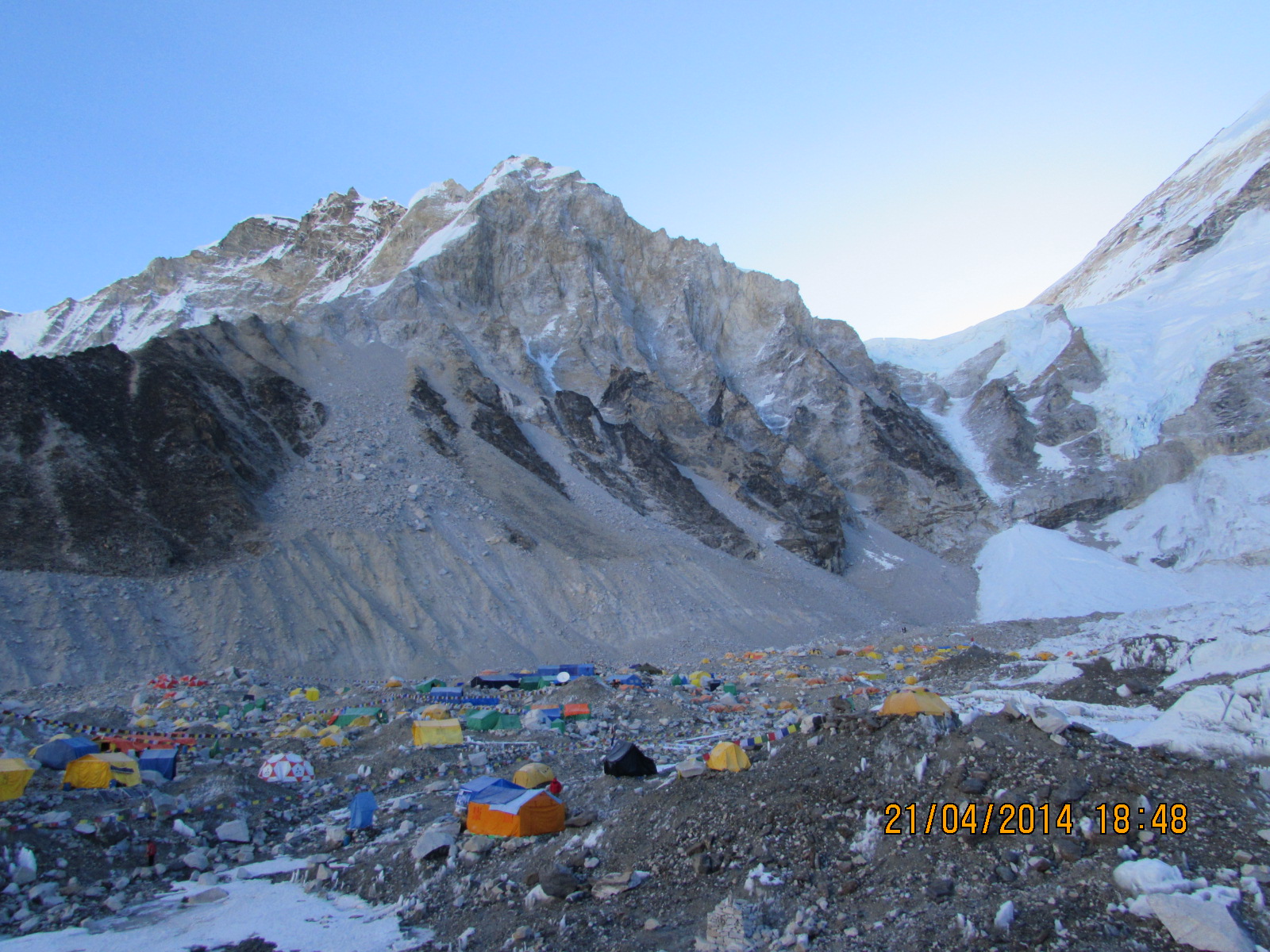
View of Everest Base Camp just before expeditions left for the season © Karma Sherpa

View of Everest Base Camp just before expeditions left for the season © Karma Sherpa

Tragedies have a way of temporarily opening up windows on worlds we never knew, giving us a peek into how people we never thought of live and die. If we are lucky we will remember a face or a story, or the color of the sky or a smell that triggers good or bad. And sometimes it is the most seemingly banal detail that can set an event into perspective.

Everest has been my teacher this year. We all know Everest, The myth. The mountain. If you live in Kathmandu, you are never allowed to forget. It is on many of my son’s t-shirts, it is the “Top of the World” coffee shop where fellow school mothers come for the wi-fi and a catch-up, it is there at “Le Sherpa” restaurant or at the “Sherpa Adventure Gear” store. It follows you in the fish-eye photo prints that line the streets of Thamel and the ubiquitous highly imaginative oil on canvas paintings that have a tiny yak crossing a rope bridge in the shadow of the world’s highest mountain.


The Khumbu Icefall seen from EBC © Karma Sherpa

The Khumbu Icefall seen from EBC © Karma Sherpa

The Sherpas call the mountain Sagarmatha and this year they believe the goddess that lives there is angry. An ice Avalanche on April 18 on Mt. Everest killed 16 Nepalese high altitude climbers, most of them Sherpas, made international news for more than a week and opened a window on the dangerous work conditions, low pay, miserly injury insurance and death benefits of the Nepalese who make it possible for all the foreign climbers to get up the mountains. Within days, as tension mounted at Everest Base Camp (EBC) between sherpas, the climbing season on Everest ended before it really began. Though the disappointment of foreign climbers was widely read on blogs, very little was heard from the vast majority of Sherpas up on the mountain.

My assignment for National Geographic was to find survivors of the avalanche in Kathmandu and tell their story. As a story goes, it was straight forward reporting. I tracked down two survivors in two hospitals. I had no child-care that day so my nine-year-old followed me into the ICU and sat next to Kaji Sherpa, at one point holding his hand and asking his own questions. I did phone interviews later at home with other Sherpas in town and international expeditions owners. I went to the expeditions website and read climber blogs.

Lucas with Kaji Sherpa at  Kathmandu hospital. ©Donatella Lorch

Lucas with Kaji Sherpa at Kathmandu hospital. ©Donatella Lorch

Neither Kaji Sherpa nor Ang Kami Sherpa had a formal education. But this job, as one of the luggers of heavy gear up to Camp 1 and 2, was the only option in their desperately poor villages to finance an education for their children and a better future for the extended family. On Everest, Sherpas work as guides that assist the climbers to summit but the majority set the ropes, lay the ladders across the dangerous crevasses of the Khumbu Icefall, lug up tents, cooking gas, oxygen, food even the toilets for the clients. Then at the end of the season, they bring everything back down including in some cases the client’s excrement. One climbing company advertises that it provides two Sherpas per climber to summit the mountain. When I asked a Sherpa friend why two were needed, he explained that one was there to push and the other to pull and if needed to carry extra oxygen. While foreign climbers who summit write books and go on talking circuits, little is known about the much larger number of Sherpas who go to the top over and over again. There are Sherpas that have summited Everest ten times or more, families where four and five brothers have all been to the top, others where three generations have gone all the way up.

Communication, or rather lack of, with EBC is what made this story frustrating. I was forced to rely on climber blogs and people in Kathmandu relating to me wildly different versions of tensions and arguments. EBC, has excellent internet connection though as yet no 3G so I couldn’t call Sherpas there to hear their perspectives and as of today many are still at EBC closing camp. The elusive and

Sushi preparations at EBC on the Website of Altitude Junkies

Sushi preparations at EBC on the Website of Altitude Junkies

rarified world of climbers came in snippets of life through posted pictures and diary-like entries. On expedition websites, I learned that a foreign climber enjoys carpeted toilets, hot showers, movies, happy hours and for some even sushi appetizers at EBC.

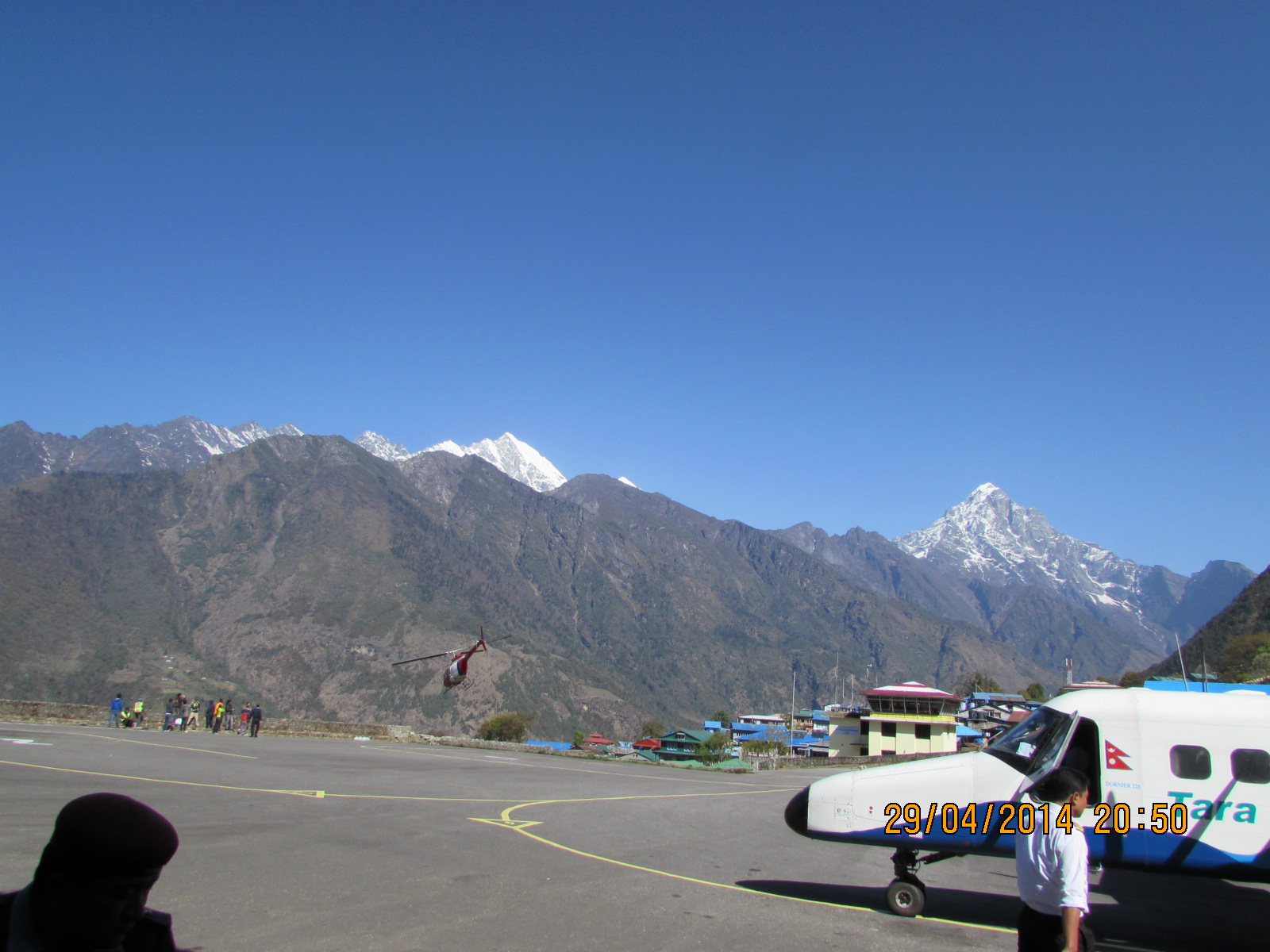
But I didn’t quite understand the logistics of what it means to climb Everest until the camp started to be dismantled. While Sherpas will stay behind to pack camp, scores of climbers and western guides hiked days to Lukla, the closest airport, a single strip of tarmac sandwiched between a precipice and a mountainside and dubbed by some ‘the world’s most

Lukla Airport runway ©Karma Sherpa

Lukla Airport runway ©Karma Sherpa

dangerous airport.’ Then for several days, bad weather stopped the 19-seater flights, duffel bags backed up stacked high against the walls and in any available space. The departure area looked more like Heathrow during Easter weekend than a single room on a village hilltop. Usually there are only a couple of flights a day that land and take-off before the winds pick up mid-morning. Yesterday, four Nepalese airlines scheduled 18 flights to Lukla.

Climbers  crowding the airport at Lukla trying to get on a flight to Kathmandu. © Karma Sherpa

Climbers crowding the airport at Lukla trying to get on a flight to Kathmandu. © Karma Sherpa

Some agencies chartered. Though there were many Sherpas trying to get to Kathmandu as well, foreign climbers were given priority.

While their clients were heading to hotels in Kathmandu, eight international teams were figuring out how to rescue tons of equipment that had been pre-positioned in Camp 1 and Camp 2 above the Khumbu Icefall that was now deemed impassable. Alpine Ascents had in addition to regular gear, the added tonnage for Discovery Channel’s planned “Live” jump off of Everest. As non-emergency evacuation helicopter flights are not allowed above EBC, they had to get a special government permit to charter a B3 helicopter for a total of 20 flights that inserted team Sherpas to pack, repack and move the gear. No doubt an expensive venture for an already hurting industry.

This week at a condolence ceremony in Kathmandu for the 16 dead, their families asked for better death and injury benefits. Kaji Sherpa hopes to be able to make the trip home to his village in Solu Khumbu soon and to see his wife and three children. He never wants to climb Everest again.

Banners welcoming Everest expeditions still line the parking lot walls at the Yak&Yeti Hotel in Kathmandu © Donatella Lorch

Banners welcoming Everest expeditions still line the parking lot walls at the Yak&Yeti Hotel in Kathmandu © Donatella Lorch

Nowadays, the hi-end Yak&Yeti hotel is home to many of the teams. Banners welcoming Everest expeditions still line the brick walls in the parking lot. And the duffel bags from the Lukla airport are heaped in matching pyramids in the elegant lobby. There is talk of book deals from climbers and guides. But sadly none of them are Sherpas.

Arguments at Everest Base Camp as Nepal’s climbing world in turmoil

With only days left in the narrow starting window for the Everest climbing season in Nepal, a small group of Sherpas at Base Camp have been intimidating other Sherpas and trying to force them to leave the camp, expedition leaders, company owners and climbing clients report. It is unclear what this group wants to achieve but their techniques, threatening violence and “repercussions”, are described as mirroring techniques used by Maoist cadres during Nepal’s ten-year civil war.

This added upheaval comes as several more expedition companies, including International Mountain Guides, have announced that, after consulting with their Sherpa teams, they are pulling out for the season, even as discussions with the Nepal government and Sherpas continue regarding demands for higher death and disability benefits as well as insurance.

The climbing world here in Nepal is in turmoil. It has been almost a week since an ice avalanche broke off the mountain, killing 16 sherpa high-altitude climbers on the Khumbu Icefall, the highest number of deaths in a single day on Everest. Buddhist funeral rituals and cremations have taken place in isolated mountain villages and in Kathmandu. Grief is still raw among the tightly knit Sherpa community, the group that takes the greatest risks on the mountain, as it struggles to come to terms with the death of loved ones. The unfolding anger and tension at Base Camp shed light on a critical turning-point for the local climbing industry, which has been for decades the main income earner for extended families across the desperately poor Solu Khumbu region. International climbers will not get refunds as their fees have already gone to the costs of preparing the expeditions, buying food and equipment, and hiring sherpas. The decision on sherpa salaries will be made individually by the companies employing them. But stakeholders are already raising the question of what will happen next year?

At Everest Base Camp, many are asking whether the mountain is even climbable this season. By this time last year, international climbers were already staying at Camp 2 to acclimate. The sherpas known as “icefall doctors”, who set the ropes up the Khumbu Icefall, could in theory reset it on top of the old route that was hit by the ice avalanche. There is enough time to make it work, but they have said that the route remains unstable and dangerous. Setting a different route along the more central one used in the 1990s would require more time and equipment, neither of which they have. The extensive melting of the Khumbu Icefall, due to climate change, has made this central route more fragile and dangerous. The companies that have pulled out are, for the most part, old-time experts on the mountain who provided the core sherpa workforce that in previous seasons worked together to provide ropes, climbs and rescues. The weather is also a wild card.

Everest will be summited this year, but in a big blow to Nepal’s mountaineering image, it may solely be scaled from China. Guy Cotter, CEO of Adventure Consultancies, like many other high-end companies, says he will definitely return to Nepal next year. Everest business funds his company’s other climbs and his staff spend six months a year organizing the season. But he foresees that the fees will increase and the client numbers decrease, and so fewer sherpas will be hired and international clients will be more tempted to cross the border to China.

The image of Nepal, “birthplace of the Buddha and home to the world’s highest mountain”, may be damaged as well. The iconic trek to Everest ‘s peak on the Nepal side is one of the most spectacular in the world. By contrast, the trek on the China side is through an arid austere part of Tibet. But in China, the climb is government-organized and bureaucratically much simpler and faster than in Nepal. If climbers head to China, the sherpas lose critical money-earning potential that has helped communities put their children in schools and start small businesses, a step beyond their traditional potato and barley fields. Though the government of Nepal‘s direct income from Everest tourism is only about $4 million a year, the actual benefit to the Sherpa community is closer to $12 million. The goal of many of these high-altitude Sherpa climbers is to make sure their children can get an education and find other careers away from the slopes of Mt. Everest.

If the threats at base camp escalate, then the Sherpas’ quasi-mythical reputation – a positive stereotype of hard-working, trusted mountaineers that has been used by almost every climbing company and written about extensively in climbers blogs – will have to battle, like the rest of Nepal, with the dark underbelly of a country still grappling with the consequences of a decade of civil war.


What 2071 means to me or how I am learning the art of living in Nepal

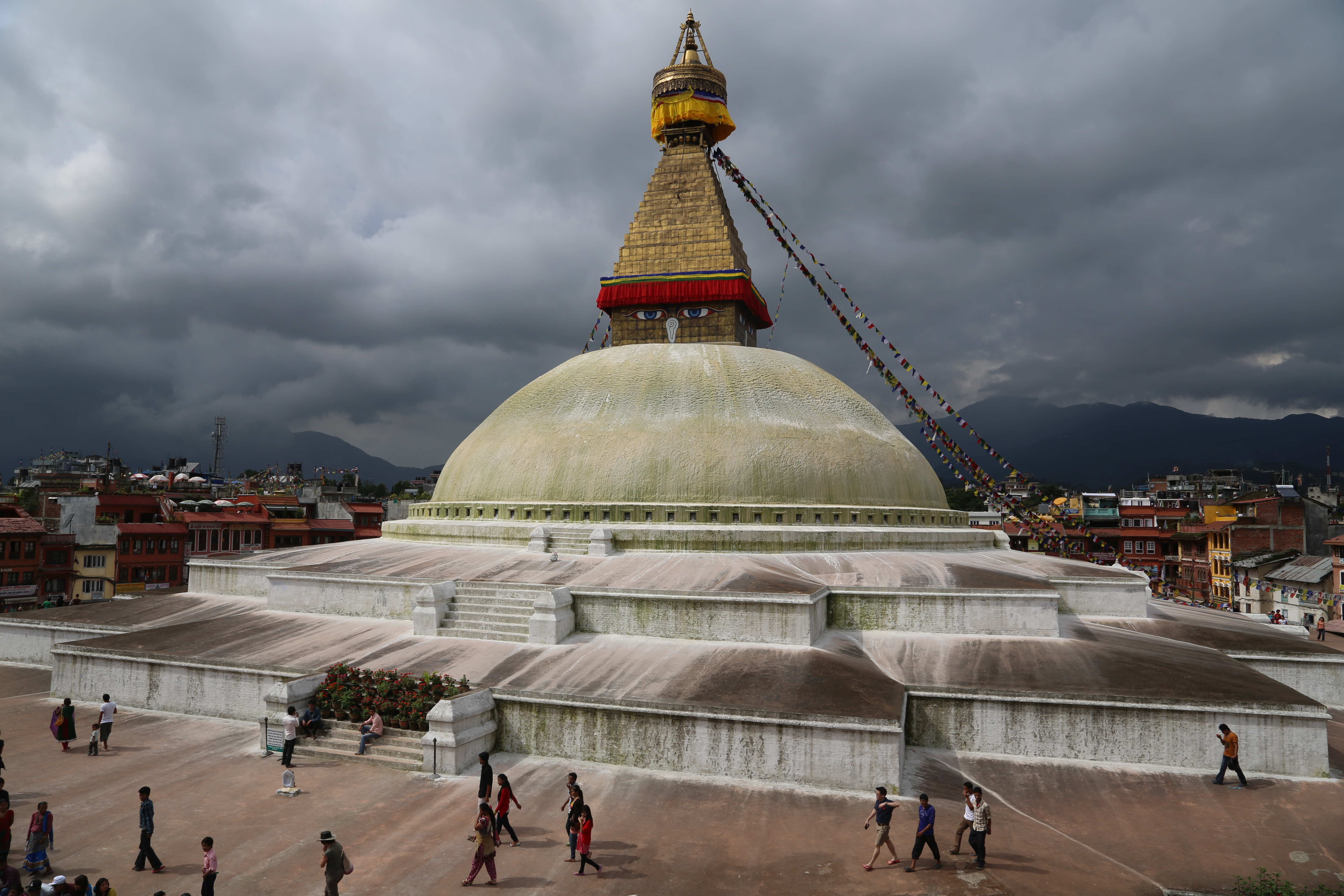
Bodhnath Stupa, a UNESCO World Heritage site is an island of calm in the chaos of Kathmandu. ©Donatella Lorch

Boudhanath Stupa, a UNESCO World Heritage site is an island of calm in the chaos of Kathmandu. ©Donatella Lorch

It’s New Years this week in Nepal. Welcome to the year 2071. It has taken me almost a year to move the Gregorian calendar aside and understand strange names of months that now begin in what my previous life considered mid-month. Luckily my cell phone has helped me cope with the transition: ”Dear customer,” it told me on April 14th, “Applicable monthly charges will be deducted tomorrow on the 1st of Baisakh.”

I’ve had to do a lot of mental gearshifts. I used to think that having a New Year’s Eve celebration was normal but in Nepal there are seven New Years, each with their own celebration. Nepali culture is based on festivals: your god, my god, their god — any occasion is good.

During Laxmi Puja, a festiva; that celebrates Laxmi, the Goddess of Wealth, Nepalese light up they city with butter lamps and worship her in the temples. ©Donatella Lorch

During Laxmi Puja, a festival that celebrates Laxmi, the Goddess of Wealth, Nepalese light up the city with butter lamps and worship her in the temples. ©Donatella Lorch

My dog, Biko, gets worshipped on Kukur Puja, and receives a garland, a Tikka and sweet rice cakes. © Donatella Lorch

My dog, Biko, gets worshipped on Kukur Puja, and receives a garland, a Tikka and sweet rice cakes. © Donatella Lorch

For a monotheist like myself who is only a church goer on three days a year (Christmas, Easter and a spare extra for good measure), who has also lived extensively in Islamic countries and who grew up in Manhattan where Jewish holidays were greeted by my father with a sigh of relief as alternate side of the street parking was suspended, I had never lived before with 330 million Hindu gods as well as Buddhist deities, demons and demonesses shared by both faiths. Early on, I started outlining in my diary Super God family trees as the top three male and female deities have multiple incarnations with their own offspring. There are official God festivals that can last more than a week. There are holy days for cows, dogs, crows and even airplanes.

Festival celebrants parade through Bakhtapur Durbar Square. © Donatella Lorch

Festival celebrants parade through Bakhtapur Durbar Square. © Donatella Lorch

Even if I wanted to, it is impossible to ignore these festivals and to continue life as it used to be in early 2013. Temples and Buddhist stupas are absolutely everywhere from sprawling ancient Hindu compounds to a stubby lingam that has split a paved road in two, a rock and a bell on the side of a road to the scores of huge ancient and holy pipal trees wrapped with string by worshippers. There are grass covered and white washed stupas dating back centuries whose gentle and humble elegance graces the chaotic polluted city of Kathmandu. Valley hillsides are dotted with gold painted rooftops that end in the airborne curling eves of Buddhist monasteries and nunneries.

The main prayer hall at Kopan Monastery, one of Nepal's biggest Buddhist monasteries. © Donatella Lorch

The main prayer hall at Kopan Monastery, one of Nepal’s biggest Buddhist monasteries. © Donatella Lorch

There is an inclusiveness and a temperance to Nepal’s two main religions that is inspiring and beautiful. Tantric Buddhism is often the bridge between the two and whenever I visit a Hindu temple which often has a Buddhist stupa or icon on the premises, I always feel gratitude to have found a place where religions coexist.

Yet all these festivals, colorful, cacophonous, crowded, and often surreal from my western perspective, easily run week into week and can be a serious drag on economic growth in Nepal. There is no sense of urgency here but rather an overwhelming sense of fatalistic Karma. Whatever will be will be. National holiday or not, businesses and shops close without notice, people don’t show up for work, teachers as well as students can easily skip school. Government offices work on skeleton staffs and restaurants can close down for days on the big holidays of Dasain and Tihar. You don’t really notice this as a tourist (the tourism industry functions on a slightly more energized schedule) but living here sometimes becomes a frustrating effort at getting work done. It is also a sad statement about Nepal’s regional future. Labor productivity is a measure of economic growth and Nepal has one of the lowest labor productivity levels in the world. It has 22 percent unemployment. An inefficient, badly equipped education system means only 11 percent of students complete their secondary education creating a vast unskilled labor force where 25 percent of young Nepalese mostly men aged 20 to 39 have migrated to foreign countries as manual laborers. Government economic policies coupled with corruption hamper more than help the economy. The cost of doing business here is 23 percent more expensive than in China and 15 percent more than in India, its two huge and rather overbearing neighbors.

A solitary Shiva shrine sits amid wheat fields on the southern edge of the capital, Kathmandu. © Donatella Lorch

A solitary Shiva shrine sits amid wheat fields on the southern edge of the capital, Kathmandu. © Donatella Lorch


There is a phrase used often here, more of a philosophical statement about life in general that is accompanied by a resigned shoulder shrug. “Khe Garne?” loosely translates as “What can one do?” No answer is expected. I catch myself increasingly using that line. Have I surrendered? I wear a red string wrapped around my wrist blessed by a Buddhist monk. I’ll clank the bell at Shiva temples and when I run past mini Hindu shrines along village paths in Kathmandu’s outskirts, I think about how a touch of the forehead can express such powerful devotion.

A Buddhist monk blesses me at Boudhanath Stupa in  Kathmandu. © Donatella Lorch

A Buddhist monk blesses me at Boudhanath Stupa in Kathmandu. © Donatella Lorch

I do believe that the Middle Way offers a beautiful path but I haven’t yet mastered mindfulness and compassion. And I have the greatest admiration for the owner of “The Secret Bakery”, one of Patan’s best bakeries. He is open through festivals, strikes and national holidays. Now that is a businessman with Chutzpah! Happy 2071.


Will Kathmandu be buried in garbage?


The nepal government is dredging the holy Bagmati River in Kathmandu unearthing decades of plastic bags. © Donatella Lorch

The Nepal government is dredging the holy Bagmati River in Kathmandu unearthing decades of trashed plastic bags. © Donatella Lorch

Although Kathmandu’s world heritage sites are well known, few may be aware of a new archeological dig that stretches for several kilometers along the Bagmati River. Deep trenches have been dug out, creating 20ft-high hills made of dirt held together with striations of blue, pink and black polypropylene that tell the 30-year local history of the plastic bag, Nepal’s most ubiquitous landmark.

A mountain of garbage, mostly plastic bags dredged from the fetid (and holy) Bagmati River. © Donatella Lorch

A mountain of garbage, mostly plastic bags dredged from the fetid (and holy) Bagmati River. © Donatella Lorch

In the Kathmandu Valley, garbage is the gift that keeps on giving. It is everywhere, stuffed in plastic bags and dropped in drainage ditches or piled high in empty lots, on the roadside or on the edges of the city’s rivers. It is thrown out of bus windows, off roof tops into neighbor’s yards.

Garbage is dumped everywhere including in the open sewers running through this upscale neighborhood. © Donatella Lorch

Garbage is dumped everywhere including in the open sewers running through this upscale neighborhood. © Donatella Lorch

As long as their house and yard is swept clean, the vast majority of valley-livers don’t seem to care. When it gets too high, the garbage is burned in open areas, the toxic fumes blanketing nearby houses. The plastic bags clog the rivers and choke drainage pipes, creating flooding and spreading fetid, disease-carrying refuse. The health impacts are felt at all levels.

Young boys scavenge for copper wires in the mountain of refuse dredged from the Bagmati River. © Donatella Lorch

Young boys scavenge for copper wires in the mountain of refuse dredged from the Bagmati River. © Donatella Lorch

Rapid unplanned urbanization has brought traffic jams and choking pollution, but politicians in Nepal’s new government have, with few exceptions, shown little political commitment to solving the problem of garbage. In 2011, the government passed the Solid Waste Management Act that set rules, regulations and fines for transgressors but enforcement is weak and detailed responsibilities are unclear.

Living amid the piles of garbage on the shore of the Bagmati River in Kathmandu. © Donatella Lorch

Living amid the piles of garbage on the shore of the Bagmati River in Kathmandu. © Donatella Lorch

It is a Sisyphean task. The Valley needs clean water but the sole operating waste water treatment plant is handicapped by more than 12 hours of load-shedding a day and needs to be overhauled. Sewage flows untreated into the rivers. There are no proper slaughter houses in any municipalities and no rules for disposing of the city’s dead cows and dogs. They end up in shallow graves near river banks, leaching into the water supply. Hospitals are responsible for disposing their own hazardous waste such as needles, tissues, organs and other body parts, but the government has not provided a dumping site. Some hospitals burn in the open, and others use incinerators that releases dioxin and furan, two highly carcinogenic pollutants. An exception is the government-run Bir Hospital that has even built a bio-gas plant on its premises.


Open dumping is ubiquitous. Nepalis dump their garbage on roadsides, along river banks and when the pile grows they light the plastic bags covering neighborhood is carcinogenic dioxin. ©Donatella Lorch

Open dumping is ubiquitous. Nepalis dump their garbage on roadsides, along river banks and when the pile grows they burn the plastic bags cloaking neighborhoods in carcinogenic dioxin. ©Donatella Lorch

Sumitra Amatiya, executive director of the Ministry of Urban Development’s solid waste management technical support center, says sanitation in the Valley is in a state of crisis management. Serving Kathmandu and Lalitpur, the valley’s only working landfill, Sisdole, 24 km from the capital, is almost full and during the monsoons is frequently cut off from the city by floods and landslides. The government has bought the land for another site but needs billions of rupees and at least four years to make it operational, according to Dr. Amatya. As a gap measure, they are expanding Sisdole. The Asian Development Bank, which last year published the most researched and detailed Solid Waste Management report on Nepal to date, will begin work later this year on Kathmandu’s waste-water treatment plant. The government has begun dredging the highly-polluted Bagmati, with the aim of laying down sewage pipes as well as planting green areas. It is unearthing tons of dumped plastic and earth but narrowing the river-bed, which experts says can cause severe flooding during the monsoons, spreading disease through its water.

Decades of plastic bags dumped everywhere in Kathmandu block drainage pipes, create flooding and spread disease. © Donatella Lorch

Decades of plastic bags dumped everywhere in Kathmandu block drainage pipes, create flooding and spread disease. © Donatella Lorch

While many Nepalese care, city life has eroded the social dynamic of communities that galvanize neighbors to act together. Many try to make a difference. But they are not enough. One ongoing high-visibility clean-up campaign, lead by Leela Mani Poudyal, the chief secretary of the government of Nepal, has been bringing hundreds of people together to clean the fetid Bagmati every Saturday morning for the past 45 weeks, but a one time cleaning, though highly commendable, is not a permanent solution and it will not make the river waste-free. In addition, small non-governmental organizations, many of them focusing on women, teach composting and garbage segregation.

Politicians are quick to point to a new landfill as the solution. But only 40 to 50 percent of the Valley’s garbage goes to Sisdole, and most of it enters the dump unsegregated. The rest ends up on the streets and rivers. Changing the Nepali mindset is the only way forward, Dr. Amatya believes. Composting is key as 60 percent of Kathmandu garbage is organic. There is the need for a government-supported country-wide public awareness and education campaign about the 3Rs – Recycle, Reuse, Reduce in schools, in the media, door to door. Nepalese need to understand the environmental damage of one-time-use plastic bags. As Bhushan Tuladhar, regional technical advisor (South Asia) of U.N. Habitat , put it: “We have to dump the attitude.” Only a social movement can keep Kathmandu from being buried in garbage.

A rugby match and the cost of development

Smoke haze from burning forests making way for palm oil plantations has covered Malaysia and Indonesia recently.  In Kuala Lumpur, schools have been closed. © Donatella Lorch

Smoke haze from burning forests making way for palm oil plantations has covered Malaysia and Indonesia recently. In Kuala Lumpur, schools have been closed. © Donatella Lorch

We landed in Kuala Lumpur at nighttime yet before the Malaysian Airlines Boeing 737’s tires hit the runway, the fog was so thick I couldn’t even see a light outside the plane window. Almost immediately, the cabin was coated in an eye-smarting burnt smell. I am a nervous flyer, and on this evening my anxiety was enhanced by the fact that MH370 had disappeared just four days before and that our pilot had not mentioned the weird weather to the passengers.

My son Lucas and his school rugby team, the Yetis, were representing Nepal in a tournament in Kuala Lumpur. © Donatella Lorch

My son Lucas and his school rugby team, the Yetis, were representing Nepal in a tournament in Kuala Lumpur. © Donatella Lorch

My husband and I were tagging along on my nine-year-old son’s school rugby trip. This was a huge event for Lucas and his seven schoolmates as their primary school team in Kathmandu, the Yetis, was (to the best of our knowledge) the first Nepali rugby team to play outside the country. The boys’ excitement was palpable. My third-culture son, who has lived overseas for almost six years, had been reminding me for weeks that he was going to Malaysia to “represent my country!”  When I had wondered which of his three nationalities, American, Canadian and Dutch, he was referring to, he had dismissed my obvious ignorance. “Nepal, of course!”

What we didn’t immediately realize is that the fog with the burnt smell was not only coating the airport but blanketing almost all of Malaysia and parts of Indonesia as well.

The smoke haze even reached beyond Malaysia's shores onto its islands, such as Pulao Pangkor where it filtered the setting sun. © Donatella Lorch

The smoke haze even reached beyond Malaysia’s shores onto its islands, such as Pulao Pangkor where it filtered the setting sun. © Donatella Lorch

Many airports in the region had already closed and by the next day, the Malaysian government declared the air quality dangerous, closed over 200 schools in the capital and advised against any outdoor sports. The first day of the rugby tournament was cancelled, much to the boys’ disappointment. The stinging smoke that was affecting their dream school trip was in fact the end product of the needs of billions of people who live far from Southeast Asia.

Palm oil plantations like this one line Malaysia's super highways for hundreds of miles. © Donatella Lorch

Palm oil plantations like this one line Malaysia’s super highways for hundreds of miles. © Donatella Lorch

Ever wonder about that “vegetable oil” listed as an ingredient in a huge amount of food we all eat?  That vegetable oil is often palm oil, and it is an essential ingredient in margarines, frying oils, cereals, baked goods, sweets and potato chips. It is also in soaps, washing powder, cosmetics and animal feeds, and it can also be used as bio fuel.  Since the 1990s, the demand for palm oil has increased by more than 45 percent. Though 17 countries produce it, Malaysia and Indonesia account for 85 percent of global palm oil production. Millions of Malaysians and Indonesians rely on palm oil for their livelihood.

The choking smoke and palm oil are inextricably connected.  Just drive for hours on Malaysia’s magnificent super highways (yes, they have Starbucks stops) and the countryside is almost entirely blanketed by thousands of acres of palm oil plantations.  But growing world demand, especially from China, means both legal and illegal unfettered cutting down and burning of pristine forests in Malaysian Borneo and Indonesia.  The governments, either because of lack of will or corruption, do little to control what has become an environmental disaster. This year, lack of rain means the burning season is particularly vicious on the lungs. The forest peat burns underground for weeks and the heavy smoke just sits over three of Asia’s most important cities: Singapore, Djakarta and Kuala Lumpur.

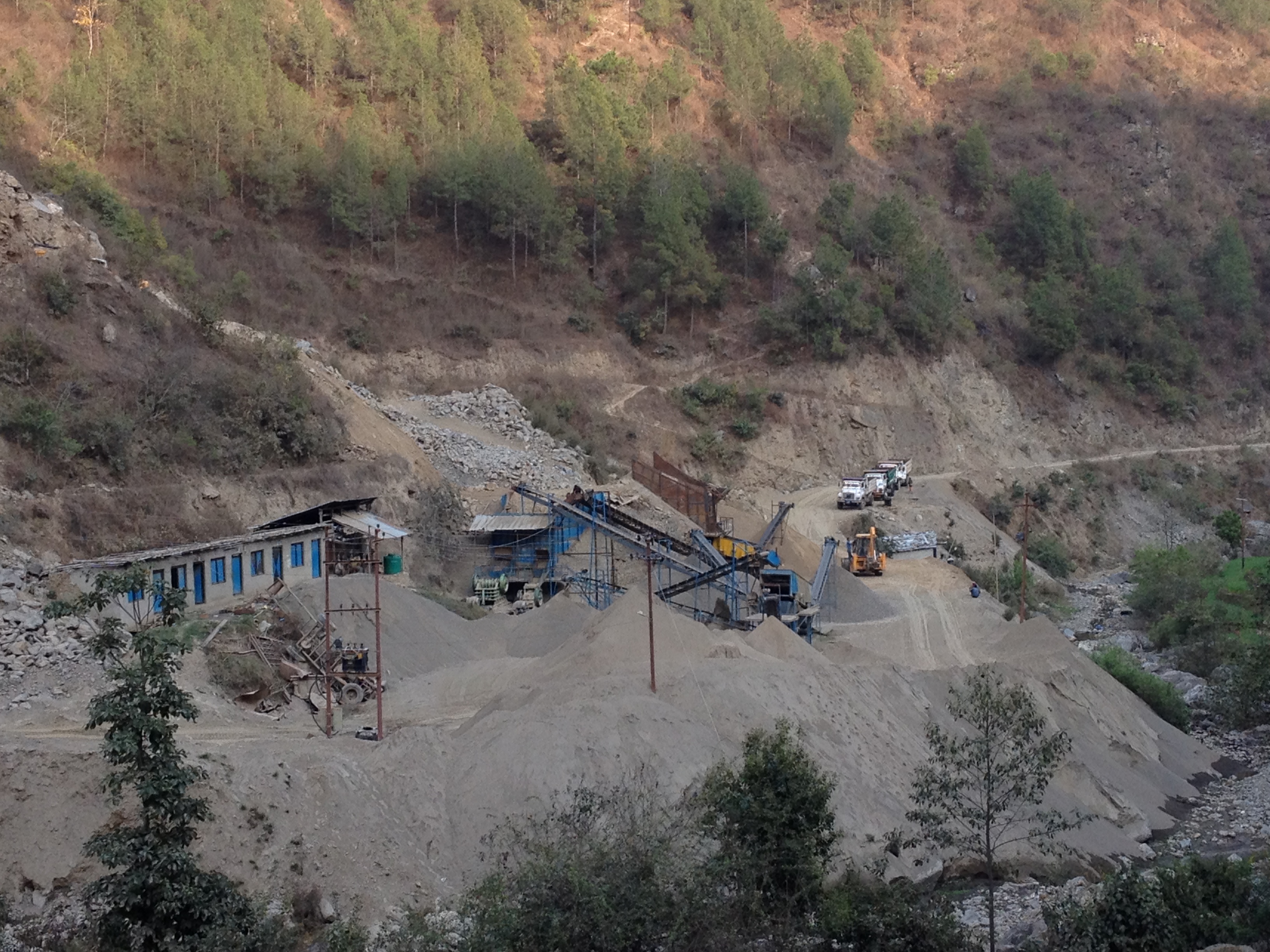
The cost of unfettered development is very visible in Nepal. Both licensed and illegal quarries strip the rivers of stone for building roads and houses but cause landslides, floods destroying homes and bridges. © Donatella Lorch

The cost of unfettered development is very visible in Nepal. Both licensed and illegal quarries strip the rivers of stone for building roads and houses but cause landslides, floods destroying homes and bridges. © Donatella Lorch

Lucas gets basic global warming. He knows it makes winters colder and summers hotter and that New York and Toronto, where our extended family lives, have had wicked snowstorms this winter. His school is plastic free and on eco days, he walks to class. Our lives in Nepal are an unexpected first row seat where we can witness the cost of development.  Lucas knows well the fetid smell of raw sewage from Nepal’s holiest and dead Bagmati River.

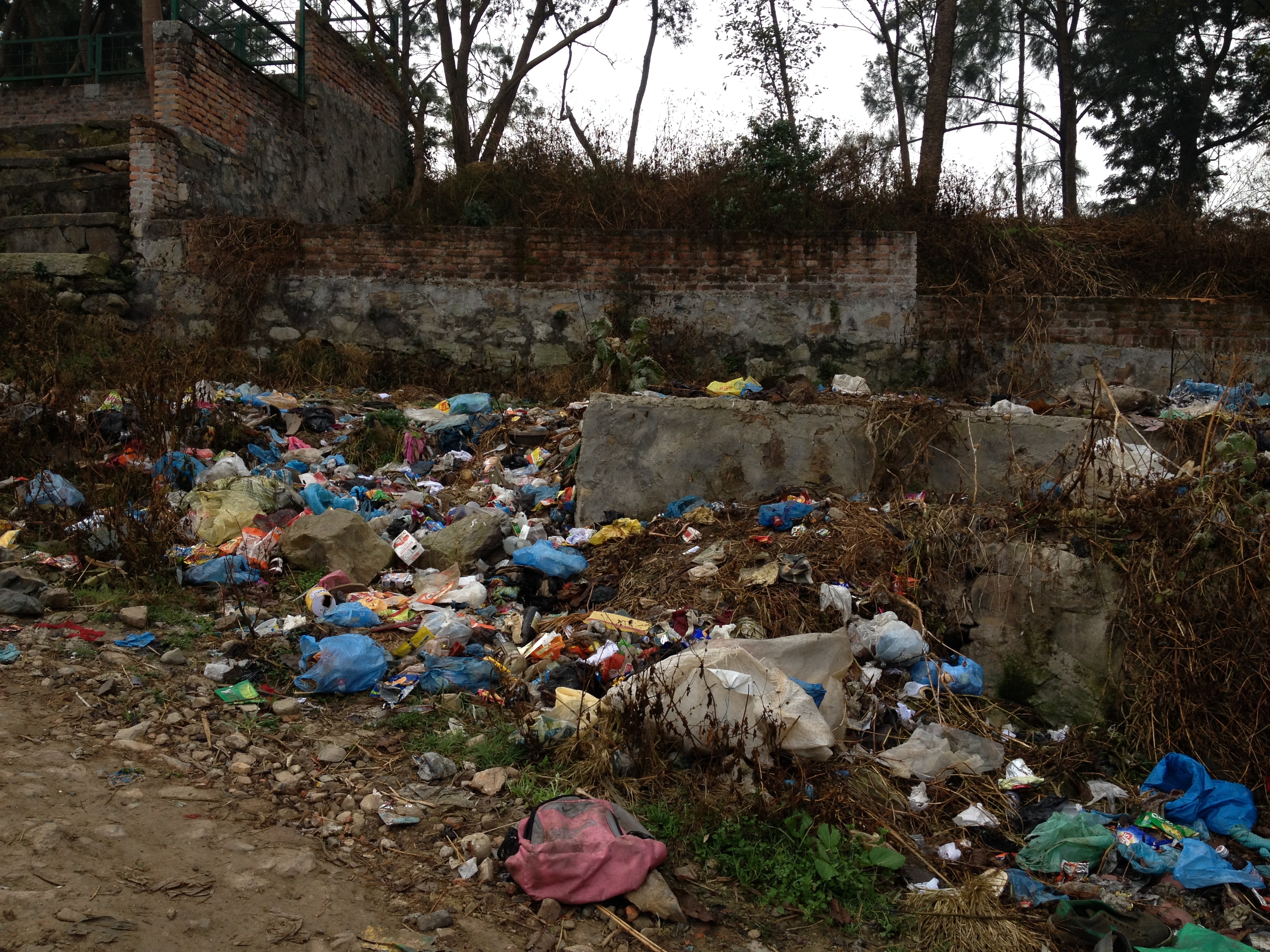
In Nepal, garbage is the gift that keeps on giving. Trashed plastic bags are everywhere. © Donatella Lorch

In Nepal, garbage is the gift that keeps on giving. Trashed plastic bags are everywhere. © Donatella Lorch

Unregulated dumping of garbage on city streets makes Kathmandu a filthy plastic-bag littered city. An open sewer runs near our house. Massive and frequently illegal stone quarrying in Nepal’s gorgeous rivers and streams supplies the unquenchable thirst for roads and building construction but result in massive erosion, flooding and landslides, destroying bridges and roads and buildings.

Kathmandu Valley smog is not only from the many cars but also from the brick factories sprouting up everywhere as demand for construction materials increases. © Donatella Lorch

Kathmandu Valley smog is not only from the many cars but also from the brick factories sprouting up everywhere as demand for construction materials increases. © Donatella Lorch


Still it hadn’t occurred to Lucas that eating his favorite sour cream and onion Pringles or Honey Nut Cheerios or washing his hands with soap could be connected to the smoke that cancelled his rugby match. I was struck by the irony that Kuala Lumpur, a modern, vibrant, clean, green gem that stands apart from the region’s capitals, was being asphyxiated by the very development and industrialization that had provided the money to make it so special.

Malaysia has built itself up as a favorite tourism destination. Its ubiquitous slogan, “Truly Asia,” could be misconstrued on smoky days. Luckily for the Yeti team, it rained and then it poured, and the smog cleared. They won one match, tied another and lost two.  The memories will last a lifetime.
Raising a family and living a marriage on FaceTime.

Lucas just turned 9 and he and I regularly butt heads over when he should practice violin and piano. Our discussions have at times devolved into my declaring that I was shipping his violin back to the original owner, his older cousin in New York. I am keenly aware that I am not a shining example of motherhood and that this is definitely not the way to make him love practice.  In fact we both know that my threat is not deliverable. We live in Nepal and the convoluted, obtuse Nepalese bureaucracy would require so many permits that the violin is basically unshippable.

Lucas, in Nepal, practices violin on FaceTime, with his father in Dhaka, Bangladesh. © Donatella Lorch

Lucas, in Nepal, practices violin on FaceTime, with his father in Dhaka, Bangladesh. © Donatella Lorch

Living in Nepal required acquiring new skills. I had to learn to make my own yogurt and pasteurize my milk (after I tracked down a local cow).  I learned the art of hoarding cooking gas and diesel and I learned to drive on death defying, precipice rimmed roads. Creating a successful violin practice seemed just another skill to develop. First step was to eliminate myself from the mix and bring in his father. John has boundless patience with our four kids that he mixes with a wicked sense of humor. He has a musical ear even though he has never played a musical instrument, but after helping in two years of practices, he understands bowings and tempo.  He manages to have Lucas not only practice for 45 minutes but enjoy it.

There remained a huge hurdle. John spends most of every month living and working in Bangladesh (not part of our original plan when we moved here). He is gone all week long and often on all or part of the weekends. There are only four direct flights a week between the two countries which limits commuting.  Nepal may have 12 hours a day of electricity loadshedding but the spirit of entrepreneurship still thrives. In Kathmandu, WiFi is ubiquitous and free in the myriad cafes and restaurants.  It was critical to our adopting FaceTime as a new family member.

John and Lucas chat on FaceTime every evening at dinnertime. © Donatella Lorch

John and Lucas chat on FaceTime every evening at dinnertime. © Donatella Lorch

Now on practice days, I am the acrobat. Lucas plays as I hold my iPhone outstretched with one hand so John can see bowings and follow the music from Dhaka. With the other hand, I am DJ-ing with my Ipad on YouTube starting and stopping “Alison’s Violin Studio,” a brilliant teacher for the Suzuki book series, so John can advise Lucas on his performance.


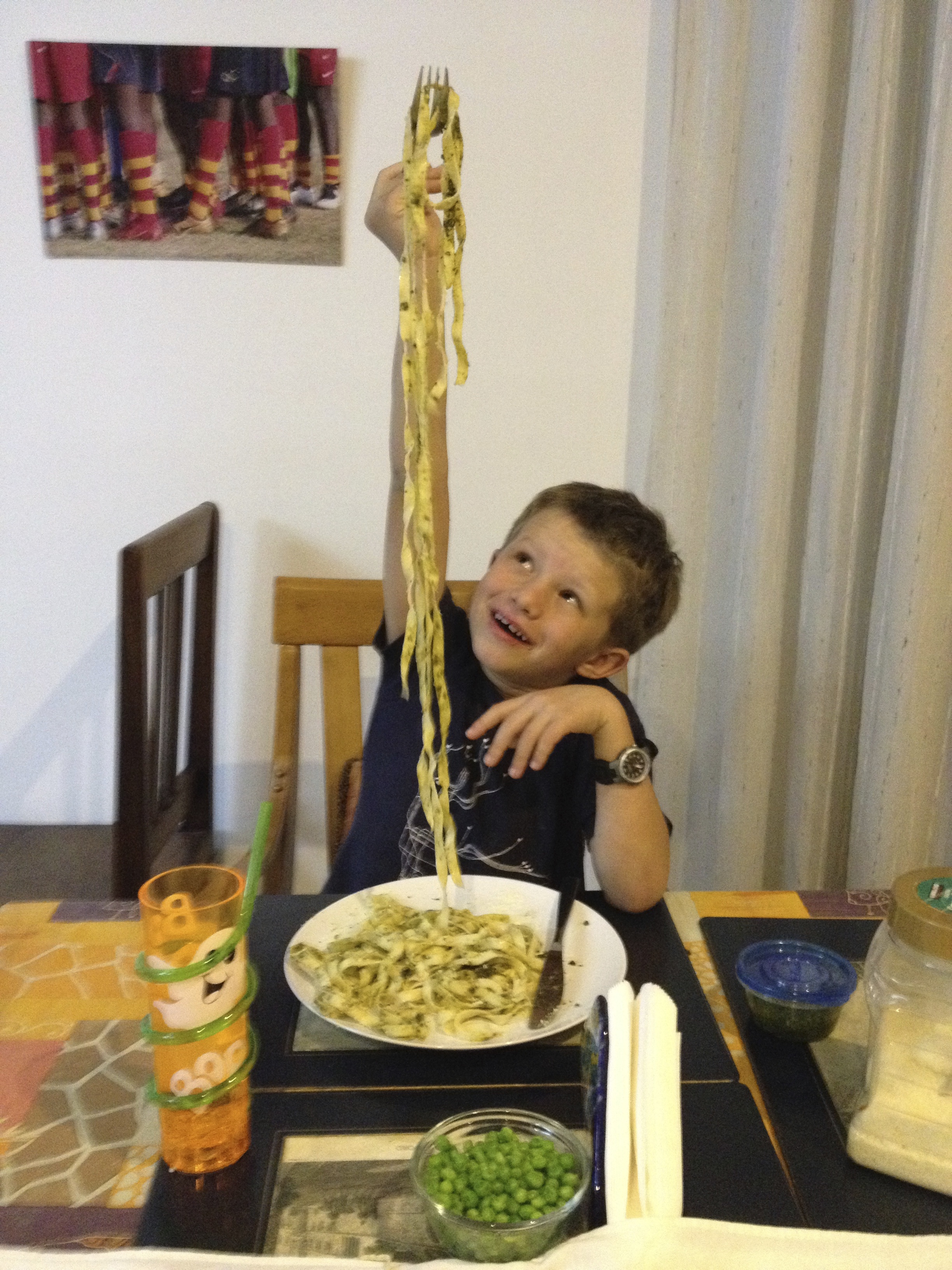
FaceTime is everywhere with us. Here John looks on as Lucas samples  pasta he helped make. © Donatella Lorch

FaceTime is everywhere with us. Here John looks on as Lucas samples pasta he helped make. © Donatella Lorch

FaceTime is everywhere for us. At dinner table, John joins us on FT from his Dhaka office. At bedtime, he says goodnight to Lucas and we then reconnect at our own bedtime. We’ll watch the BBC news broadcast simultaneously but in two different countries and comment on the Ukraine crisis as if we were lying in bed side by side. I’ll pop into a café for a caffe latte if I am in town so I can have a morning conversation in between his meetings. It is our survival mechanism as a family.

Lucas reading "Roman Mysteries" to John on FaceTime just before dinner in Kathmandu. © Donatella Lorch

Lucas reading “Roman Mysteries” to John on FaceTime just before dinner in Kathmandu. © Donatella Lorch


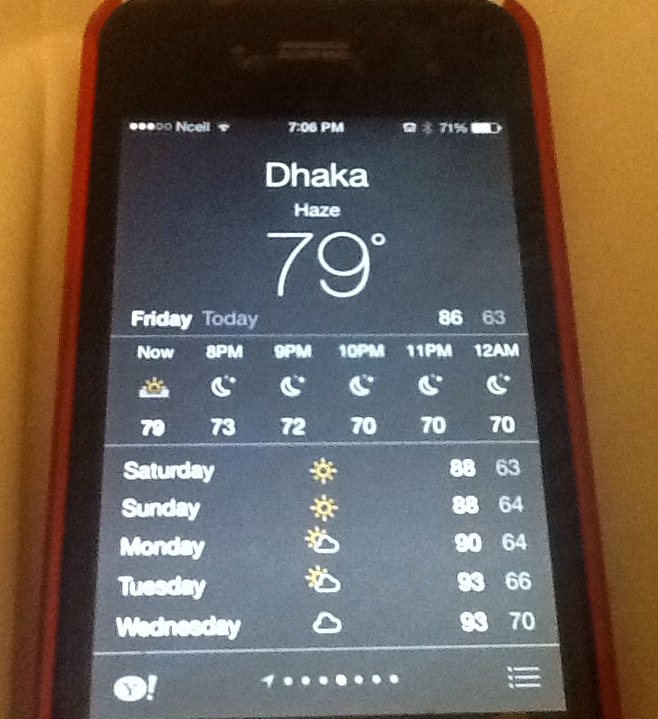
I do hate the separation and my emotions range from frustration, bitterness, depression and anger. What keeps me happy is that I love living in Nepal. I know I am incredibly lucky to be here. Despite the pollution, the traffic chaos and the looming earthquake dangers, I live next door to wide-open spaces where Lucas and I bike, run and hike. Not an option in Dhaka, a heavily polluted city of over 12 million people, and where my iPhone Dhaka weather forecast alternates between “haze” and “smoke.” Lucas adores being here and reminds me everyday how he enjoys his school.

Dhaka weather on my iPhone alternates between "haze" and "smoke". © Donatella Lorch

Dhaka weather on my iPhone alternates between “haze” and “smoke”. © Donatella Lorch

I am far from alone in living a long distance marriage.  Kathmandu is a big hub for the United Nations and other international organizations whose employees travel constantly. One friend, a fellow school mother, has experienced living apart from her husband for several years already when he was stationed in Khartoum, Sudan and the family in Kenya. This was before moving to Kathmandu. She told me today that he leaves Kathmandu next week for three months in Khartoum.  Another mother is coping with two small kids as her husband is on a temporary duty posting in Myanmar (where the government lowers bandwidth to limit internet communications). And it is not only “trailing” spouses. A colleague of my husband commutes to visit his wife in the Phillipines. And an ambassador is trying out Facetime to ease the distance with his partner in the other hemisphere.

The international community commute is just the tip of the iceberg. Nepal is a land of families that live apart.  Unable to find jobs at home, tens of thousands of Nepalese go to India and to the Middle East working  mostly menial jobs for years at a time. Their earnings contribute 25 percent of Nepal’s GDP.


To cheer us up, we even put Biko, our eccentric Rhodesian Ridgeback on FaceTime. © Donatella Lorch

To cheer us up, we even put Biko, our eccentric Rhodesian Ridgeback on FaceTime. © Donatella Lorch

I remind myself every day that I am very lucky. FaceTime is just the icing on the cake.


Gods have birthdays too. In Kathmandu, none is more bizarre than Shiva’s

Thousands of Hundu devotees stand on line to enter Pashupatinath on Maha ShivaRatri © Donatella Lorch

Thousands of Hindu devotees stand on line to enter Pashupatinath on Maha ShivaRatri © Donatella Lorch

Nepal boasts 330 million gods and counting but none garners a more unusual collection of birthday well-wishers than Lord Shiva, the creator and the destroyer. In non- Hindu terms, Shiva is like the patron saint of Nepal. His spiky trident and his bull are ubiquitous from big city temples to impromptu shrines sprouting up in the middle of fields and roads.  In fact, one of Hinduism’s holiest places, Pashupatinath, in the heart of Kathmandu, is one of the most renowned Shiva shrines as well as a UNESCO World Heritage Site. This year Shiva’s birthday fell on February 27.

Maha ShivaRatri (Big Shiva Night) is a national holiday in Nepal. On the big day, thousands of devotees inched down the main road towards the main gate, tightly packed in a several kilometer-long snaking line waited to enter the holy room where they can worship the Shiva Lingam, a phallus symbolic of the regenerative power of nature.

Sadhus come to Nepal from all over the Indian subcontinent to Pashupatinath in Kathmandu ©Donatella Lorch

Sadhus come to Nepal from all over the Indian subcontinent to Pashupatinath in Kathmandu ©Donatella Lorch

But some birthday guests had come many days before. This year, more than 5,000 Sadhus or ascetic holy men who give up worldly possessions to achieve enlightenment, walked, biked and bused from far reaches of the Indian subcontinent and set up camp in every nook and cranny in the vast complex of Pashupatinath, making for a rather kooky birthday party.


Most of eastern Kathmandu roads were closed to traffic to accommodate the crowds. The massive temple complex on the banks of the putrid but very holy Bagmati River was crammed with people. Tiny shack shops were doing brisk business, loudspeakers were blaring and thumping a Bollywood religious song.

Pashupatinath is well known as a cremation site and on Maha Shivaratri festival it was business as usual. © Donatella Lorch

Pashupatinath is well known as a cremation site and on Maha Shivaratri festival it was business as usual. © Donatella Lorch

Pashupatinath is famous for its open-air cremations and the very distinctive both sweet and acrid smell of burning flesh and scented wood hit me even before I reached the three pyres that were brightly crackling, the smoke curling upwards into the grey sky. Amid the relatives of the dead squatting near holy men and asking for blessings, a young boy on very high stilts was entertaining a crowd of devotees. But this was not the scene that distinguishes Pashupatinath.


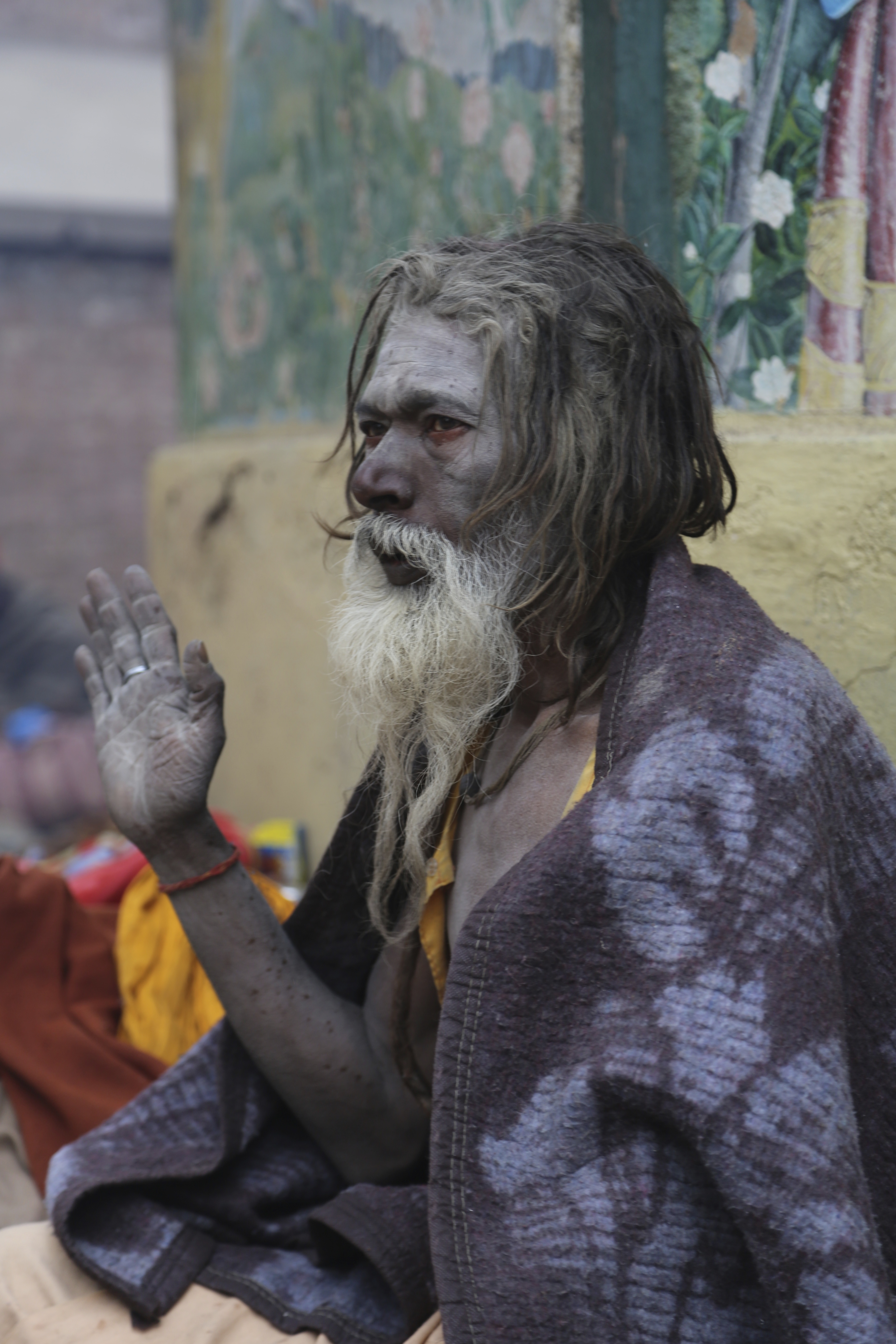
On an upper terrace, in between several small temples laid out around a square were hundreds of saffron robed Sadhus, scores of devotees, some tourists and about a dozen police. Some Sadhus, called Naga Sadhus, were naked or almost so. Many were smeared in ash with massive dreadlocks piled on their heads, colorfully painted faces and long beards.

One Sadhu sat shivering covered only by a blanket. © Donatella Lorch

One Sadhu sat shivering covered only by a blanket. © Donatella Lorch

One, with only a loincloth and a blanket, his eye rims bright red sat shivering and mumbling. In the chilly, drizzling morning, they shared home-made fires smoking more than burning on the stone pavement.  The cremation scent quickly mixed with wafts of ganja (marijuana) that grew more and more intense as I walked deeper into the complex, stinging my eyes and coating my lungs.

This Sadhu greatly enjoyed his ganja. © Donatella Lorch

This Sadhu greatly enjoyed his ganja. © Donatella Lorch

This year the police were not allowing the open sale of drugs but some of the Sadhus were doing a brisk business with young Nepali men as police looked on.


Religion aside, this is a money making venture for many Sadhus. A tourist pays one who then allows him  to take pictures. © Donatella Lorch

Religion aside, this is a money making venture for many Sadhus. A tourist pays one who then allows him to take pictures. © Donatella Lorch

While many devotees want to pay their respects to the Lingam, some do gather for blessings from these yogis who are thought to be very wise and gifted with special powers. Some Hindus consider them saints and the government of Nepal feeds and lodges them for their entire stay. The Pashupati Area Development Trust (PADT) estimates that about $14,000 will be spent on their room and board. The government also provides each one with a financial ‘gift’ when they leave.

Devotees come to ask for guidance from Sadhus and pray together. © Donatella Lorch

Devotees come to ask for guidance from Sadhus and pray together. © Donatella Lorch

The yogis may have been saintly and one claimed he was 110 years old but a lot of their holiness and their weird charm was lost for me as I watched their aggressive demands for money from anyone who wanted to take their pictures. In fact picture-taking was a brisk business. They may claim to forgo all worldly possessions, but many had easily available change for big bills. I photographed one foreign tourist busy posing one Sadhu in a variety of different poses against a wall. No doubt for a hefty fee.


Thousands of people throng to Pashupatinath on  Shiva's birthday. © Donatella Lorch

Thousands of people throng to Pashupatinath on Shiva’s birthday. © Donatella Lorch

Sadhus belong to different sects. There was one much smaller group of Sadhus that were given a wide berth by their fellow ascetics and by the crowds. These men, dressed entirely in black, are Tantric or followers of the occult and worship Bhairav or Shiva’s fiercest manifestation. Some Hindus believe that they live near cremation grounds and feed off of human remains. When I saw them they were eating rice.


Then of course, like at every huge party anywhere in the world, there are also the Birthday gate-crashers. Beware, not all Sadhus are real Sadhus.

By air, by land and by Karma – transportation in Nepal’s Himalayas


The Canadian Twin Otter is the war horse of airplanes and an expert at treacherous routes through mountains and short take-offs and landings

The Canadian Twin Otter is the war horse of airplanes and an expert at treacherous routes through mountains and short take-offs and landings

I learned a new expression this week: Controlled Flight into Terrain or CFIT meant to describe a plane crash where a pilot unintentionally flies into the ground or a mountain. For anyone who flies around Nepal, this is a stark reminder of the risks. The day I read about CFIT on Twitter, a Nepal Airlines Canadian-built Twin Otter, the war horse of all planes, one of the few able to navigate Nepal’s uncompromising and unforgiving mountains and its short airstrips, crashed into a fog enshrouded mountain side, killing all 18 people on board. The flight bound for Jumla in the high Himalayas took off in dense fog and then asked to be rerouted before contact broke.

Traveling around Nepal is surreally beautiful but far from simple.

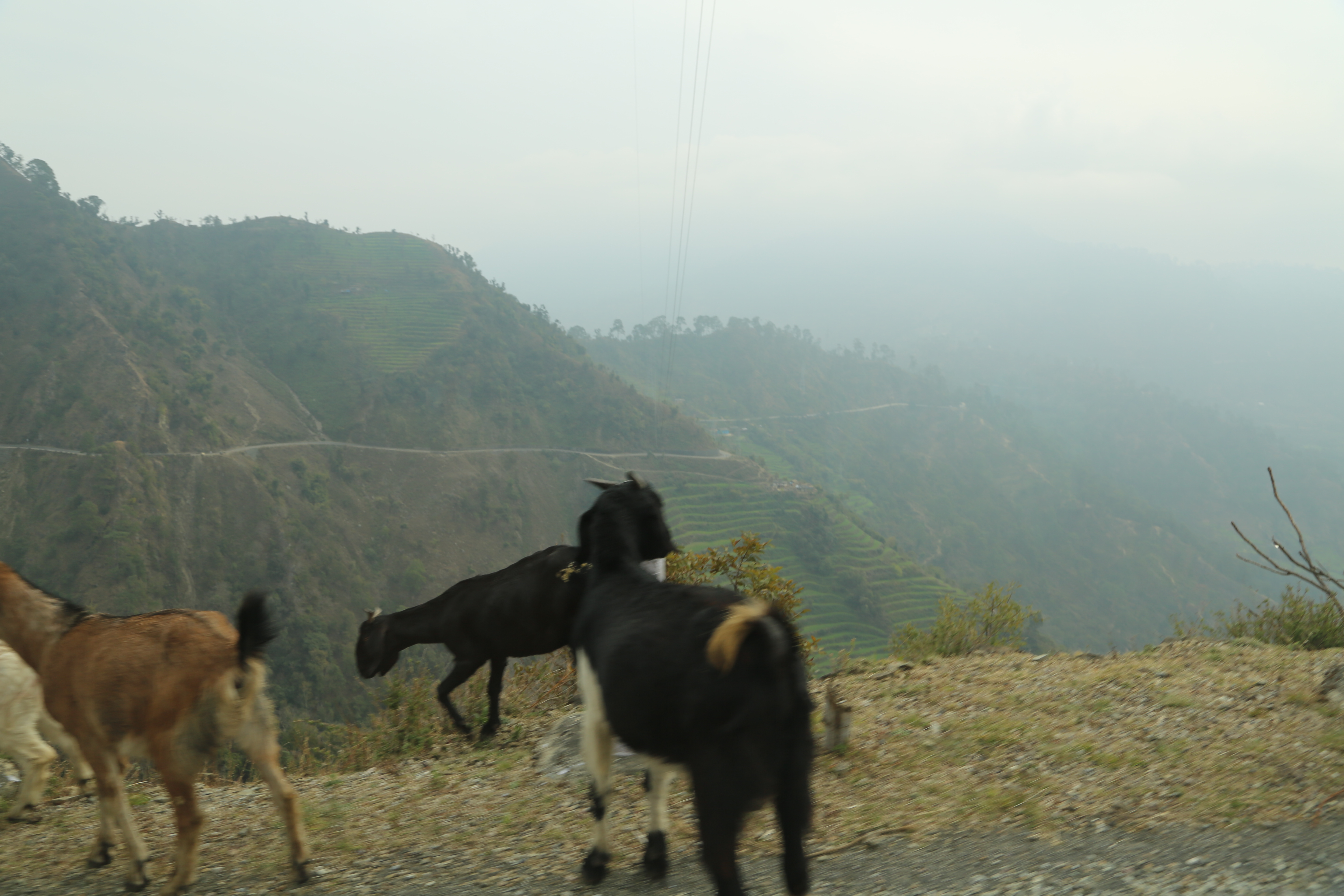
Winding road into Western Nepal with goats the only ones able to navigate the precipice © Donatella Lorch

Winding road into Western Nepal with goats the only ones able to navigate the precipice © Donatella Lorch

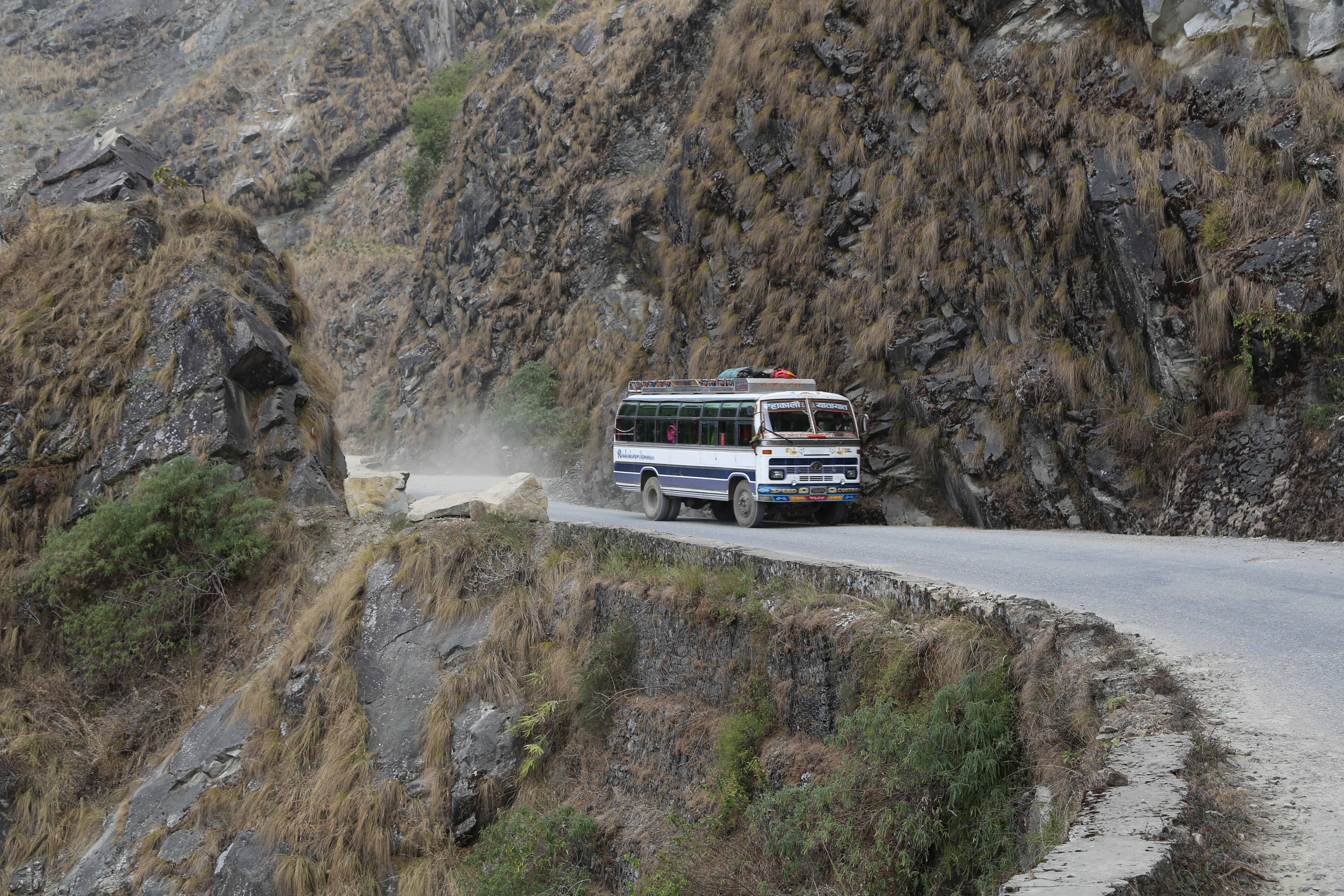
There are few paved roads and the dirt ones, mostly carved out of perpendicular mountain sides next to 1000 meter plunges are listed on maps as “fair weather” which means they are impassable for four or more months during the monsoons or by the frequent landslide. Many of the remote and desperately poor communities are only easily reachable by plane and on dirt airstrips that require STOL or short take offs and landings. But snow, fog and rain make navigating mountains treacherous so much so that airports, including Kathmandu’s, regularly close down for hours.


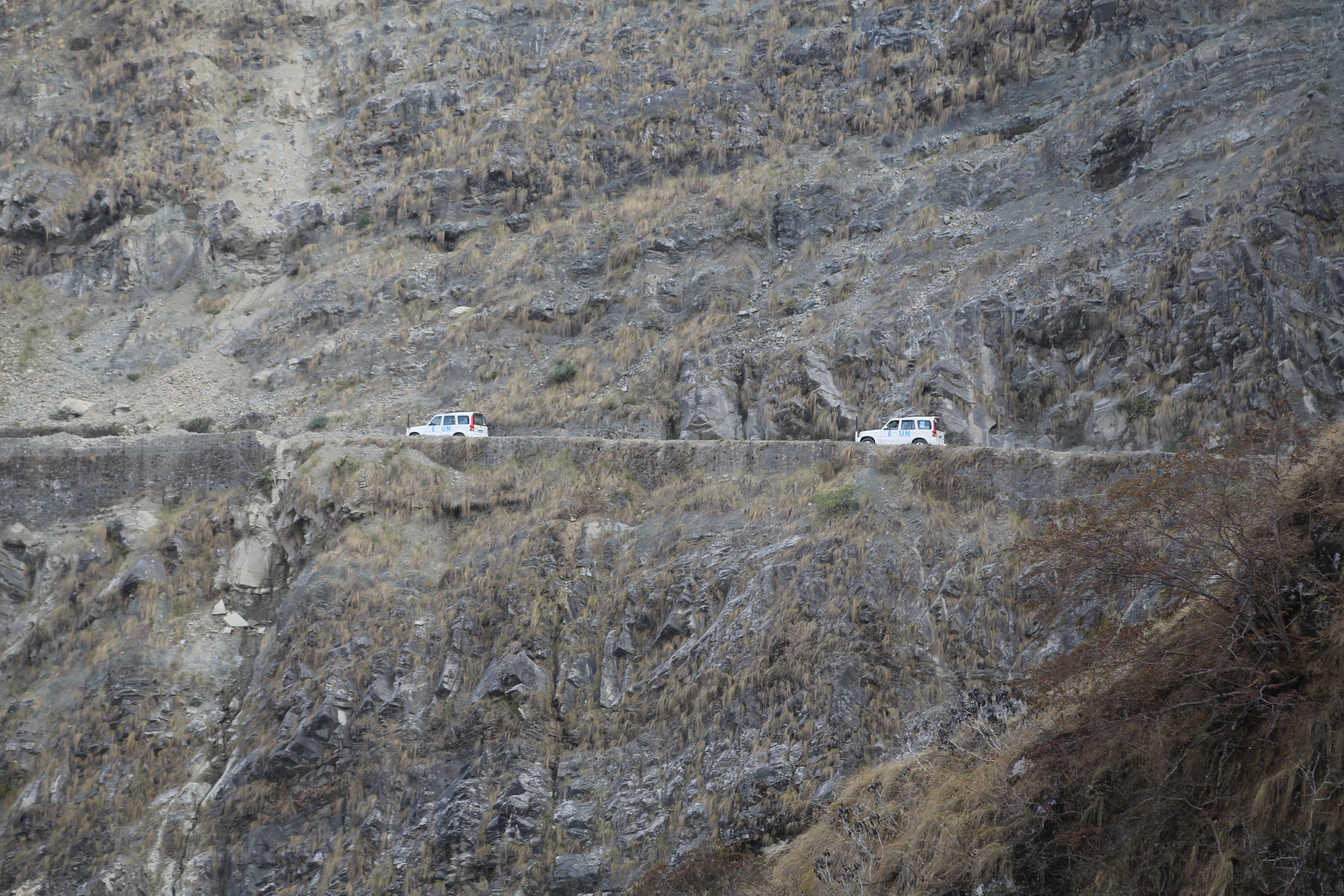
Paved roads in Nepal are few and far between. This is the only paved road into far Western Nepal. Here two UN vehicles navigate a narrow section © Donatella Lorch

Paved roads in Nepal are few and far between. This is the only paved road into far Western Nepal. Here two UN vehicles navigate a narrow section © Donatella Lorch

This is the land of the Twin Otter. Maybe this crash was an anomaly?. Kunda Dixit, a renowned journalist and flying aficionado burst my bubble. Sixteen of Nepal’s fleet of 25 Twin Otters have crashed. According to Dixit, Nepal Airlines has now lost 70 percent of its 12 Twin Otters to crashes and has only one still airworthy. Even more heart stopping, Dixit’s article in the Nepali Times pointed out that of all crashes since 1955, about 90 percent were due to CFIT.

The reasons are multifaceted. Cut throat competition in the airline business and thin profit margins coupled with political and local corruption has decimated safety nets. The government, struggling after a decade of a vicious Maoist revolt, has shown itself too weak to implement reform in that sector. Many of the smaller planes, such as the one that just crashed, are not provided with weather radar or de-icing. Flying has become a booming business and some pilots are careless and not as well trained as the veterans. Flight dispatchers should also be held responsible but the biggest pressure is on the pilots to fly regardless of bad weather and cash incentives are given for successful landings at destination. Last year a plane crashed at Jomson, when the captain refused to heed instructions not to land in a tail wind.

Late last year, the European Commission blacklisted all Nepali planes from European airspace. Some might think this move irrelevant since no Nepali airline flies that far. But more to the point, they advised Europeans not to fly in Nepal. We have also been advised not to fly on any plane except for Buddha Air which has my eight-year-old son teasing me at take-off that this may be the fastest way to get to Nirvana.

Nepal ---- in Sign Language © Donatella Lorch

Nepal —- in Sign Language © Donatella Lorch

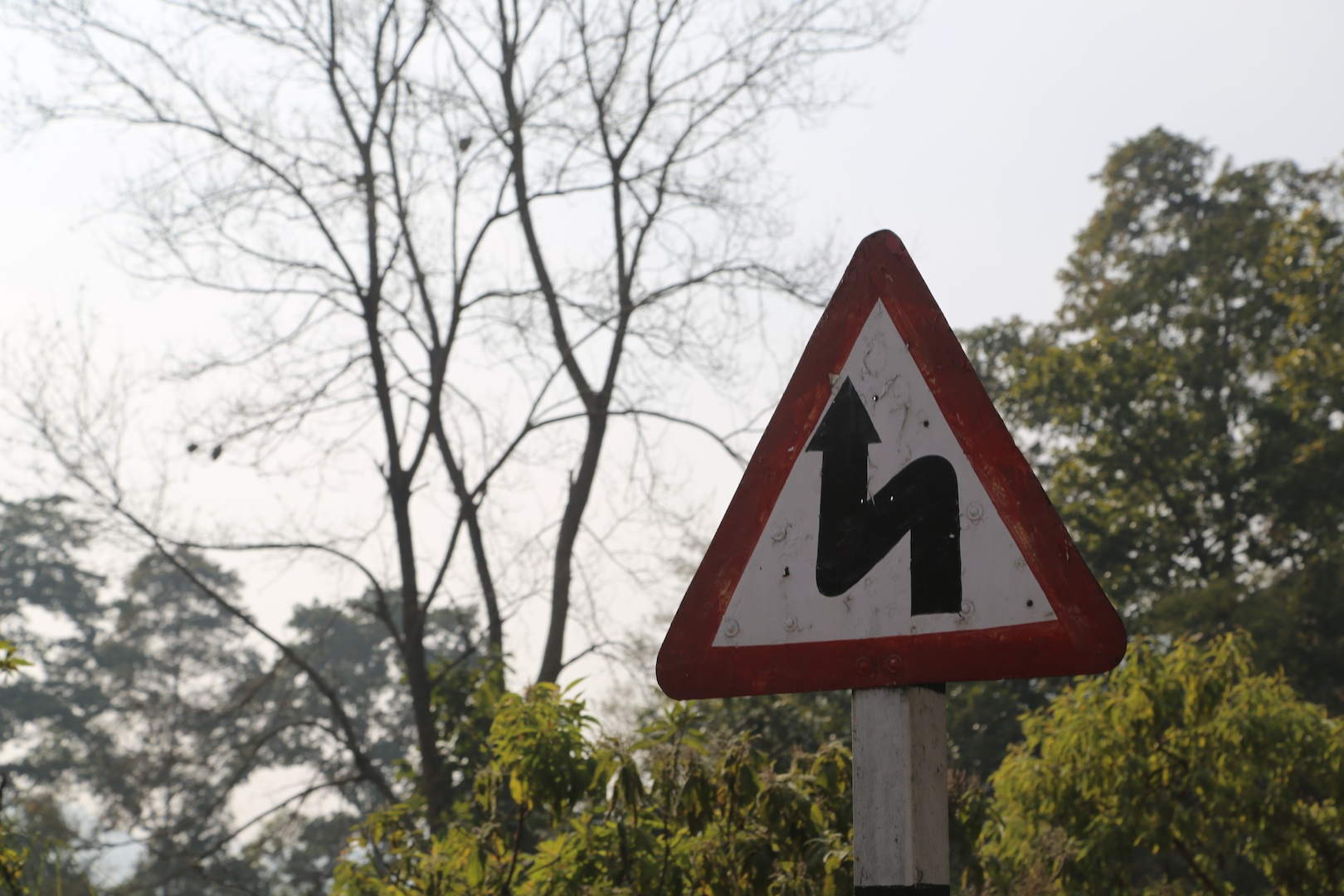
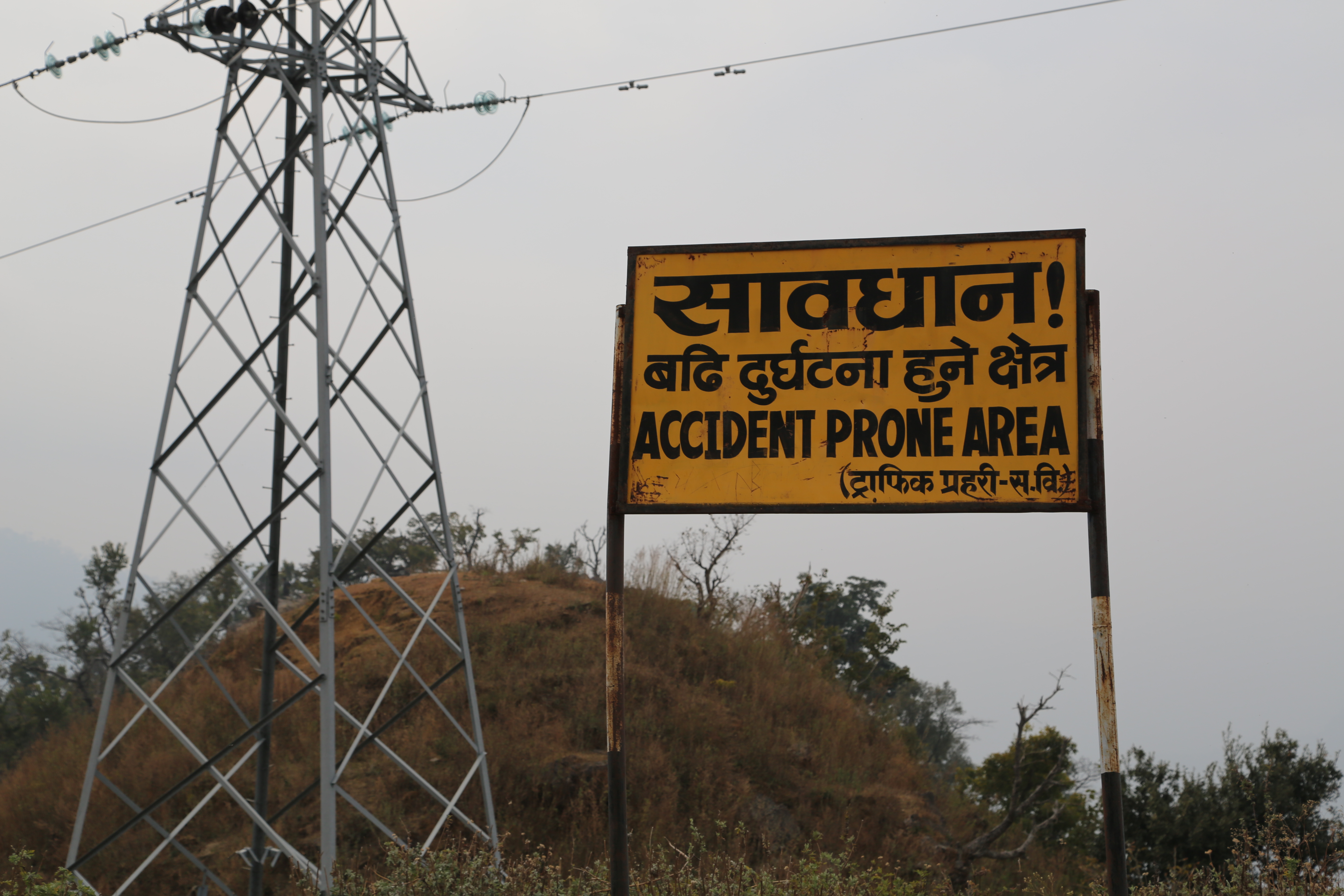
So what are people to do, stick to the roads? Nepal has one of the highest accident rates in the world.  Despite a plethora of signs saying “Dead Slow”, “Sharp Bend,” “Push Horn” and “Accident Prone Area,” trucks, buses and taxi jeeps are overloaded, have non working signals, don’t use headlights and their drivers rarely slow down when they see you coming in the other direction on a road barely the width of a lane and a bit (with a precipice on one side).

Road signs are an obvious alert to drivers © Donatella Lorch

Road signs are an obvious alert to drivers © Donatella Lorch

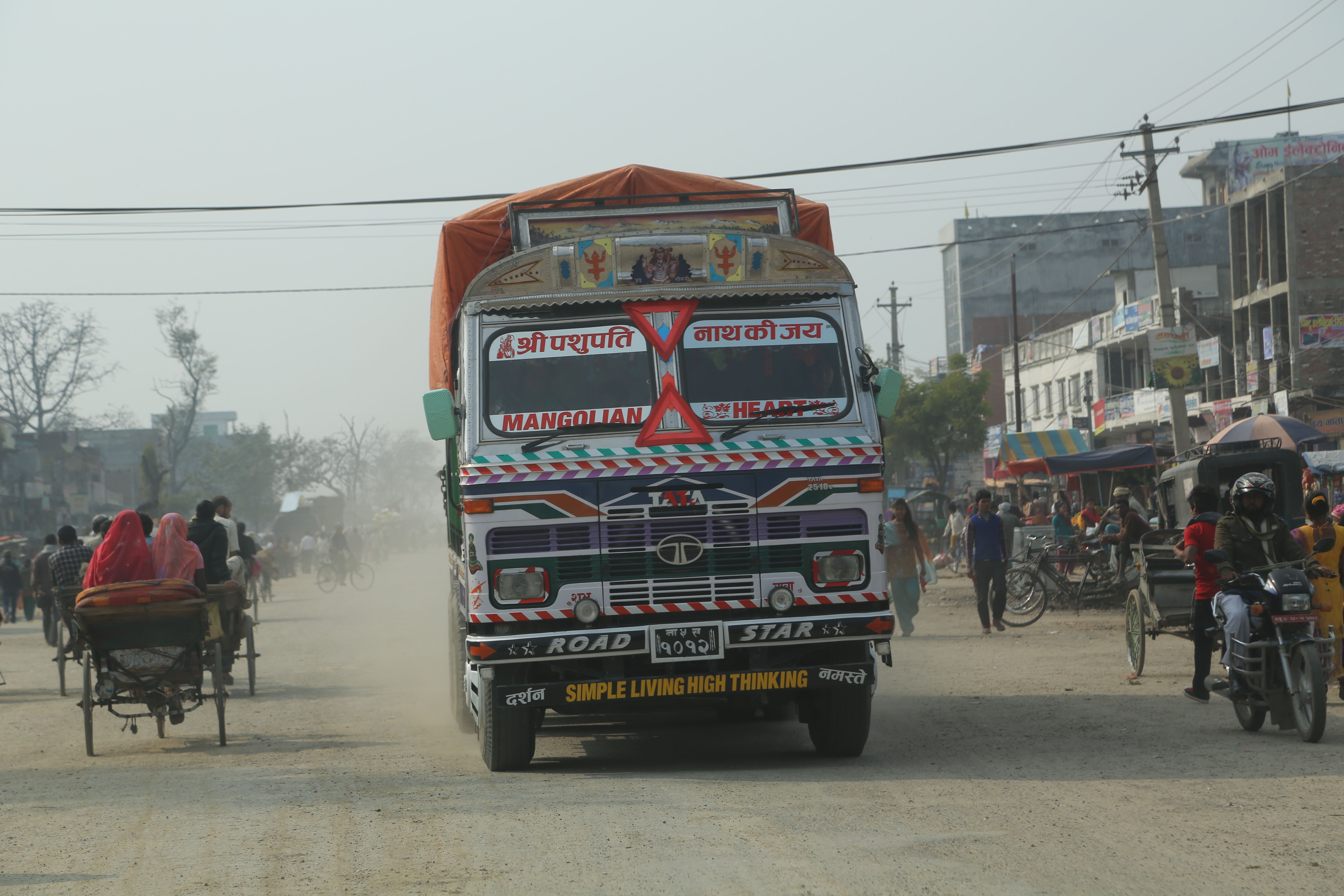
Truck windshields are an artistic collection of colored stickers, plastic multi-colored flowers, and religious paintings leaving two small slits through which to see the road. Breakdowns are marked by a few tree branches stuck in the back of the vehicle held immobile by a rock behind a wheel gathered from the nearby recent landslide.

Truck windshields are festooned with taped decorations and plastic flowers making driving more challenging © Donatella Lorch

Truck windshields are festooned with taped decorations and plastic flowers making driving more challenging © Donatella Lorch

After driving 1000 kms from Kathmandu to Western Nepal, I quickly learned to give up my American road etiquette. Asking “how far” provides useless information. The key is “how long does it take to get there.” The only paved road snaking uphill almost 2000 meters into remote districts of western Nepal is a 134km stretch or a six-hour drive.

A bus drives through a recently cleared landslide on the road to Dadeldhura, Western Nepal © Donatella Lorch

A bus drives through a recently cleared landslide on the road to Dadeldhura, Western Nepal © Donatella Lorch

It is marked by 18 roadside rock shrines, engraved with the date and location where a vehicle plunged into the abyss. It is so steep here, that the wreckage remains untouched.  Even the country’s vast population of stray dogs participates in making driving challenging. They curl up and sleep in the middle of the road and like everyone else on the road, they do not give way. In fact, they don’t even wake up.

Nepali stray dogs consider the road home. Why move? © Donatella Lorch

Nepali stray dogs consider the road home. Why move? © Donatella Lorch

My Nepali friends shrug their shoulders at the dangers. It all boils down to Karma, they say.  If it is your time, it is your time. I have yet to reach that zen acceptance.

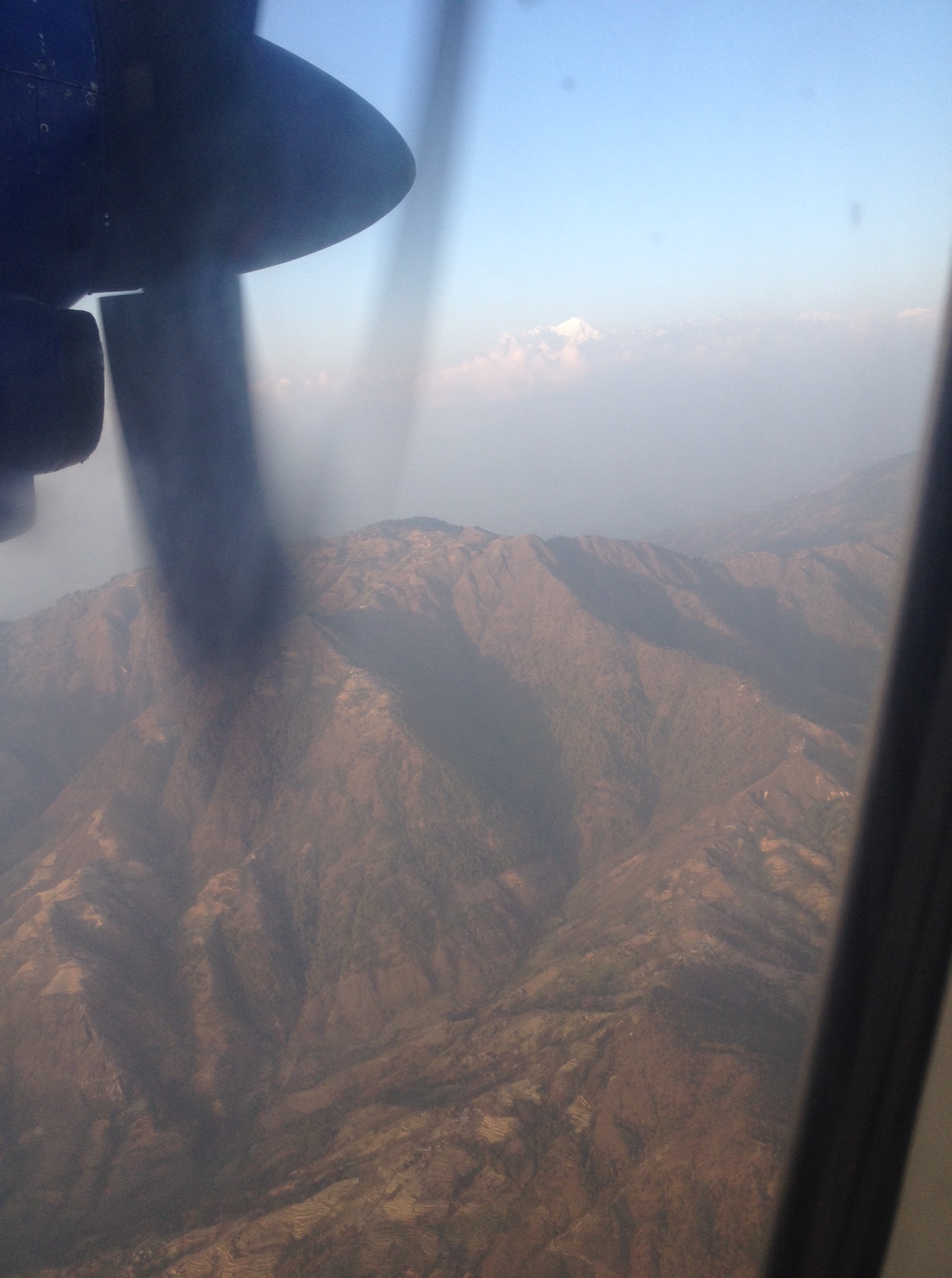
The Buddha Air flight back to Kathmandu © Donatella Lorch

The Buddha Air flight back to Kathmandu © Donatella Lorch

I thought I’d alternate risk. I flew back to Kathmandu on Buddha Air.